
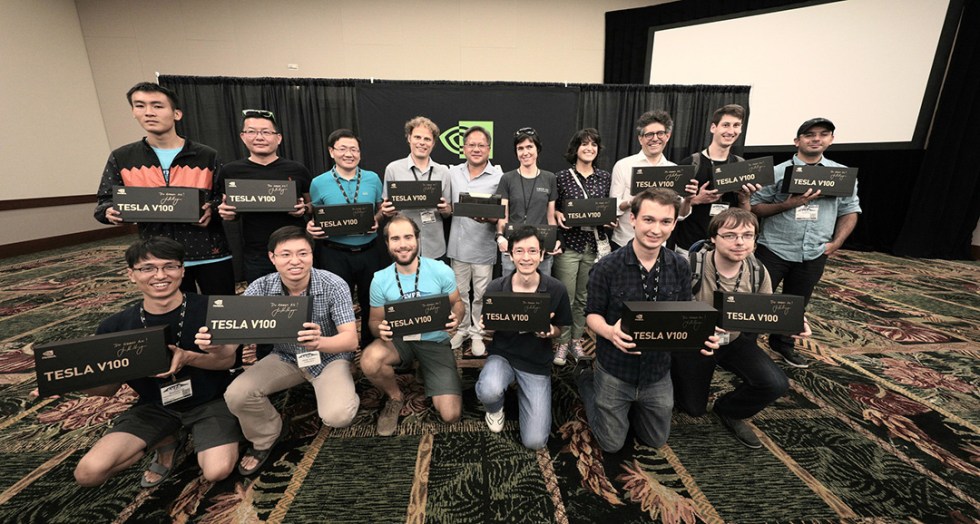
Fifteen top AI research institutions of the NVIDIA AI Labs programmes were each presented with the Volta-based NVIDIA Tesla V100 GPU accelerator.
They were participating in Computer Vision and Pattern Recognition (CVPR) conference in Honolulu.
“AI is the most powerful technology force that we have ever known. I’ve seen everything. I’ve seen the coming and going of the client-server revolution. I’ve seen the coming and going of the PC revolution. Absolutely nothing compares,” said Jensen Huang, CEO of NVIDIA.

 At the inaugural Audi Summit in Spain, Audi revealed that its flagship 2018 A8 features a multitude of high-tech wizardry powered by NVIDIA.
 Volvo Cars and Autoliv are teaming up with NVIDIA to develop advanced systems and software for AI self-driving cars. The three companies will work together along with Zenuity — a newly-formed automotive software development joint venture equally owned by Volvo Cars and Autoliv — to develop next-generation self-driving car technologies.
 Singapore will be focusing on four technology areas to build the foundation for its digital transformation. These are artificial intelligence (AI) and data science, cybersecurity, immersive media, and Internet of Things and future communications infrastructure.
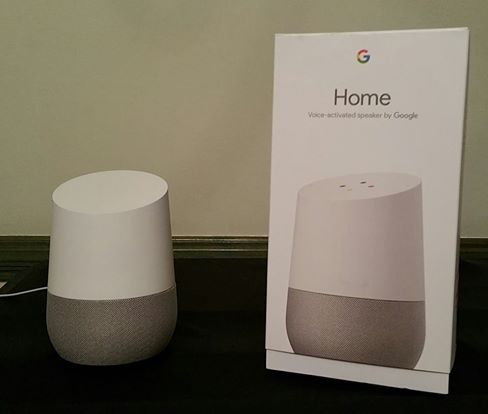 The keynote address at Google I/O yesterday showed that Google is much more than just a search company. It is becoming more artificial intelligence (AI). Google is specifically using deep learning to help in many areas of everyday life.
 Robots driven by artificial intelligence (AI) are replacing workers in various labour-intensive and service sectors but doctors, lawyers and even IT professionals are at risk of being made redundant. Or at least, certain aspects of each of these practices.

 Facebook is developing new artificial intelligent (AI) systems to help manage the vast amount of information — such as text, images and videos — generated daily so people can better understand the world and communicate more effectively, even as the volume of information increases.
 NVIDIA and Microsoft are working on a new hyperscale GPU accelerator that will provide hyperscale data centres with a fast, flexible path for artificial intelligence (AI).
 Many cars were on display at CES last week but perhaps one of the most significant announcements is the collaboration between Mercedes-Benz and NVIDIA to bring an NVIDIA AI-powered car to market.
 Advances in various technologies will drive users to interact with their smartphones in more intuitive ways, said Gartner. It expect that, by 2019, 20 percent of all user interactions with the smartphone will take place via virtual personal assistants (VPAs).


 Entelechy Asia