As a prelude to Computex, which starts tomorrow, ASUS has announced a slew of products at a press conference packed with journalists from around the world at Le Meridien Taipei. The products are part of what Chairman Jonney Shih described as “innovations that transform the market”.
The lineup include a powerful tablet, a phablet, a value tablet, a PC with a difference, complete with mouse and router, an all-in-one PC.
First up is the ASUS Transformer Pad Infinity, the world’s first NVIDIA Tegra 4-powered tablet.
Low-cost Android-based devices are fueling growth in the tablet market, which, in turn, is predicted to outstrip portable PC shipment this year.
According to IDC’s Worldwide Quarterly Tablet Tracker, the worldwide average selling price (ASP) for tablets is expected to decline -10.8 percent to US$381 this year. In comparison, the ASP of a PC in 2013 is nearly double that at US$635.
IDC expects tablet prices to decline further, which will allow vendors to deliver a viable computing experience into the hands of many more people at price points the PC industry has strived to meet for years.
The launch of new 3G data plans by all three Thai mobile operators will introduce broad changes to the competitive dynamics among mobile operators, particularly in how they deal with the mass market segment.
IDC issued this warning after a review of the price plans and potential market share of the three mobile operators after the release of their 3G service plans.
IDC believes the industry is set for a slew of promotional and pricing competitive pressures in the next six months, possibly resulting in significant churn among the customer base if one of the telco operators does not keep its defenses up.
The Asia-Pacific region grew 6.4 percent year-on-year in Q1 mobile phone sales, the only region in the world to register growth, according to Gartner.
Worldwide mobile phone sales to end users totalled nearly 426 million units this period, only a slight increase of 0.7 percent from the same period last year. Worldwide smartphone sales hit 210 million units in the first quarter of 2013, up 42.9 percent from the first quarter of 2012.
“More than 226 million mobile phones were sold to end users in Asia-Pacific in the first quarter of 2013, which helped the region increase its share of global mobile phones to 53.1 percent year-on-year,” said Anshul Gupta, Principal Research Analyst at Gartner. “In addition, China saw its mobile phone sales increase 7.5 percent in the first quarter of 2013, and its sales represented 25.7 percent of global mobile phone sales, up nearly 2 percentage points year-on-year.
Intel Corporation has announced a range of new products, including a new dual-core Atom SoC (“Clover Trail+”) platform for smartphones and Android tablets, and its first global, multimode-multiband LTE solution that will ship in the first half of this year.
Other disclosures included “Bay Trail” momentum, mobile device enabling efforts, and continued smartphone momentum in emerging markets with the Intel Atom Z2420 processor-based platform.
“Today’s announcements build on Intel’s growing device portfolio across a range of mobile market segments,” said Hermann Eul, Intel Vice President and co-General Manager of the Mobile and Communications Group. “In less than a year’s time, we have worked closely with our customers to bring Intel-based smartphones to market in more than 20 countries around the world, and have also delivered an industry-leading low-power Atom SoC tablet solution running Windows 8, and shipping with leading OEM customers today. Looking forward, we will build upon this foundation and work closely with our ecosystem partners, across operating systems, to deliver the best mobile products and experiences for consumers with Intel Inside.”
Available in the NVIDIA Tegra 4 family of mobile processors, the NVIDIA Chimera Computational Photography Architecture offers a number of features never before available on mobile devices, including always-on high-dynamic range (HDR) photos and videos, HDR panoramic and persistent tap-to-track capabilities.
Previous mobile device architectures have made it difficult to use the best tools for different parts of complex image processing. Chimera architecture removes those boundaries by providing the power to conduct nearly 100 billion mathematical operations per second to perform image processing, using computational techniques used in X-ray CT scanners, deep space telescopes and spy satellites.
“We developed the Chimera Computational Photography Architecture to take mobile photography far beyond where it is today,” said Brian Cabral, Vice President of Computation Imaging at NVIDIA. “We’re enabling developers and users to not only use image processing to enhance their photos, but also use computer algorithms to create images no lens can capture alone.”
ZTE has launched UniCare, a service solution developed specifically for mobile operators.
UniCare is an end-to-end integrated solution covering the whole network by offering operation assurance aimed at network performance management, service quality management and customer experience assurance, as well as operation consulting aimed at network, service and market development.
“Traditionally, technical services have focused on a specific area of an operator’s business, rather than the whole operation. As a result, they have failed to bring about improvements in operational efficiencies or user experience and have not delivered increased revenues or profits,” said Yang Jiaxiao, Vice President of ZTE. “The UniCare service solution overcomes these failures by providing mobile operators with an overall service assurance for their entire business.”
NVIDIA has announced Project SHIELD, a gaming portable for open platforms, designed for gamers who yearn to play when, where and how they want.
Created with the philosophy that gaming should be open and flexible, Project SHIELD flawlessly plays both Android and PC titles. As a pure Android device, it gives access to any game on Google Play. And as a wireless receiver and controller, it can stream games from a PC powered by NVIDIA® GeForce GTX GPUs, accessing titles on its STEAM game library from anywhere in the home.
“Project SHIELD was created by NVIDIA engineers who love to game and imagined a new way to play,” said Jen-Hsun Huang, co-founder and chief executive officer at NVIDIA. “We were inspired by a vision that the rise of mobile and cloud technologies will free us from our boxes, letting us game anywhere, on any screen. We imagined a device that would do for games what the iPod and Kindle have done for music and books, letting us play in a cool new way. We hope other gamers love SHIELD as much as we do.”
Project SHIELD combines the advanced processing power of NVIDIA Tegra 4, breakthrough game-speed Wi-Fi technology and stunning HD video and audio built into a console-grade controller. It can be used to play on its own integrated screen or on a big screen, and on the couch or on the go.
Gartner has revealed its top predictions for IT organisations and IT users for 2013 and beyond.
Gartner’s top predictions focus on economic risks, opportunities and innovations that will impel CIOs to move to the next generation of business-driven solutions. Selected from across Gartner’s research areas as the most compelling and critical predictions, they address the trends and topics that underline the reduction of control that IT has over the forces that affect it.
“The priorities of CEOs must be dealt with by CIOs who exist in a still-turbulent economy and increasingly uncertain technology future,” said Daryl Plummer, Managing Vice President and Gartner Fellow. “As consumerisation takes hold and the Nexus of Forces drives CEOs to certain expectations, CIOs must still provide reliability, serviceability and availability of systems and services. Their priorities must span multiple areas. As the world of IT moves forward, it is finding that it must coordinate activities in a much wider scope than it once controlled, and as a result, a loss of control echoes through several predictions we are making.”

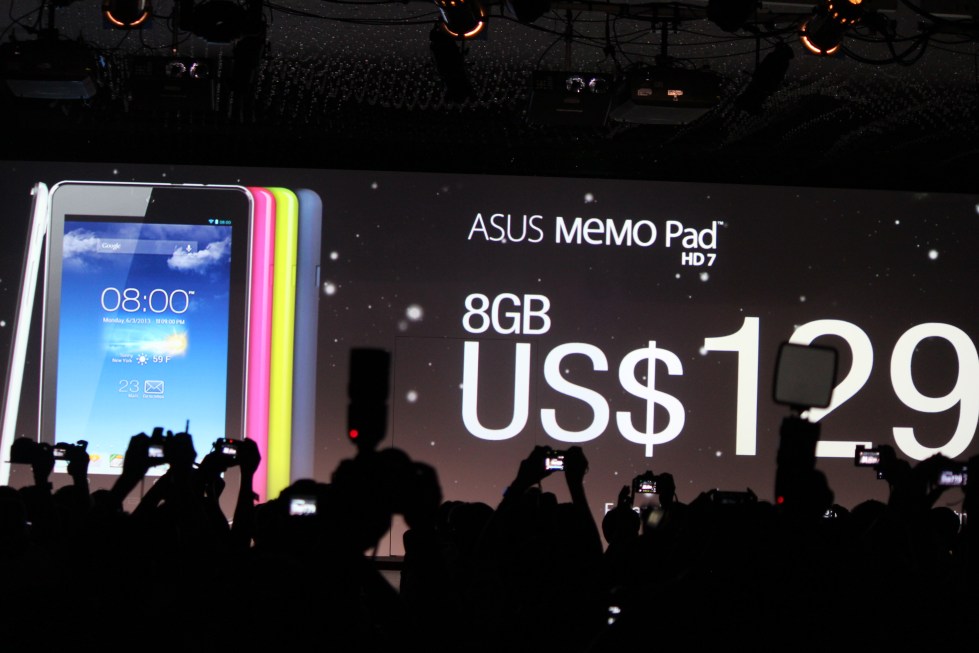 As a prelude to Computex, which starts tomorrow, ASUS has announced a slew of products at a press conference packed with journalists from around the world at Le Meridien Taipei. The products are part of what Chairman Jonney Shih described as “innovations that transform the market”.
 Low-cost Android-based devices are fueling growth in the tablet market, which, in turn, is predicted to outstrip portable PC shipment this year.
 The Asia-Pacific region grew 6.4 percent year-on-year in Q1 mobile phone sales, the only region in the world to register growth, according to Gartner.



 Entelechy Asia