
Tag: Cineca

NVIDIA Tesla GPU accelerators power world’s most energy efficient supercomputer

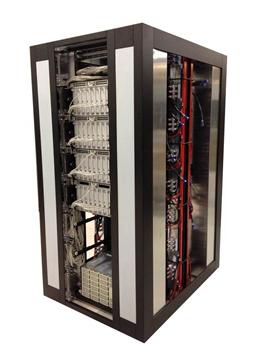
Eurora SystemNVIDIA Tesla GPU accelerators are powering the world’s two most energy efficient supercomputers, according to the latest Green500 list published last week.

The winning system is Eurora at CINECA, Italy’s largest supercomputing centre, in Casalecchio di Reno. Equipped with NVIDIA Kepler architecture-based GPU accelerators – the highest-performance, most efficient accelerators ever built – Eurora delivers 3,210 MFlops per watt, making it 2.6 times more energy efficient than the best system using Intel CPUs alone (at Météo France). It also greatly surpasses the most efficient Intel Xeon Phi accelerator-based system, Beacon, at the National Institute for Computational Sciences, at the University of Tennessee.

The number two system on the June 2013 Green500 list is the Aurora Tigon supercomputer at the Selex ES facilities Chieti, Italy.
Eurora supercomputer sets world record for energy efficiency

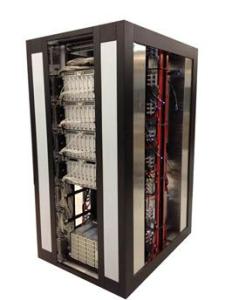
EuroraItaly’s “Eurora” supercomputer has set a new record for data centre energy efficiency. Based on NVIDIA Tesla GPU accelerators, it is built by Eurotech and deployed at the Cineca facility in Bologna. It is Italy’s most powerful supercomputing centre, reaching 3,150 megaflops per watt of sustained performance – a mark 26 percent higher than the top system on the most recent Green500 list of the world’s most efficient supercomputers.

Eurora achieved the record-breaking achievement by combining 128 high-performance, energy-efficient NVIDIA Tesla K20 accelerators with the Eurotech Aurora Tigon supercomputer, featuring innovative Aurora Hot Water Cooling technology, which uses direct hot water cooling on all electronic and electrical components of the HPC system.

Available to members of the Partnership for Advanced Computing in Europe (PRACE) and major Italian research entities, Eurora will enable scientists to advance research and discovery across a range of scientific disciplines, including material science, astrophysics, life sciences, and Earth sciences.