
Meta is acquiring Singapore-based startup Manus to embed AI agents across Meta’s consumer and business platforms. While the terms of the transaction were not disclosed, Manus’ fast revenue growth and millions of paying users underscore […]
Meta is acquiring Singapore-based startup Manus to embed AI agents across Meta’s consumer and business platforms. While the terms of the transaction were not disclosed, Manus’ fast revenue growth and millions of paying users underscore […]

Palo Alto Networks has launched the Cortex AgentiX platform designed to build, deploy and govern an AI agent workforce for the enterprises of the future. As automation has already transformed routine tasks, Cortex AgentiX heralds […]

FairPrice Group has become the first in Singapore to receive approval from the Land Transport Authority (LTA) to operate autonomous vehicles (AVs) on public roads for supply chain operations. The initiative, conducted in partnership with […]

NVIDIA has announced a new set of tools to make the development of advanced robots and artificial intelligence (AI) easier, faster and more realistic for enterprises and researchers. Unveiled at Siggraph, the new Omniverse libraries […]
NVIDIA has a new technology called Helix Parallelism that makes AI assistants much smarter and faster even when they have to deal with vast amounts of information. The technology allows AI models to process as […]

The Singapore-MIT Alliance for Research and Technology (Smart) has formed the interdisciplinary research group called Wisdom to develop next-generation technologies that will enable machines to “see” like humans. Wisdom, which stands for Wafer-scale Integrated Sensing […]

ServiceNow and NVIDIA have unveiled the Apriel Nemotron 15B reasoning model to power a new generation of intelligent AI agents for enterprises. Announced at ServiceNow’s Knowledge 2025 event, this compact, high-performance large language model (LLM) […]

NVIDIA’s NeMo microservices are now generally available to help businesses rapidly build, deploy and continually optimise AI agents that can work alongside employees to boost productivity and efficiency. The new suite of tools lets developers […]

NTT Data has has launched its next-generation Smart AI Agent to accelerate the adoption of generative AI (GenAI) across industries. It projects that this advanced AI solution will generate about US$2 billion in revenue from […]

More companies turn to conversational AI for their customer support with spending expected by Gartner to hit about US$2 billion in 2022. The growth of the technology is predicted to reduce contact centre agent labor […]

Fintech startup ABC Technology has been rated by IDC as among the 101 fastest growing fintech companies in the Asia-Pacific region (excluding Japan).
 Dell EMC and Comet have unveiled a Kubernetes reference architecture for data science teams using the their artificial intelligence (AI)-enabled infrastructure and machine learning platform.

Source: ArmArm has launched the Cortex-M55, an artificial intelligence (AI) processor based on the Armv8.1-M architecture with Arm Helium vector processing technology for significantly enhanced, energy-efficient digital signal processing and machine learning (ML).

Unsurprisingly, a Gartner report is predicting that three quarters of all databases will reside in the cloud by 2022. Only five percent of migration will remain on premises.
 H2O.ai has announced that its Driverless AI automated machine learning platform and H2O4GPU open source GPU-accelerated machine learning package are now both fully optimised for the latest-generation NVIDIA Volta architecture GPUs — the NVIDIA Tesla V100 — and CUDA 9 software.

It’s been said that more data was generated in 2017 than in the previous 5,000 years. According to Statista, this figure will increase 10 times in less than a decade.
 Global IT spending is expected to grow to US$3.7 trillion in 2018, an increase of 4.5 percent from 2017, according to Gartner.
 Advances in various technologies will drive users to interact with their smartphones in more intuitive ways, said Gartner. It expect that, by 2019, 20 percent of all user interactions with the smartphone will take place via virtual personal assistants (VPAs).
“The role of interactions will intensify through the growing popularity of VPAs among smartphone users and conversations made with smart machines,” said Annette Zimmermann, Research Director of Gartner.
Gartner’s annual mobile apps survey conducted in Q4 among 3,021 consumers across three countries (US, UK and China) found that 42 percent of respondents in the US and 32 percent in the UK used VPAs on their smartphones in the last three months. More than 37 percent of respondents (average across US and UK) used a VPA at least one or more times a day.
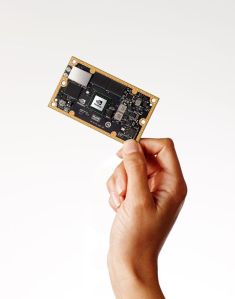 As the first embedded computer designed to process deep neural networks, the new NVIDIA Jetson TX1 is set to enable a new wave of smart devices. Drones will evolve beyond flying by remote control to navigating through a forest for search and rescue. Security surveillance systems will be able to identify suspicious activities, not just scan crowds. Robots will be able to perform tasks customised to individuals’ habits.
That’s what the credit-card sized module can do. It can harness the power of machine learning to enable a new generation of smart, autonomous machines that can learn.
Deep neural networks are computer software that can learn to recognise objects or interpret information. This new approach to program computers is called machine learning and can be used to perform complex tasks such as recognising images, processing conversational speech, or analysing a room full of furniture and finding a path to navigate across it. Machine learning is a groundbreaking technology that will give autonomous devices a giant leap in capability.
 NVIDIA has collaborated with a research team at Stanford University to create the world’s largest artificial neural network built to model how the human brain learns. The network is 6.5 times bigger than the previous record-setting network developed by Google in 2012.
Computer-based neural networks are capable of “learning” how to model the behaviour of the brain – including recognising objects, characters, voices, and audio in the same way that humans do.
Yet creating large-scale neural networks is extremely computationally expensive. For example, Google used approximately 1,000 CPU-based servers, or 16,000 CPU cores, to develop its neural network, which taught itself to recognise cats in a series of YouTube videos. The network included 1.7 billion parameters, the virtual representation of connections between neurons.
 Entelechy Asia