
Twilio has expanded beyond its traditional role as a communications infrastructure provider by using agentic AI to help businesses deliver more connected and context-aware customer interactions across channels.
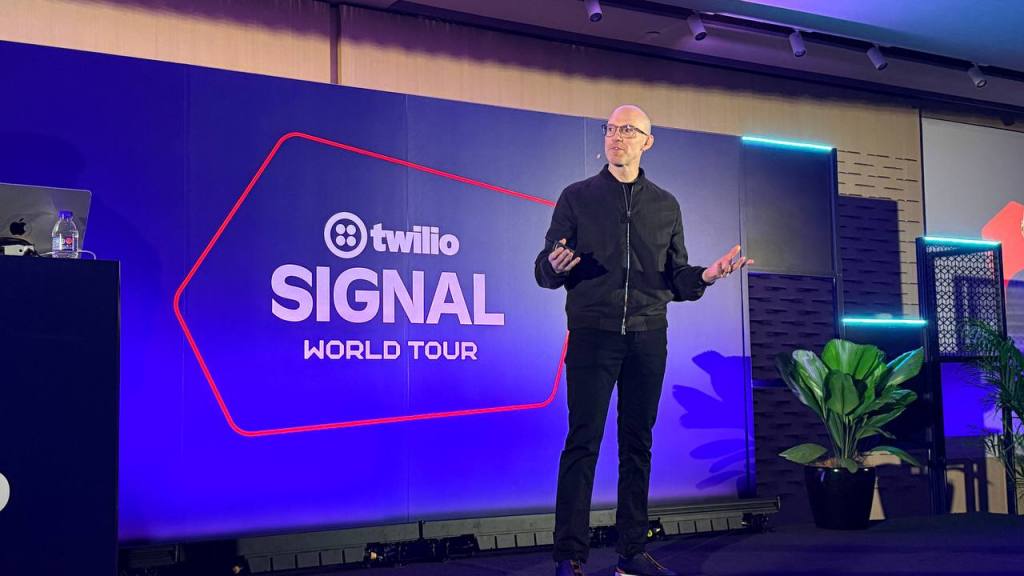
At the Twilio Signal event in Singapore, Chief Operating Officer Thomas Wyatt (top) said the company’s platform is evolving to support organisations as AI becomes embedded in customer journeys. Unlike conventional chatbots that largely respond to prompts, agentic AI systems can use context, access business systems and take action on a customer’s behalf.
The shift comes as customer interactions increasingly move between messaging, voice, email, and other channels. Wyatt cited Gartner data that showed that more than 70 percent of customer journeys span multiple communication channels, often across disconnected systems.
“Customers don’t just expect faster answers, they expect us to understand the context behind every interaction, wherever the conversation goes,” Wyatt said. “The challenge isn’t just reaching the customers across more channels or doing it faster. It’s making everything seem more connected, more relevant and more timely.”
From messaging to AI infrastructure
Historically, Twilio has been associated with APIs for messaging, voice and email. It now sees its role as helping businesses build customised experiences on top of communications, customer data and global infrastructure.
Its platform operates across 180 countries and has supported 260 billion messages, 38 billion voice calls, 2.4 trillion emails, and 10.8 trillion API calls. The scale and regulatory complexity involved mean that AI cannot simply replace the underlying communications infrastructure.
“This is no longer just software. This is infrastructure, physical, regulated and deeply operational,” said Wyatt.
Twilio’s proposition is to provide the infrastructure and tools that let organisations deploy AI-driven customer experiences while retaining control over the channels, data and workflows involved. This includes use cases such as automated service interactions, personalised travel communications, secure authentication, and voice-first experiences.
For businesses operating in Southeast Asia, the challenge is amplified by differences in customer behaviour, payment systems, regulations, and preferred communication channels across markets. A customer experience designed for Singapore may not transfer directly to Thailand, Vietnam or the Philippines.
Grab adopts hybrid approach
Grab is applying a hybrid approach to AI and customer experience. It is developing capabilities that are central to its regional operations while working with specialist technology providers where external infrastructure can accelerate delivery.
According to Paul-Eric Licari, Regional Head of Group Business Development for Tech and Travel at Grab, the company’s scale and the complexity of Southeast Asia mean that it cannot rely entirely on off-the-shelf technology.
“Like Twilio, Grab is a builder’s company. We like to build, and we like to build very often because we are not 100 percent served,” he added.
Grab has developed core capabilities such as its maps, matching systems and dispatch algorithms in-house. These systems depend on regional data and operational knowledge that are central to the company’s ride-hailing, delivery and other services.
At the same time, Licari said partnerships enable Grab’s engineering teams to concentrate on the technology and experiences that differentiate the platform, rather than rebuilding every supporting capability internally.
“We work with other partners, and when we partner, we’re looking at specialists that are able to help us scale and understand the market complexities that we have to work with,” he said.
Grab’s use of technology shows how agentic AI is likely to be deployed in practice — not as a single replacement for existing systems, but as a layer that connects customer conversations with operational workflows and specialised services.
In a regional platform such as Grab, an AI agent may need to understand a customer’s history, location, preferred channel, and service context before responding. It may also need to interact with dispatch, payments, logistics or support systems, while operating within market-specific rules.
This makes integration, reliability and control as important as the underlying AI model. It also explains why companies are likely to combine proprietary systems with external platforms for communications, identity, data and workflow execution.
Successful agentic AI deployments are tied to clearly defined customer journeys. The technology is most useful when it can preserve context across interactions, deliver information through the appropriate channel, and trigger the next step in an operational process.
For Twilio, this represents a shift from enabling individual messages or calls to orchestrating a continuous conversation between an organisation and the people it serves. For enterprises, the value lies less in adding another chatbot than in connecting AI to the communications and business infrastructure required to act on a request.
“At the core, Twilio is a platform that powers the world’s most important conversations,” said Wyatt.

