Singapore has unveiled national AI missions for financial services, targeting financial crime prevention, better access to business financing, and safe transactions by AI agents.
Supporting initiatives include synthetic data for scam-detection research, a sandbox for agent-led payments and partnerships to strengthen the sector’s AI capabilities.
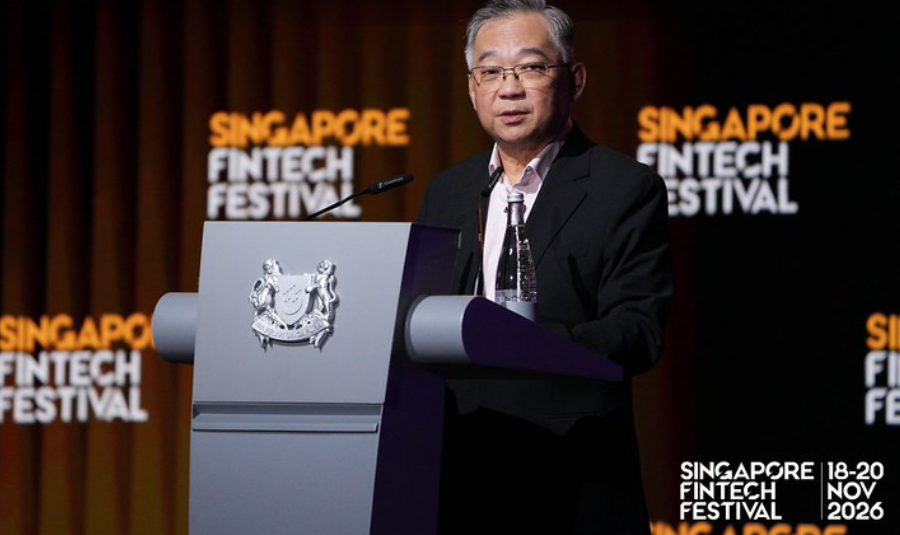
Deputy Prime Minister and Monetary Authority of Singapore (MAS) Chairman Gan Kim Yong (top) announced these at Singapore FinTech Festival on November 18.
MAS and Future of Finance Institute (FFI) will work with financial institutions, technology companies, researchers, and public agencies to develop and test practical solutions.
DBS, OCBC, Standard Chartered, and UOB were named as FFI’s financial institution launch partners, working alongside technology and research partners on shared industry needs.
Connecting data to catch scams
Financial crime prevention will be the first focus of FFI’s AI Innovation Arena. Developed with Government Technology Agency of Singapore (GovTech), a synthetic dataset will reflect interbank transaction patterns and scam activity in data pooled from five banks for an earlier proof-of-value exercise. Developers can use it to train and evaluate AI models for scam detection.
The movement of stolen funds across institutions made a coordinated approach essential.
“We must connect information across the financial system while strengthening detection within each institution, so that we can identify suspicious activity earlier, intervene faster, and stop more money from being lost,” said Gan.
Findings from the five-bank exercise will inform an industry-wide Scam Detection Utility. MAS will begin a design study in early 2027 to develop its blueprint, including governance and operating arrangements.
Using richer data to improve SME financing
Another mission will test whether AI can help lenders assess small and medium-sized enterprises more effectively, especially businesses with limited track records or assets.
Relevant information can be scattered across bank accounts, invoices, payment records, business profiles, and government records that make comprehensive credit assessments difficult.
“With richer data, AI can identify information and patterns that traditional approaches may miss, giving lenders a fuller picture of an SME’s creditworthiness,” said Gan.
AI technology companies will be invited to develop and test solutions using realistic synthetic data, with financial institutions and public agencies contributing data and expertise.
Feedback from SMEs will help assess whether the proposed solutions address their financing needs before longer-term infrastructure requirements are determined.
Controlled trials for AI-led payments
FFI will establish an Agentic Money Sandbox where financial institutions can test transactions carried out by AI agents using digital money. Initial applications will include agent-initiated payments and treasury management across participating institutions.
Gan said trials would explore how agents could interact with purpose bound money to make payments within defined authority and limits. Potential uses include fulfilling contractual payments once agreed conditions have been met and checked, or completing purchases for users.
“However, greater autonomy must come with clear responsibility and accountability,” he said. “Institutions and enterprises remain accountable for actions taken on their behalf, with safeguards built in from the start.”
Building local AI capabilities
FFI will also work with A*Star’s Institute of Advanced Intelligence and Computing to bring locally grounded speech-to-text technology into live financial-sector pilots.
Designed to transcribe Singlish and a mix of commonly spoken languages and dialects, the technology could support real-time compliance monitoring for operational risk management.
Other work will explore generative AI guardrails, while a partnership with AI Singapore will support talent development through initiatives such as apprentice programmes.
“Trust is essential to how quickly we can innovate. Financial institutions must remain accountable, with strong human oversight and effective safeguards,” said Gan.
Photo credit (top): GFTN | Singapore FinTech Festival



Leave a Reply