
Alibaba has unveiled a full-stack AI strategy covering chips, cloud infrastructure, foundation models, and AI agents.
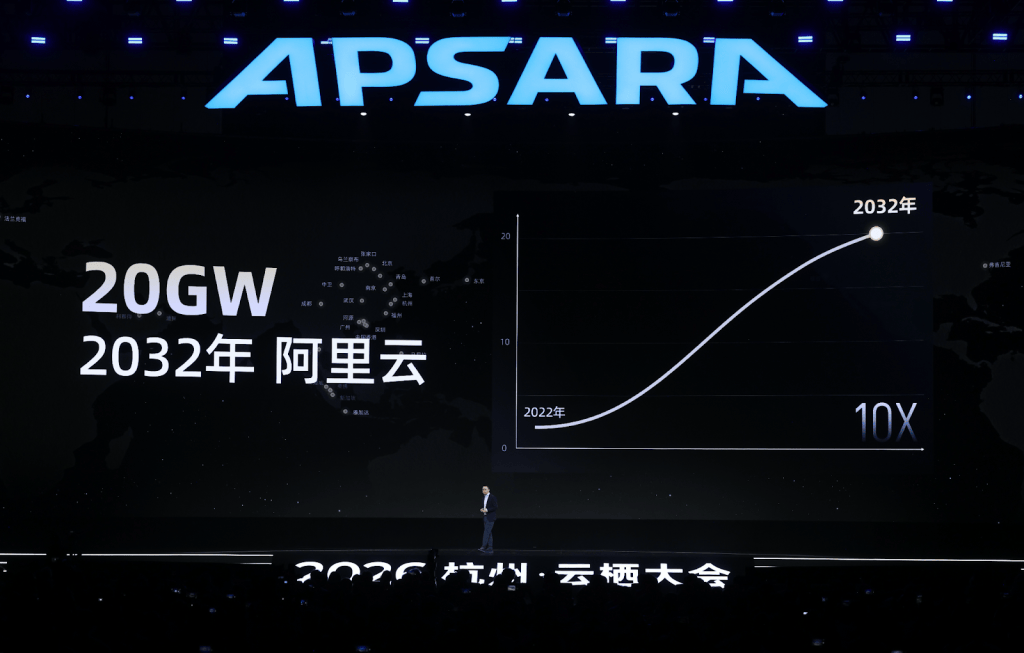
At its annual Apsara Conference in Hangzhou, China, Alibaba Cloud revealed a roadmap to increase the capacity of its global data centres to more than 20 gigawatts (GW) by 2032.
“Today, the total volume of Machine Thinking is less than three percent of all human thinking. If that volume eventually scales to 1,000x human capacity, the simple math tells us: machine thinking still has an enormous growth runway,” said Eddie Wu (top), CEO of Alibaba Group. “With this in mind, our target is that by 2032, the global data centre capacity operated by Alibaba Cloud will surpass 20GW, fuelling the industry’s exponentially rising demand for AI.”
The company’s next-generation Qwen model is in training with future Qwen 4.5 and Qwen 5 models expected to scale from five trillion to 10 trillion parameters.
Alibaba is working on recursive self-improvement for its models using feedback from model performance to improve future training and capabilities.
New AI hardware
T-Head, its semiconductor division, has introduced the Zhenwu V900 processor for AI training and inference. The chip is scheduled for mass production and commercial release in Q1 of 2027.
The V900 can be deployed in clusters of up to 500,000 cards. Also unveiled is a supernode server that combines the Zhenwu V900 with its networking and storage components. The server is designed to support large-scale AI training and inference, including clusters with hundreds of thousands of cards.
Zhenwu chips are already used by more than 650 customers in sectors such as automotive, finance, energy, manufacturing, and embodied intelligence.
Plans are underway for new proprietary central processing units designed for AI agents. The processors are expected to launch in 2027 and will offer higher single-core performance, greater core density and improved energy efficiency than the Yitian 710.
Cloud services
Alibaba Cloud announced upgrades across its AI infrastructure, including its Cloud Parallel File Storage system. The company said the system can deliver throughput of hundreds of terabytes per second and up to hundreds of millions of input/output operations per second.
It said the system could reduce enterprise AI storage costs by 69%.
Alibaba also introduced HPN 8.0 Pro, a networking architecture designed for AI workloads. It offers up to 100 petabits of bandwidth and low latency, according to the company.
The company said its Platform for AI, or PAI, now combines optimisation for inference, caching, sample replay and model training. In post-training tests involving Qwen models, PAI completed training in five days, Alibaba said.
AgentCore platform
Alibaba Cloud also introduced the AgentCore enterprise platform for building, running and managing AI agents. Designed to help enterprises build AI tools with security control built into its operating layer, the platform manages cooperation between people and agents, and monitor agent performance.
Also announced is the Agent Context data service that gives agents real-time information and long-term memory. The service connects company documents, business systems, chat records, and multimodal data. This allows agents to remember earlier tasks, share knowledge across teams and continue learning.
OpenLake has been upgraded into a multimodal data lakehouse to let different computing engines use one copy of structured, unstructured, vector and streaming data for processing, search, analysis, and model training.
Together, the announcements strengthen Alibaba’s position as a full-stack AI provider, spanning applications, models, chips, cloud infrastructure, and AI agents.

