
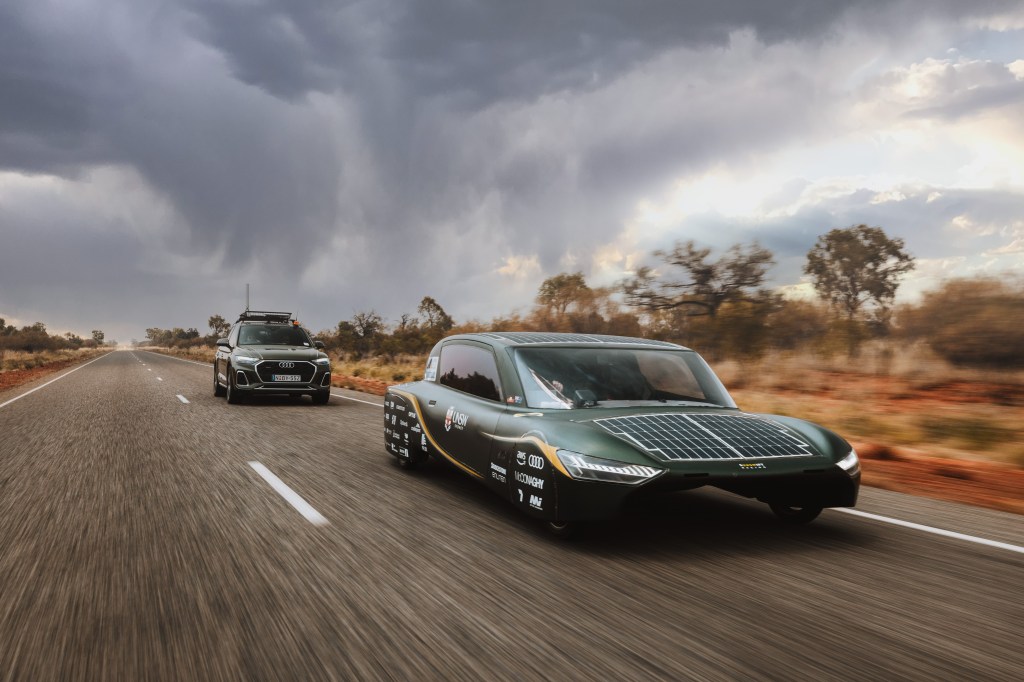
In the world’s premier solar race car event, the University of New South Wales (UNSW) Sunswift Racing team has emerged as the champion, clinching the coveted Cruiser Cup at the World Solar Challenge. This prestigious competition, which began 35 years ago, saw nearly 100 academic teams from across the globe vying for glory.
The World Solar Challenge spans more than 3,000 km over four grueling days, challenging participants not for speed but for the highest energy efficiency.
UNSW Sydney’s Sunswift 7 vehicle, powered by NVIDIA Jetson Xavier NX for energy optimisation, not only secured victory in the energy efficiency competition but also crossed the finish line first. Notably, it was the sole competitor with four occupants on board and a remote mission control team.
“It’s a completely different proposition to say we can use the least amount of energy and arrive in Adelaide before anybody else, but crossing the line first is just about bragging rights,” said Richard Hopkins, Project Manager of Sunswift and a UNSW Professor.
The World Solar Challenge is known for cutting across the entire Australian continent on public roads, spanning from Darwin in the north to Adelaide in the south. It is touted as the “world’s greatest innovation and engineering challenge contributing to a more sustainable mobility future.” Moreover, the event has become a launchpad for students seeking careers in the electric vehicle industry.
After a three-year hiatus due to COVID-19, UNSW’s return to the competition was eagerly anticipated.
Energy efficiency is the name of the game in this race. Participants start with fully charged batteries and can only charge them during overnight stops at two designated locations. Around 90 percent of the remaining energy is harnessed from the sun through the vehicles’ solar panels.
UNSW’s seventh-generation Sunswift 7 employs sophisticated algorithms to optimise energy efficiency, effectively shutting down non-essential computing processes to maximise battery life. It relies on NVIDIA Jetson AI, which manages about 100 automotive monitoring and power management systems. The vehicle can even adjust its speed based on weather forecasts, aiming to go faster when rain is anticipated later in the day.
The Sunswift 7 was specially designed for the race, with the primary goal being to consume the least amount of power outside of its mission to drive from Darwin to Adelaide.
“Sunswift 7 late last year was featured in the Guinness Book of World Records for being the fastest electric vehicle for over 1,000 km on a single charge of battery,” said Hopkins
The UNSW team’s dedication to refining their vehicle’s aerodynamics is evident in the nearly 60 design iterations they undertook. Using computational fluid dynamics modeling and simulations, they optimised the vehicle without employing a physical wind tunnel.
The team has also been working on a model to determine the optimal driving speed for maximum energy conservation, considering various parameters.
According to Josh Bramley, Technology Manager of Sunswift Racing, a lot of the AI and computer vision will be coming for Sunswift 8 in the next solar challenge.
This monumental achievement at the World Solar Challenge represents the collective effort of more than 100 students, who have been actively involved in the Sunswift Racing team, earning course credit and nurturing their interest in electric vehicles.
 Entelechy Asia