
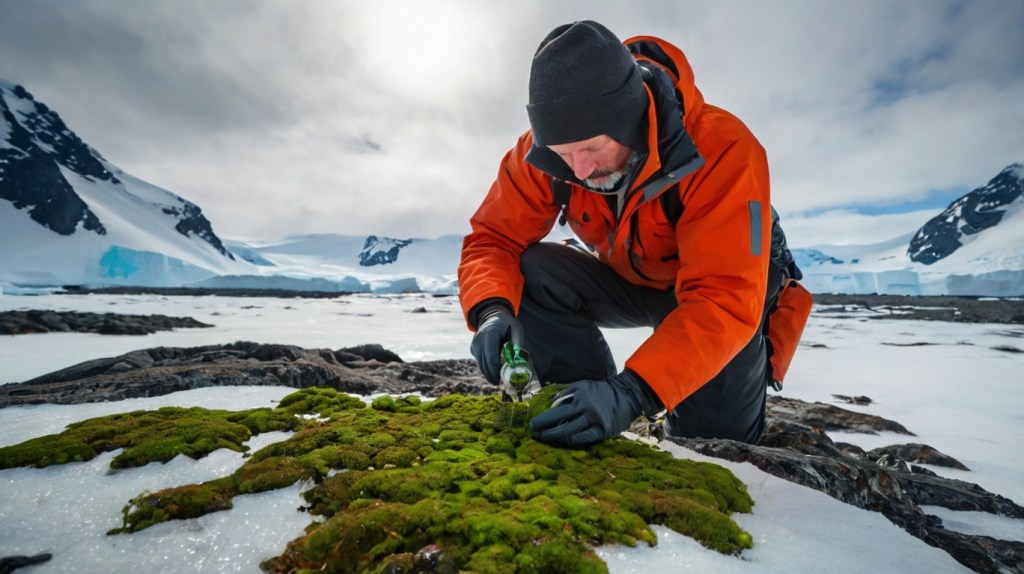
In the harsh, icy expanse of Antarctica, a small but powerful device is transforming climate research. The NVIDIA Jetson Orin Nano edge computing platform is enabling scientists to monitor the health of Antarctic moss in real-time, providing crucial insights into the continent’s changing ecosystem.
Though covering only less than one percent of Antarctica’s surface, moss plays a vital role in the continent’s ecosystem. These tiny plants act as miniature forests, absorbing atmospheric carbon dioxide and providing habitat for microorganisms and small invertebrates. The health of these moss beds serves as an early warning system for environmental changes, making them invaluable indicators of climate change.
Over the past two decades, scientists have observed an alarming decline in moss health across many parts of Antarctica. This deterioration has been linked to changing wind speed patterns, which are associated with climate change and ozone depletion.
The challenge in studying this phenomenon lies in the unique microclimates created by moss communities, which differ significantly from ambient conditions measured by standard weather stations.
Innovative AI solution
To address these challenges, researchers from Securing Antarctica’s Environmental Future (SAEF) developed an artificial intelligence of things (AIoT) platform to collect and process environmental data in situ, sending only the most pertinent information to researchers in near real-time.
Powering the AIoT platform is the NVIDIA Jetson Orin Nano, a small yet powerful AI computer capable of delivering up to 40 TOPS of AI performance with power options between 7W and 15W. The edge computing device processes data from various sensors, including moss canopy and air temperature, relative humidity, soil moisture and heat flux, solar radiation, and imagery.
It runs an image segmentation model (SegFormer) that analyses imagery data at the edge, letting researchers access and fine-tune state-of-the-art pre-trained image segmentation models for moss health analysis.
Real-world impact
The AIoT platform was successfully deployed at Casey Research Station during the 2022-2023 summer season. Data collected is now available in real-time on the MossCam dashboard, providing researchers and the public with unprecedented access to Antarctic environmental data.
“The Jetson and its edge AI technology in the AIoT platform allows us to continuously monitor the environment around the moss, so that when events such as the heatwaves that hit in 2020 and 2022 occur, we’ll be collecting the data in real time,” said Professor Sharon Robinson, Deputy Director of Science Implementation at SAEF.
Following the initial success, SAEF is finalising the second generation of the platform for deployment this year. Additionally, the Antarctic Terrestrial and Nearshore Observing System project of the Australian Antarctic Division has adopted the Jetson platform for its upcoming fleet of 20 remote sensing towers for Antarctica.
As climate change continues to be a pressing global concern, the NVIDIA Jetson Orin Nano is bridging the gap between cutting-edge AI technology and earth sciences, allowing researchers to decode the secrets of Antarctica’s changing climate, one moss bed at a time.
 Entelechy Asia