
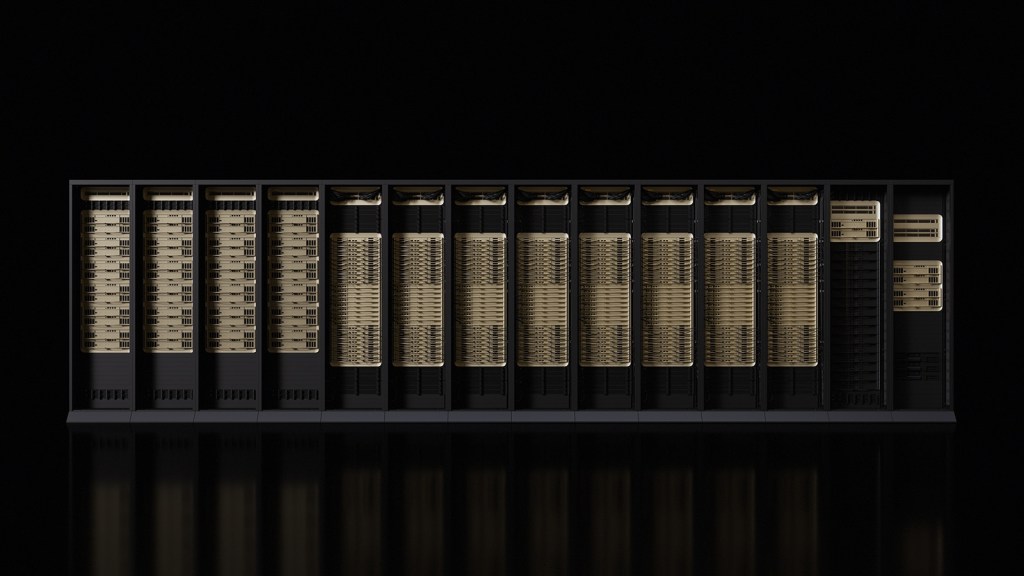
NVIDIA unveiled its Rubin AI supercomputer architecture at CES 2026. The platform features six co-designed chips — including the Vera CPU, Rubin GPU, NVLink interconnects, and advanced networking components — to power the next wave of physical AI, agentic systems and robotics.
Named after astronomer Vera Rubin, it has entered full production to enable massive-scale deployments such as the NVL72 rack-scale system that consolidates 72 GPUs and scales to DGX SuperPOD supercomputers for hyperscalers such as Amazon, Meta and Microsoft.
Along with the hardware, NVIDIA has released new open models, frameworks and infrastructure, with global partners showcasing industry-specific robots built on this stack.
“Rubin arrives at exactly the right moment, as AI computing demand for both training and inference is going through the roof. With our annual cadence of delivering a new generation of AI supercomputers — and extreme codesign across six new chips — Rubin takes a giant leap toward the next frontier of AI,” said Jensen Huang, Founder and CEO of NVIDIA.
Advancements over Blackwell
Rubin delivers up to 5x the NVFP4 inference compute (50 PFLOPS per GPU) of Blackwell through TSMC 3nm process, multi-chiplet design, HBM4 memory (50 percent more capacity, nearly 2x bandwidth), and innovations such as third-gen Transformer Engine and NVLink.
The full platform trains large MoE models using only a quarter of the GPUs of Blackwell while slashing inference token costs by up to 10x and boosting efficiency with mandatory liquid cooling for 150kW+ racks.
Overall system performance reaches 3.3-5x gains, positioning Rubin as a cost-efficient leap for AI factories.
NVIDIA’s extensive end-to-end ecosystem — spanning CUDA software, confidential computing and partner integrations — sets Rubin apart from rivals offering discrete chips, locking in dominance as physical AI craves holistic stacks for robotics and edge deployment.
 Entelechy Asia