
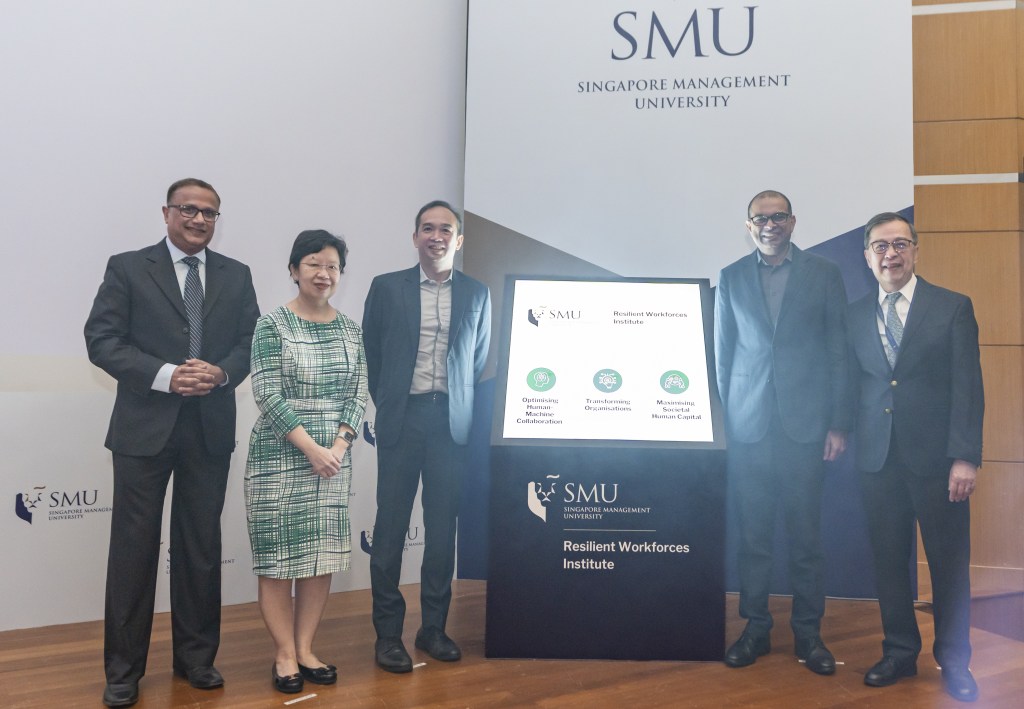
Singapore Management University (SMU) has launched the Resilient Workforces Institute (ResWORK) to strengthen the nation’s workforce resilience amid accelerating AI and digital changes.
The university focuses on lifelong learning and the future of work, directly tackling vulnerabilities in job markets and skills demands.
“The launch of the Resilient Workforces Institute reflects SMU’s commitment to research that matters – research that shapes public policy, informs organisational practice and ultimately strengthens the resilience of Singapore’s workforce,” said Lily Kong, President Professor of SMU.
Guest-of-Honour Janil Puthucheary, Senior Minister of State, highlighted industry partnerships enabled by research to overcome AI disruptions.
Research pillars
ResWORK targets three pillars: optimising human-machine collaboration, transforming organisations for AI workplaces, and maximising societal human capital through inclusive policies.
With more than 20 faculty, nine seed-funded projects, and S$1.5 million in external grants already secured, the institute will commit SMU’s S$5 million over five years, with a target of S$8 million more.
Strategic partnerships
SMU and SkillsFuture Singapore (SSG) have signed a two-year memorandum of undestanding to study AI’s effects on skills, learning and productivity.
“Our partnership with SMU on ResWORK is driven by a singular objective: to future-proof the national SkillsFuture system,” said Tan Kok Yam, CEO of SSG.
“By partnering with SMU on its resilient workforce initiative, we’re investing in research that will help position Singapore as a regional leader on AI and the future of work,” said Leong Yee May, Managing Director of Equinix, which has contributed S$450,000 for an AI exposure index.
According to Archan Misra, Interim Director of ResWORK, the institute is built on the belief that AI-led change will reshape opportunity rather than displace it.
“Our research agenda is designed to move beyond diagnosis to solutioning,” he said.
 Entelechy Asia