
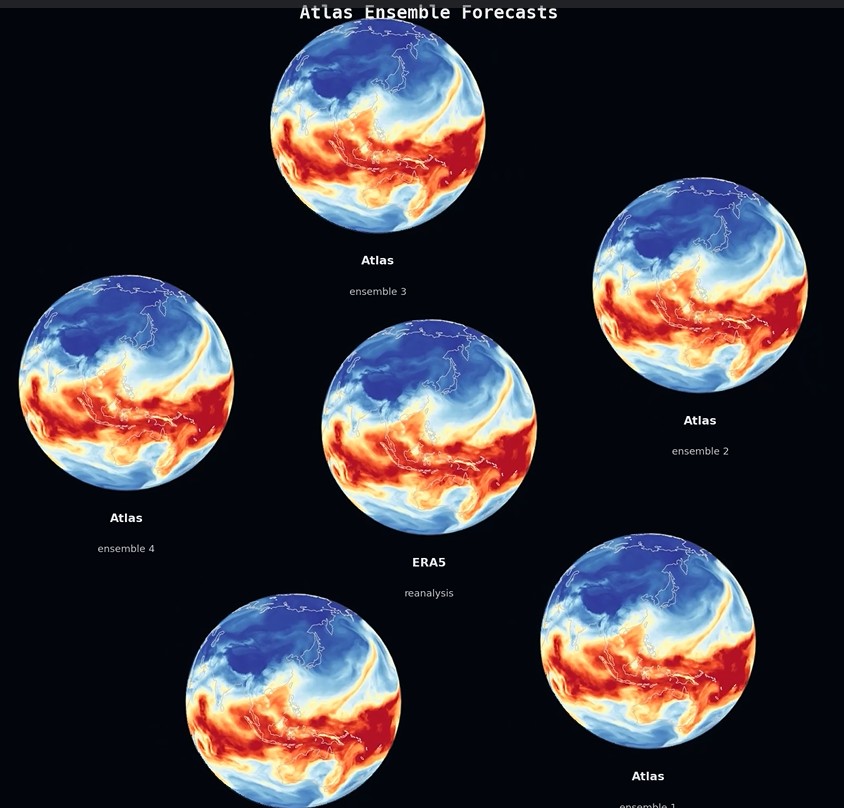
NVIDIA has unveiled the Earth-2 open family of AI weather and climate models, tools and frameworks to accelerate everything from local storm forecasts to 15-day global outlooks.
By replacing traditional physics-only supercomputing runs with AI-accelerated models, Earth-2 delivers faster, cheaper and more customisable forecasts that can run on local infrastructure — a boon for data-sensitive governments and enterprises across the region.
For a region facing intensifying monsoon rains, heatwaves and typhoons, Earth-2’s high-resolution, short-term nowcasting can support more precise city-level flood warnings, port and airport operations, and urban disaster response in Asia.
Israel’s Meteorological Service is already using Earth-2 CorrDiff to generate high-resolution forecasts up to eight times a day with a 90 percent reduction in compute time at 2.5km resolution, showing how similar AI-driven setups could make rapid-update systems more affordable for emerging economies.
Regional meteorological agencies can also fine-tune Earth-2 models on their own historical and sensor data to improve local performance without sending sensitive data offshore.
Earth-2’s potential extends deep into Asia’s energy transition, where solar, wind and hydro operators struggle with highly variable weather.
In China, solar giant GCL is already running Earth-2 models in its photovoltaic prediction system and reports more accurate, lower-cost forecasts compared with traditional numerical weather prediction, a pattern that could translate to better day-ahead scheduling and grid integration for solar farms in markets such as the Philippines,Thailand and Vietnam.
NVIDIA also highlights use cases where utilities and power pools apply Earth-2 to intraday and day-ahead wind forecasting, an approach that could help grid operators manage renewables while protecting reliability.
Financial institutions and insurers in Singapore and the wider region can harness Earth-2 for climate-risk analytics, pricing and portfolio stress testing.
S&P Global Energy is using Earth-2 CorrDiff to convert climate data into local risk insights, while AXA uses FourCastNet to generate thousands of hypothetical hurricane scenarios — a methodology that can be adapted for typhoon and flood risk across coastal Asia.
With open models available via NVIDIA Earth2Studio, Hugging Face and GitHub, local climate-tech startups can also build bespoke risk platforms and catastrophe models without having to develop foundational weather AI from scratch.
Beyond risk management, Earth-2 can support agriculture and public health planning in tropical climates where small changes in rainfall and temperature can disrupt harvests and disease patterns.
Earth-2 is as a production-ready stack that agencies and enterprises can deploy and fine-tune on their own infrastructure for national weather services, smart-farming platforms and health ministries to develop tailored forecasting and early-warning workflows.
As Earth-2 integrates models from sources such as European Centre for Medium-Range Weather Forecasts (ECMWF), Google and Microsoft, Asian developers gain a unified, open toolkit to experiment, benchmark and operationalise AI weather systems that match the region’s complex geography and microclimates.
 Entelechy Asia