
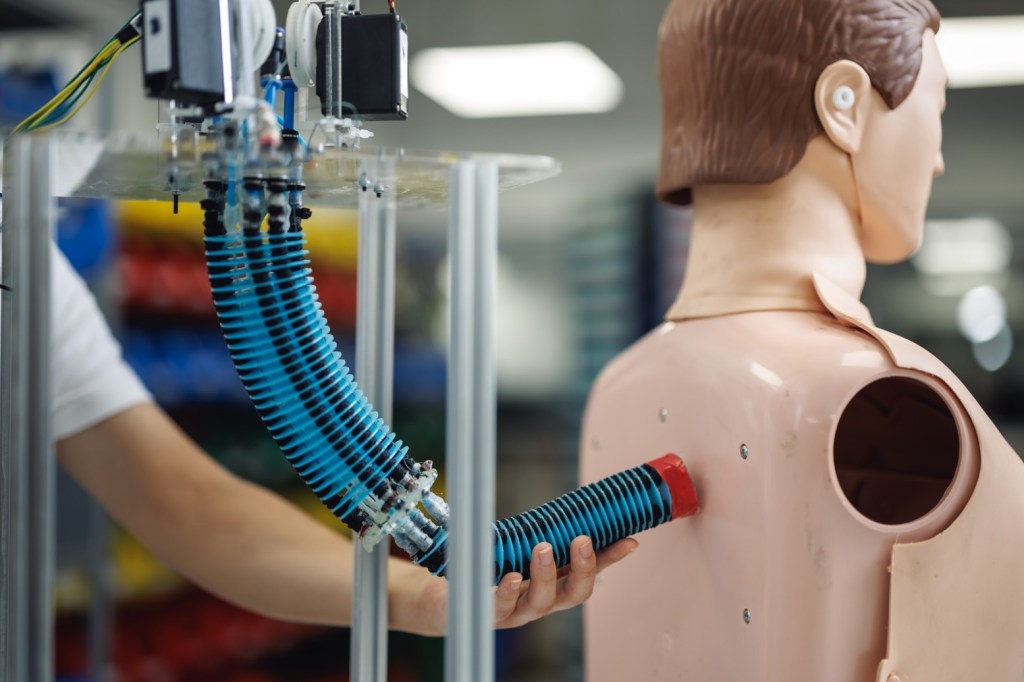
Researchers from Singapore‑MIT Alliance for Research and Technology and National University of Singapore, working with partners at Massachusetts Institute of Technology and Nanyang Technological University, have developed a neuron‑inspired AI control system that gives soft robots a remarkable level of human‑like intelligence and adaptability.
Made from flexible materials rather than rigid joints, soft robots have long promised safer, more intuitive automation for healthcare, manufacturing, and home assistance. Yet their very flexibility makes them hard to control. A shift in weight, a gust of air or a minor hardware fault can throw their movements into disarray. Traditional approaches could achieve either learning, adaptation or stability — rarely all three.
The new system, described in Science Advances, changes that. Drawing inspiration from the human brain, the researchers designed two types of artificial synapses that work together to enable generalised learning and real‑time adjustment.
Structural synapses encode foundational skills such as bending, grasping and extending while plastic synapses update continuously as the robot operates, allowing instant responses to unfamiliar conditions.
A built‑in stability metric keeps movements safe and predictable as the robot learns on the fly.
In experiments, a soft robotic arm powered by the system showed a 44 to 55 percent drop in tracking errors during major disturbances, maintained more than 92 percent shape accuracy under variable payloads and airflow, and remained stable even when up to half its actuators failed.
It smoothly handled diverse tasks, from trajectory tracking to object placement and whole‑body shape control.
The breakthrough paves the way for soft robots that can think and react like humans — automatically adjusting to patients’ changing strength in rehab settings, or responding to unpredictable factory environments without new programming.
The team now plans to scale the technology to faster and more complex robotic systems.
 Entelechy Asia