
For years, AI has dazzled, generating text, analysing data, spotting patterns. However, intelligence that cannot sense, move or act is ultimately constrained. Robotics is where that ceiling is being lifted, and physical AI is the force doing the lifting.
Physical AI refers to AI software that fuses perception, cognition and control like vision, language, physics, motion and learning into mechanical systems like robots. Without Physical AI, robots are scripted, they only move in a certain way. With the software, they become adaptive, autonomous and useful in messy, human environments.
This is why robotics has re-emerged as one of the most strategically important frontiers in AI. A robot that can reason about what it is doing – and why – crosses a threshold from automation to agency.
Crucially, Physical AI shifts robotics from niche deployments into a general-purpose platform. Robots are no longer confined to cages or controlled factory lines. They are learning to navigate hospitals, warehouses, homes and cities and in environments designed for humans, not machines. This is where productivity gains, labour augmentation and entirely new services begin to scale.
Seen through this lens, there is renewed global focus on robotics that is less a hardware story than an AI one: Can we build intelligence that survives contact with the real world?
That question burst into the open at CES 2026, where robotics emerged as the most visible expression of Physical AI’s coming of age. Humanoids, mobile robots and dexterous machines were no longer side attractions. They were centre stage.
ChatGPT moment for physical AI
No company articulated this shift more clearly than NVIDIA.
“The ChatGPT moment for physical AI is here, when machines begin to understand, reason and act in the real world,” said Jensen Huang, Founder and CEO when he laid out a vision that places robots at the heart of the next computing platform in his keynote address at the annual convention.
That vision is anchored in software as much as silicon. NVIDIA introduced Cosmos foundation models and Isaac simulation environments for robots to learn physics, practise at scale in virtual worlds, and transfer those skills safely into reality. Intelligence, in this worldview, must be trained not just on data but on the laws of the physical world.
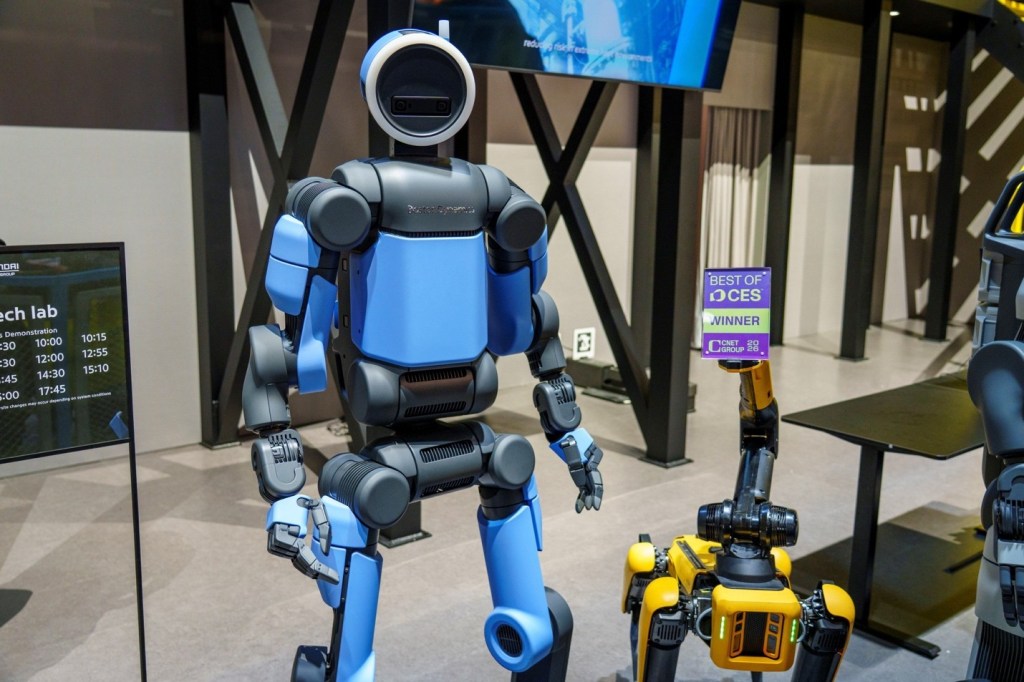
The results were evident across the show floor. LG’s CLOiD humanoid demonstrated domestic tasks such as laundry folding using what it described as “affectionate intelligence”. Boston Dynamics showcased its electric Atlas prototype, integrating advanced AI models from Google DeepMind and targeting deployment in Hyundai factories by 2028. Unitree Roboticsimpressed with legged robots exhibiting good balance powered by AI control systems.
Singapore in the limelight
Singapore’s presence was also felt. Robotics firm Sharpa drew accolades for its AI-driven dexterous robotic hands. In a table tennis demonstration it highlighted one of Physical AI’s hardest challenges, dexterity which requires fine motor control in unpredictable conditions.
Capital is following capability. According to research firm CB Insights, robotics accounted for 11.4 per cent of the US$225.8 billion raised by global private AI companies in 2025. Mergers and acquisitions surged with 782 deals, an expansion of up to 1.5 times, as enterprises looked beyond experimentation towards systems that could act.
One transaction crystallised this shift. Singapore-headquartered Manus was acquired by Meta for a reported US$2 billion in late 2025. While Manus is often framed as an agentic AI company, its valuation reflects something closer to Physical AI thinking.
Launched by Chinese-American entrepreneurs who relocated to Singapore, Manus hit over US$125 million revenue in a mere eight months.
Unlike chatbots confined to conversation, its agents operate in the real and digital worlds. They browse the web – scraping data, filling forms and navigating e-commerce – and execute code like writing, debugging and deploying scripts across languages). They also analyse datasets such as generating visualisations, forecasts and reports as well as orchestrate workflows such as booking travel, building websites and conducting market research.
Meta plans to keep Manus as a standalone service while embedding the start-ups capabilities into WhatsApp and Instagram commerce services and its Llama models, pointing to a clear signal that action-oriented AI is becoming core infrastructure. As Manus CEO Xiao Hong had put it: “The era of AI that doesn’t just talk, but acts, creates and delivers, it is only the beginning.”
Manus exemplifies the rising interest in robotics. Singapore successes such as Sharpa’s CES 2026 Innovation Award for AI-driven dexterous hands reflects the Republic’s deep interest to grow its robotics sector.
What matters is this: Physical AI is the connective tissue between AI ambition and real-world impact. And as robotics steps out of controlled environments and into daily life, leadership will be determined by who can build intelligence that understands the physical world and act within it, safely and at scale.
By Edward Lim
Photo: Boston Dynamics
This story is produced through a content partnership between Entelechy Asia and News on Tech, bringing together shared perspectives on technology and innovation.
 Entelechy Asia