
Zoom has announced expansion of its agentic AI platform that closes the gap between conversations and actual execution.
Announced at Enterprise Connect 2026, the upgrade positions Zoom not just as a collaboration suite but as a full system of action capable of orchestrating workflows across meetings, calls, chat, and customer experience environments.
“The next phase of enterprise AI will be defined by the ability to move from conversation to action. Zoom’s agentic AI platform is designed to orchestrate action across systems, turning every meeting, call, and customer interaction into a trigger for workflow automation,” said Velchamy Sankarlingam, President of Product and Engineering at Zoom.
While most enterprise AI tools today excel at summarising discussions, the real bottleneck lies in fragmented follow‑through — where decisions made in meetings rarely translate seamlessly into tasks, updates or actions across disparate systems. The enhanced capabilities are built to automate that handoff.
A new generation of custom AI agents can now be deployed without writing code. These agents can retrieve insights, automate repetitive tasks and trigger workflows across third‑party systems such as Salesforce, Slack and ServiceNow.
Zoom has also added 10 new secure connectors that allow enterprises to synthesise data from multiple sources while maintaining governance and privacy controls.
AI Companion 3.0, previously limited to the browser, now spans the entire Zoom ecosystem, including Zoom Workplace, Zoom Phone, Zoom CX and Workvivo. This expansion is powered by Zoom’s federated AI architecture, which blends proprietary models with third‑party LLMs and customer‑owned models.
The number of monthly active users of AI Companion have more than tripled year‑over‑year, signalling strong demand for embedded AI assistance.
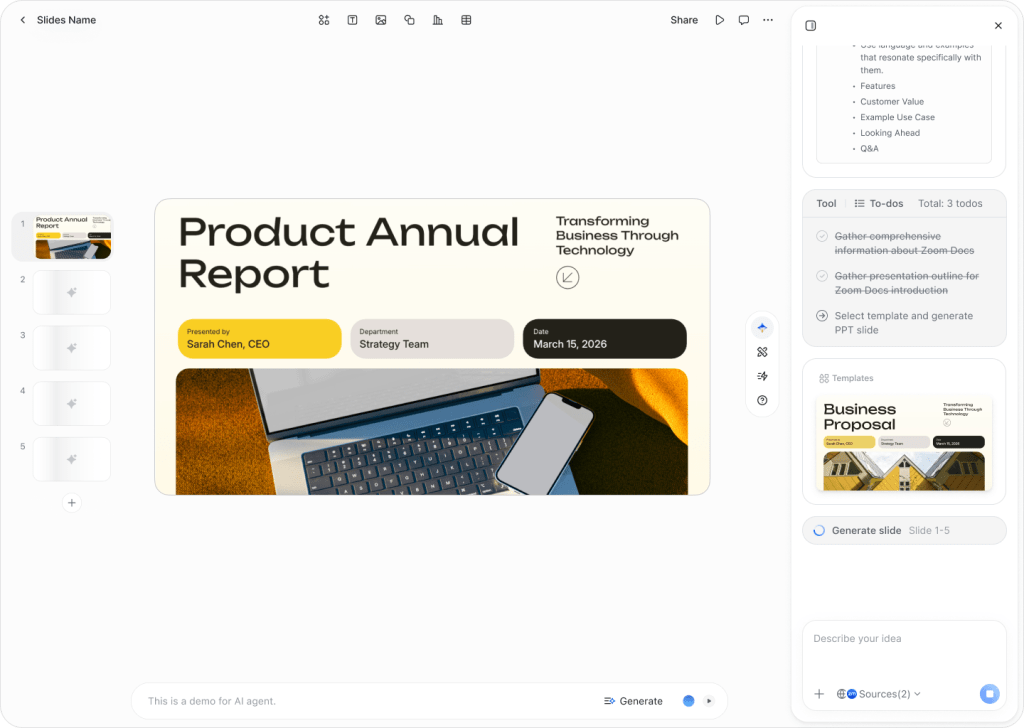
Zoom has also introduced a suite of AI‑first canvases — AI Docs, AI Sheets and AI Slides — that enable teams to transform meeting insights into structured documents, analysis and presentations without switching tools. These canvases are designed for real‑time co‑creation, positioning Zoom as a contender in the collaborative productivity space traditionally dominated by Google Workspace and Microsoft 365.
The broader Zoom Workplace experience is receiving a redesign as well, with a cleaner interface, a dedicated AI Companion tab, and the introduction of the Zoomie group assistant for meetings and rooms. AI‑first Chat now supports custom agents and topic summaries, while real‑time voice translation launches with five languages.
Zoom is also adding deepfake detection to bolster meeting security. This is an increasingly urgent concern as generative media becomes more sophisticated.
Zoom Phone, which has surpassed 10 million seats globally, is gaining agentic workflows for automated follow‑ups, SMS support for the AI Receptionist, and a new mobile‑first experience called Zoom Phone Mobile.
The Customer Engagement Pack adds deeper analytics for organisations managing high‑volume communications.
On the customer experience front, Zoom CX and Revenue Accelerator are receiving significant upgrades, including AI Expert Assist 3.0 for real‑time agent guidance, natural‑language workflow orchestration, and advanced quality management for virtual agents.
For Asia, where digital transformation is accelerating and organisations often juggle multiple legacy systems, Zoom’s push into agentic AI could be particularly impactful. The region’s enterprises, especially in sectors such as financial services, logistics, and retail, stand to benefit from tools that can automate cross‑system workflows and reduce operational friction.
 Entelechy Asia