
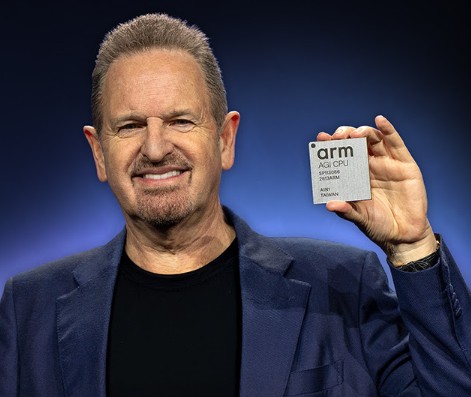
Arm has launched its first ever production silicon designed for large‑scale agentic AI workloads.
The AGI CPU signifies a historic shift in the company’s business model from licensing CPU IP to also selling its own chips, placing it in more direct competition with Intel, AMD and alternative architectures in AI infrastructure.
Based on Neoverse‑based, Arm‑designed server processor, the Arm AGI CPU is aimed at AI data centres where software agents continuously orchestrate models, data and accelerators at global scale. It targets the CPU control plane of AI infrastructure: coordinating accelerators such as GPUs and NPUs, managing memory and storage, and scheduling thousands of distributed AI tasks in real time.
A reference 1OU dual‑node server blade integrates two AGI CPUs for a total of 272 cores per blade, with 30 blades in a standard 36 kW air‑cooled rack delivering 8,160 cores. In partnership with Supermicro, a 200 kW liquid‑cooled design can house 336 AGI CPUs for more than 45,000 cores per rack.
An AGI‑based rack can deliver more than twice the performance per rack of the latest x86 server platforms for representative AI workloads. This gain is attributed to high‑performance Neoverse V3 cores, class‑leading memory bandwidth and a rack‑level architecture that keeps per‑thread performance high even under sustained, massively parallel load.
The AGI CPU can scale up to 136 cores at around 300 W per chip, with energy efficiency and performance per watt versus traditional x86 CPUs from Intel and AMD that often throttle under heavy contention.
By fitting up to 64 AGI CPUs and roughly 8,700 cores into a single air‑cooled rack configuration, Arm is pitching a path to lower CAPEX and OPEX for AI data centres constrained by power and cooling budgets.
Strategic significance
Delivering its own data centre CPU fundamentally expands Arm’s role from IP licensor to direct silicon supplier in a trillion‑dollar AI infrastructure market.
The AGI CPU is the first product in a broader data centre silicon line, alongside its ongoing Neoverse and CSS roadmap, giving customers options to license IP, adopt compute subsystems or deploy Arm‑designed chips.
This strategy allows Arm to capture more value from AI data centre build‑outs while reinforcing its platform story, since AGI CPUs remain software‑compatible with existing Arm‑based cloud CPUs such as AWS Graviton, Google Axion, Microsoft Cobalt, and NVIDIA Vera. It also tightens Arm’s collaboration with hyperscalers and AI players, potentially influencing future hardware standards for AI‑native data centres.
“We are now in a new business for Arm, and we are supplying CPUs as chips. The biggest reason we’re doing this is that our partners have asked for it,” said Rene Haas (top), CEO of Arm.
Ecosystem momentum
Arm has lined up a roster of high‑profile partners, with Meta as the lead customer co‑developing AGI CPU for gigawatt‑scale infrastructure and to work alongside its MTIA accelerators. Other partners include Cerebras, Cloudflare, F5, OpenAI, Positron, Rebellions, SAP, and SK Telecom, spanning AI accelerators, cloud networking, enterprise software, and telecom AI services.
“We worked alongside Arm to develop the Arm AGI CPU to deploy an efficient compute platform that significantly improves our data centre performance density and supports a multi-generation roadmap for our evolving AI systems,” said Santosh Janardhan, Head of Infrastructure at Meta.
Commercial systems from ASRockRack, Lenovo and Supermicro are already available to order, and Arm plans to contribute its 1OU dual‑node reference server and associated firmware to the Open Compute Project to speed broader adoption.
With this launch, Arm is not only challenging x86 in AI data centres but also strengthening alternative CPU choices such as Arm and, indirectly, RISC‑V, in a market that has historically defaulted to x86 for GPU‑driven AI servers.
 Entelechy Asia