Clio has launched the Clio Duo AI tool for the legal sector in Singapore and the Asia-Pacific (APAC) region. The AI tool automates repetitive administrative work, extracts key insights from legal documents, and generates smart, […]
The global generative AI (GenAI) market is set explosive growth, with predicted spending of US$644 billion in 2025, marking a staggering 76.4 percent increase from the previous year, according to Gartner. Despite challenges such as […]
SAP has appointed Simon Davies as President for the newly-created Asia-Pacific region reponsible for overseeing strategy, operations, people, sales, services, partners, and profitability. Based in Singapore, he is in charge of more than 31,000 employees […]
Amazon Web Services (AWS) has opened its new Asia Pacific hub in Singapore, underscoring the nation’s growing importance as a strategic hub for digital transformation in the region. As the anchor tenant in IOI Central […]
Security continues to be a top priority for governments and organisations in the Asia-Pacific (APAC) region. According to IDC, spending on security hardware, services and software in APAC is expected to increase by 16.7 percent […]
The Petronoas FutureTech 3.0 accelerator programme is expanding beyond Malaysia to the Asia-Pacific region, Co-organised by Petronas Ventures and Singapore-based StartupX, the platform aims to uncover innovations and game-changing technologies, and to accelerate these ideas […]
Sovereign Cloud Australia (AUCloud) and Arqit Quantum have announced general availability of the Asia Pacific region’s first Quantum Safe Symmetric Key Agreement Software (SKAS). Powered by Arqit’s QuantumCloud, the service is available now from AUCloud as […]
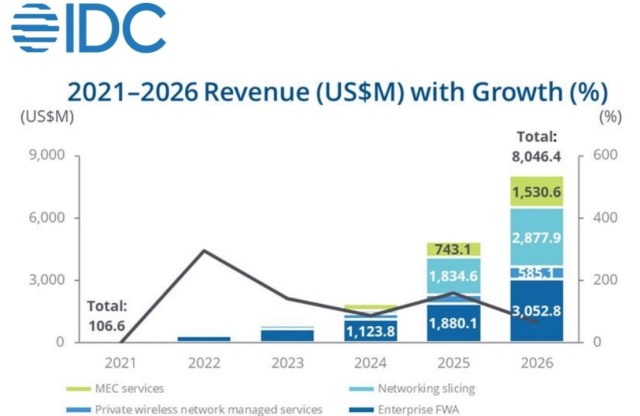
5G adoption is gaining momentum in the consumer market as countries open up to a post-pandemic world. In the enterprise space, IDC is predicting strong growth from US$106 million in 2021 to US$8 billion in […]
As IT security is a major concern for organisations, demand for cybersecurity professionals is high. (ISC)² aims to help increase the pool of such professionals with the launch of its entry-level certification pilot programme in […]
Milestone Systems has appointed Malou Toft as Vice President for Asia Pacific (APAC). He will be responsible for the company’s long-term growth strategy in APAC through business expansion, strategic partnerships and customer acquisition. Pandemic nothwithstanding, […]
VIS Global and Uniphore have formed a multi-country strategic partnership to provide a comprehensive communication and customer experience (CX) management portfolio with conversations automation offerings in Asia Pacific. This partnership will deliver to enterprises benefits […]
SambaNova Systems and ScaleWorX are partnering to drive AI adoption in the Asia-Pacific region. Under the partnership, ScaleWorX will offer innovative and best-in-class AI solutions from SambaNova to its end users. It will implement SambaNova’s […]
Informatica has launched its Intelligent Data Management Cloud (IDMC) platform on Microsoft Azure to expand its footprint in the Asia-Pacific region. The move follows Informatica and Azure’s collaboration which grew 109 percent year-on-year in 2020. […]
Huawei has announced new flagship products for the Asia-Pacific region. Most of these have already been introduced earlier in China. Huawei nova 8i smartphone: Targeted at a younger audience, it is slim with curved design, […]
Application development platform Vantiq is expanding into the Asia-Pacific (APAC) region and on the lookout for partners in Australia, India, Indonesia, Malaysia, Philippines, Singapore, South Korea, Thailand, and Vietnam. The US-headquartered company’s platform lets customers […]
Digital identity solution provider ForgeRock has appointed David Hope as Senior Vice President for Asia-Pacific and Japan.
5G is expected to boost smartphone sale, particularly in the Asia-Pacific region, in 2020. Greater China and emerging Asia-Pacific will retain the top two positions globally with respective sales of 432.3 million and 376.8 million smartphones this year, according to Gartner.
SAP has expanded its presence in Asia-Pacific (APAC) with the opening of a new data centre in Singapore to support SAP Commerce Cloud deployment.

The global GPU as a Service (GPUaaS) market is expected to jump tenfold from around US$700 million in 2018 to US$7 billion by 2025, according to Global Market Insights. The Asia-Pacific (APAC) region is expected to lead this charge with a compounded annual growth rate of more than 40 percent between 2019 and 2025.

Dell EMC turned in a stellar performance in Q1 by growing 51.4 percent in server revenue, enabling it to widen the gap with second-place Hewlett Packard Enterprise (HPE) which nevertheless grew an impressive 21.5 percent.

The downward trend continues for worldwide PC shipment with a 1.4 percent drop in Q1, making it the 14th consecutive quarter of decline, according to Gartner.
Spurred by growing interest in artificial intelligence (AI), the Asia-Pacific (APAC) robotics market is expected to growth to US$162 billion in 2021, accounting for 70 percent of the world’s total robotics market in 2021, according to […]
Motorola Solutions has unveiled highly advanced technology solutions to enhance the capabilities of nation-wide public safety networks at Critical Communications World 2017 in Hong Kong. These include mission-critical radio technologies, specialised software, mission critical broadband, command […]
Governments in Asia Pacific are notably vested in the Internet of Things (IoT) technologies because it enables a broad new range of citizen services, according to IDC’s 2016 Global IoT Decision Maker Survey.
Based on the survey, 40 percent of Asia-Pacific government organisations are investing on IoT solutions in the next 12 months while 50 percent of them are investing in an IoT solution in next 12 to 24 months.
“Improving productivity, improving time to market for products/services and improving energy efficiency reducing costs are the top benefits of an IoT solution. IoT enables access to new and granular data sources, empowered by swift connectivity and quick data gathering capability giving access to a wider range of information that enhances the quality of government services at a scale, which previously has been thought to be unattainable,” said Shreyashi Pal, Market Analyst, IDC Asia/Pacific Government and Education Insights.
Worldwide PC shipment shed 9.6 percent to 64.8 million in Q1, according to Gartner. This was the sixth consecutive quarter of PC shipment declines, and the first time since 2007 that shipment volume fell below 65 million units.
In the Asia-Pacific, PC shipment dropped 5.1 percent to 23.3 million units. The ongoing fragile Chinese economy and weak global demand continued to dampen consumer sentiment in the region.
With high PC penetration in the major cities, it was a challenge to invoke PC replacements on the appeal of new technology. The PC life cycle is lengthening as many consumers are waiting until their PC breaks down before purchasing a new one.
IBM and MasterCard are partnering to offer smaller merchants real-time, analytics-based market insights on revenue, market share, customer demographics and competitors in a particular location and across multiple locations.
The solution integrates IBM Watson Analytics with insights based on aggregated and anonymised MasterCard transaction data through MasterCard Advisors Local Market Intelligence (LMI).
According to MasterCard’s latest research, more than seven out of 10 smaller businesses in Asia-Pacific expect higher business costs in 2016. With this enhanced analytical platform powered by MasterCard Advisors and IBM, merchants will hence be better equipped to make informed decisions that lower costs based on a deeper knowledge of their business’ financial strengths and pitfalls.
The economic gloom has hit the global enterprise client device market comprising thin and terminal clients. The market was down 6.8 percent in Q4, bringing 2015 decline to 6.9 percent, according to IDC.
This was due to project cutback or delay in the face of a faltering economic outlook and reduced public budgets.
The Asia-Pacific region (excluding Japan) provided the only bright spark in the downturn, growing just over 10 percent in 2015.
While voice interaction remains the primary communication channel in contact centres, the concept of an omni-channel is gaining popularity in Asia-Pacific, according to Frost & Sullivan.
With smartphone penetration and social media usage on the rise, an increasing number of organisations are working closely with system integrators and independent software vendors to implement the omni-channel platform. Their objective is to overcome the existing silo nature of communication channels and provide a consistent and seamless customer experience across voice, email, SMS, Web-chat, social media and real-time video interactions. In response, contact centers are transforming into ‘customer engagement centers’ with multi-channel strategies that are tightly integrated with mobile applications and self-service capabilities.
According to Frost & Sullivan, the market earned revenues of US$699.5 million in 2014 and is estimated to reach US$952.9 million in 2021 with a compound annual growth rate of 4.5 percent. The study covers automatic call distributors, outbound systems, computer telephony integration, interactive voice response, workforce management, call monitoring, speech technology and multimedia systems. Workforce optimisation and analytics are expected to lead revenue growth across these segments, driven by the continuous focus on contact centre operation performance management.

Shipment of devices (PCs, tablets, ultramobiles, and mobile phones) in Asia Pacific are expected to hit 1.2 billion units in 2015, an increase of 3.2 percent over 2014, according to Gartner.
“Device penetration is very high in Asia Pacific – at or beyond saturation point in mature markets and major cities in the emerging markets. Market saturation, along with consumers extending the lifetime of their tablets, has caused a re-calibration in the growth trajectory in the market. From 2016, we expect the tablet market to resume growth from a stabilised base,” said Lillian Tay, Principal Analyst of Gartner.
The computing devices market is forecast to drop 1.9 percent this year, affected by weak demand for tablets. The PC market overall will continue to grow slightly, as shipment in the premium ultramobile category compensate for a decline in sales of traditional desk-based and notebook PCs.
Lenovo maintained its pole position in the PC market, holding off HP and Dell. However, the gap between Lenovo and HP narrowed as HP garnered 18.8 percent of the market in Q4, relative to Lenovo’s 19.4 percent, according to Gartner. Dell remained third with 12.7 percent market share.
Overall, worldwide PC shipment totalled 83.7 million units in Q4, a one-percent increase from the fourth quarter of 2013. These results indicate a slow, but consistent improvement following more than two years of decline.
“The PC market is quietly stabilising after the installed base reduction driven by users diversifying their device portfolios. Installed base PC displacement by tablets peaked in 2013 and the first half of 2014. Now that tablets have mostly penetrated some key markets, consumer spending is slowly shifting back to PCs,” said Mikako Kitagawa, Principal Analyst of Gartner.
Rising demand for broadband will spur economies in the Asia-Pacific region (APAC).
According to a new GSMA report, increased broadband connections in APAC will generate US$1.2 trillion of GDP growth and create up to 35 million new jobs by 2020.
However, this opportunity can only be realised if governments act now to fully release existing harmonised mobile spectrum bands and allocate more spectrum for mobile to meet rising consumer demand and support the development of new mobile services in the longer term.
Adrian Jones is Symantec’s new Senior Vice President for Asia Pacific and Japan. He will be responsible for growing the company’s presence and market position across the region, in addition to leading business operations and business […]
Global PC shipment dipped 1.7 percent to 76.6 million units Q1, compared to the same period last year, according to apreliminary results by Gartner.
“The end of XP support by Microsoft on April 8 has played a role in the easing decline of PC shipments,” said Mikako Kitagawa, Principal Analyst of Gartner. “All regions indicated a positive effect since the end of XP support stimulated the PC refresh of XP systems. Professional desktops, in particular, showed strength in the quarter. Among key countries, Japan was greatly affected by the end of XP support, registering a 35 percent year-over-year increase in PC shipments. The growth was also boosted by sales tax change. We expect the impact of XP migration worldwide to continue throughout 2014.”
“While the PC market remains weak, it is showing signs of improvement compared to last year. The PC professional market generally improved in regions such as EMEA. The US saw the gradual recovery of PC spending as the impact of tablets faded.” said Kitagawa.
The server market continued to decline for the third consecutive quarter. According to IDC’s Worldwide Quarterly Server Tracker, factory revenue in the worldwide server market decreased 3.7 percent year over year to $12.1 billion in Q3.
Server market demand remained soft ahead of a forthcoming refresh cycle, which is expected to emerge in early 2014. After increasing modestly in Q2, server unit shipments were flat year over year in Q3 with 2.3 million units shipped worldwide.
On a year-over-year basis, volume systems experienced 3.5 percent revenue growth. At the same time, demand for midrange and high-end systems experienced year-over-year revenue declines of 17.8 percent and 22.5 percent respectively in Q3. The midrange and high-end segments were impacted by difficult year-over-year compares and continued weakness in Unix demand while volume demand was helped by solid x86 server demand.
Worldwide smartphone shipments are expected to surpass one billion units in 2013, representing 39.3 percent growth over 2012, according to a recently published mobile phone forecast from IDC Worldwide Quarterly Mobile Phone Tracker.
Despite a number of mature markets nearing smartphone saturation, the demand for low-cost computing in emerging markets continues to drive the smartphone market forward. By 2017, total smartphone shipments are expected to approach 1.7 billion units, resulting in a compound annual growth rate (CAGR) of 18.4 percent from 2013 to 2017.
While shipment has gone up, the average selling price (ASP) has seen a steady decline. Android has enabled a number of new manufacturers to enter the smartphone market supported by a variety of turnkey processing solutions. Many of these handset vendors have focused on low-cost devices as a way to build brand awareness.
GSMA is collaborating with the International Telecommunication Union (ITU) in a new programme to encourage the development of mobile broadband in the Asia-Pacific region.

The new “m-Powering for Mobile Broadband” campaign will facilitate the exchange of experiences and sharing of best practices in specific policy areas with the goal of encouraging investment in mobile broadband infrastructure, instilling consumer confidence in mobile applications and supporting the long-term growth of the sector.
“Mobile is a transformative technology that has had a significant economic and social impact not only in Asia, but on a global basis,” said Irene Ng, Head of GSMA Asia. “Mobile provides access to healthcare where there are no doctors, access to education where there are no teachers and access to financial services where there are no banks. GSMA is pleased to be working hand in hand with ITU to accelerate the widespread adoption of mobile broadband in Asia and the Pacific, and in turn, to enable new opportunities for economic growth, technological innovation and social development.”
The numbers are clear. Big is getting more popular. Large screen smart phones (five-inch and above) accounted for 22 percent of the quarter billion smartphones shipped in Q3. This is the highest number ever and translates to a staggering 56 million units.
Samsung is the dominant player in the large screen segment. Breaking this down further, 66 percent of the 56 million smart phones had a five-inch display, 31 percent had screens between five and six inches while just three percent had six-inch or larger screens.
According to Canalys, the smartphone market grew 44 percent year-on-year in Q3. The top two vendors, Samsung and Apple, maintained their positions, with market shares of 34 percent and 15 percent respectively. Huawei, Lenovo and LG completed the top five.
Android’s smartphone mobile app revenues are projected to reach almost US$6.8 billion by the end of 2013, nearly doubling its revenues from the previous year, according to ABI Research.
The Android platform has some way to go before catching iOS’s smartphone revenues but the smartphone app market will be Android’s most fruitful hunting ground compared to other devices.
ABI Research estimates that Android smartphone app revenues will increase from 59.1 percent to 65.9 percent when compared to iOS smartphone app revenues over the next 12 months.

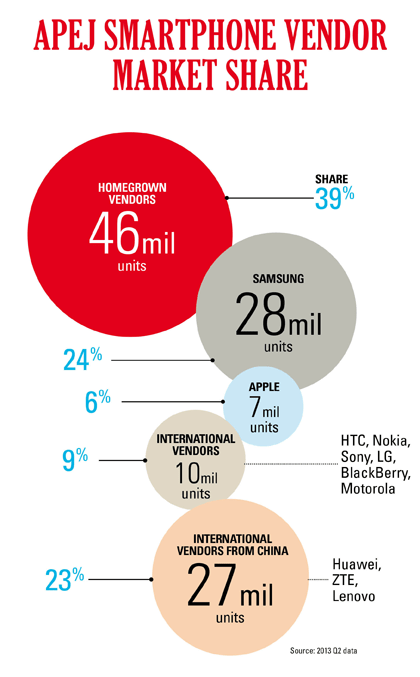
Homegrown brands are gaining more market share in the Asia-Pacific (excluding Japan) (APEJ) smartphone market. While Samsung continues to lead the smartphone pack, Apple fell out of the top five in the region for the first time. Chinese players — Lenovo, Coolpad, Huawei and ZTE — all outshipped Apple in the Q2, according to the IDC Asia/Pacific Quarterly Mobile Phone Tracker.
Limited land availability and high real estate prices are unlikely to make Hong Kong lose its status as a key data centre market in Asia Pacific, according to Frost & Sullivan.
The limitations are countered by the Hong Kong Government’s continuous support for the sector.
“Hong Kong’s strong political connection to Mainland China allows it to act as a gateway for global companies that seek to tap into opportunities in China’s market,” said Danni Xu, Research Analyst, ICT Practice, Asia Pacific at Frost & Sullivan. “Moreover, Hong Kong’s business-friendly and free-trade environment has drawn a number of multinational corporations (MNCs) to set up their regional headquarters in the country. This has brought in numerous investments and job opportunities, and created demand for data center services.”
The worldwide IT outsourcing (ITO) market is predicted to reach US$288 billion in 2013, a 2.8 percent increase from 2012, according to Gartner. Compared with Gartner’s previous forecast, nearly all ITO segments are now forecasted to grow more slowly this year.

Gartner’s forecast includes slight upward revisions for both custom application outsourcing and infrastructure utility services (IUS) for 2014 through 2017. Although software as a service (SaaS) impacts the ITO market, it is forecasted as part of the software market, rather than as part of the ITO market.
“We continue to see overall market growth being constrained by near-term market factors, such as evolving ITO delivery models, economic, political and labor conditions, and service provider financial performance,” said Bryan Britz, Research Vice President at Gartner. “Mature Asia/Pacific and Western Europe are the regions where the outlook is most tempered, partly due to currency but also reflective of our view that 2013 is likely to be similar to 2012 in these regions.”
Huawei is banking on the popularity of tablets among the younger generation with the launch of the Huawei MediaPad 7 Youth. Compact, sturdy and stylish with its aluminum metal unibody measuring just 9.9mm and weighing […]
UK online fashion and beauty store ASOS has selected the hybris Commerce Suite to launch its new e-commerce business in China. Providing an omni-channel experience for those 420 million potential customers, the site will include a fully-integrated, feature-rich mobile version.
With six million active customers, ASOS stocks more than 60,000 branded and own-label products through each of its websites: UK, USA, France, Germany, Spain, Italy, Australia, and Russia. It ships to 241 countries and territories from its 1.1 million square foot global distribution centre in the UK.
According to a report from eMarketer released in February 2013, this year’s B2C e-commerce sales are expected to grow 18.3 percent to US$1.298 trillion worldwide as Asia-Pacific (APAC) surpasses North America to become the world’s No. 1 market for B2C e-commerce.
Mobile communications is more than just a way of communications — it is impacting and driving economies in the Asia-Pacific (APAC) region.
According to GSMA’s ‘Mobile Economy: Asia Pacific 2013’ report, the region is at the forefront of mobile innovation, with the number of unique mobile subscribers having outpaced the rest of the world over the last decade, reaching 1.5 billion at the end of 2012.
In 2017, it is expected that APAC will reach 1.9 billion unique mobile subscribers, accounting for almost half of the predicted global total of 3.9 billion.

Source: GSMA’s Mobile Economy: Asia Pacific 2013’ report
ZTE has introduced the new MF90 4G uFi (unified WiFi) mobile hotspot device that delivers high-speed data access for mobile consumers via LTE wireless networks.
The MF90 supports simultaneous wireless data access by 10 users, and offers maximum data transmission speeds of 100Mbps. It is supported on mainstream 4G frequency bands globally, including Asia Pacific, and is backward compatible with 3G and 2G networks. The MF90 supports dual-band 2.4GHz/5GHz WiFi networks, WiFi 2X2 MIMO, and 802.11 b/g/n.
Offering improved power consumption capabilities compared with first-generation LTE uFi devices, the MF90’s 2300mAh battery supports four hours of continuous use, meeting the needs of most business users and consumers.
ZTE has overtaken Alcatel-Lucent to slot just behind leader Huawei in the global optical networking (ON) market. This is the first time that Chinese vendors are holding the top two ranks in ON, according to Ovum.
Ovum’s analysis of Q1 results in the US$14.5b global ON market has highlighted that growth in 100G remains a bright spot as annualised revenues exceeded $1b for the first time ever. However, market growth overall remains difficult and challenging equipment vendors with only Fujitsu posting sequential and year-over-year gains.
“While it is not uncommon for the market to decline going into the first calendar quarter, the decline is worrisome as this is the fifth straight time the market has declined versus the prior year’s quarter, and quarterly revenues are the lowest they’ve been in six years,” said Ron Kline, Network Infrastructure Analyst at Ovum.
ZTE has launched the ZTE MF823, the world’s smallest 4G LTE datacard, which offers fast and easy internet connectivity with driver-free capabilities.
The card uses Qualcomm’s second generation LTE chip platform and is only 13mm thick, nearly a third of the size of the first generation LTE datacard, making it the world’s smallest LTE datacard.
The MF823 has a web UI operation, supports IPV6 and is compatible with Win8/XP/Mac and all major operating systems. It supports LTE-FDD DL/UL 100/50Mbps, UMTS-HSPA+: DL/UL 42/5.76Mbps and GPRS/GSM downward compatibility allowing consumers to enjoy high speed internet access wherever they are without the need for a fixed line internet connect or public WiFi hotspot.