
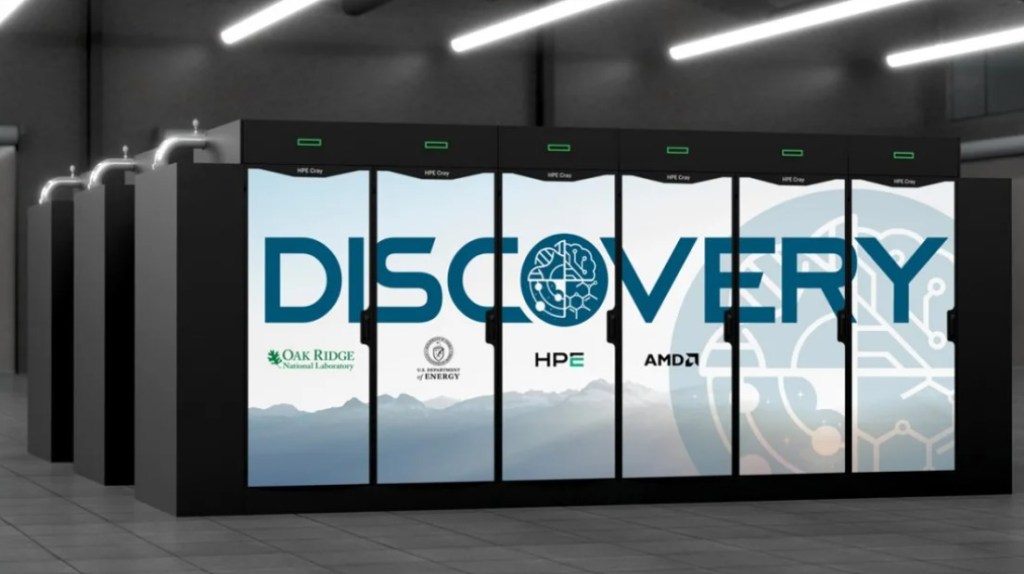
Hewlett Packard Enterprise (HPE), AMD and Oak Ridge National Laboratory (ORNL) have joined forces to launch the Discovery exascale supercomputer and the Lux AI cluster.
Discovery deepens AMD and HPE’s partnership with the Department of Energy (DOE) and ORNL, and builds on the performance foundation laid by Frontier, the world’s first exascale computer.
Scheduled to be operational by 2029, it features next-generation AMD EPYC Venice CPUs and the powerful AMD Instinct MI430X GPUs, a new accelerator designed specifically for sovereign American AI and scientific computing.
With its “Bandwidth Everywhere” memory and networking architecture, Discovery will deliver vastly heightened performance, energy efficiency and AI capabilities. Researchers will be able to train, simulate and deploy advanced AI models on systems built and operated in the US, safeguarding national data and scientific competitiveness.
Discovery’s architecture also ensures seamless transition for Frontier users, maintains comparable power costs with far greater compute output, and leverages open-source software and open standards to serve as a cornerstone for the developing American AI Stack.
“The Discovery system will drive scientific innovation faster and farther than ever before. With Discovery, the integration of high-performance computing and AI promises breakthroughs at the accelerated speed and scale necessary for continued US leadership in an increasingly competitive global environment,” said Stephen Streiffer, Director of ORNL.
Dedicated AI factory
Slated for deployment at ORNL in early 2026, the Lux AI supercomputer will be the US’ first dedicated AI factory for scientific research.
Developed collaboratively by ORNL, AMD, Oracle Cloud Infrastructure, and HPE, Lux features AMD Instinct MI355X GPUs, AMD EPYC CPUs and AMD Pensando advanced networking.
The system will support novel public and private partnerships by offering sovereign AI infrastructure and expanding access for US researchers pursuing breakthroughs in energy, medicine, manufacturing, and national security.
Lux is engineered for data-intensive, model-centric workloads and is expected to catalyse rapid AI-driven innovation in core areas such as energy, biology and materials science.
US Secretary of Energy Chris Wright described the Lux announcement as “the first example of a new commonsense approach to computing partnerships,” emphasising the role of private-public collaboration in accelerating the deployment of shared innovation.
Industry collaboration
Powered by AMD and HPE technologies, Discovery and Lux are supported by a combined US$1 billion investment in public and private funding.
These systems directly advance the US AI Action Plan to accelerate AI-enabled science, strengtheng national competitiveness, and build secure, standards-based sovereign infrastructure.
“Discovery and Lux will leverage AMD’s high-performance and AI computing technologies to advance the most critical US research priorities in science, energy, and medicine – demonstrating the power of public-private partnership at their best,” said Lisa Su, Chair and CEO of AMD.
“When we built Frontier for Oak Ridge National Laboratory and ushered in exascale, we achieved the pinnacle in supercomputing history and a triumph for the US. We are proud to build on that leadership innovation and strong public-private partnership with the US Department of Energy, ORNL and AMD, to build Discovery and Lux, accelerating the next era of scientific discovery and AI innovation,” said Antonio Neri, President and CEO of HPE.
 Entelechy Asia