
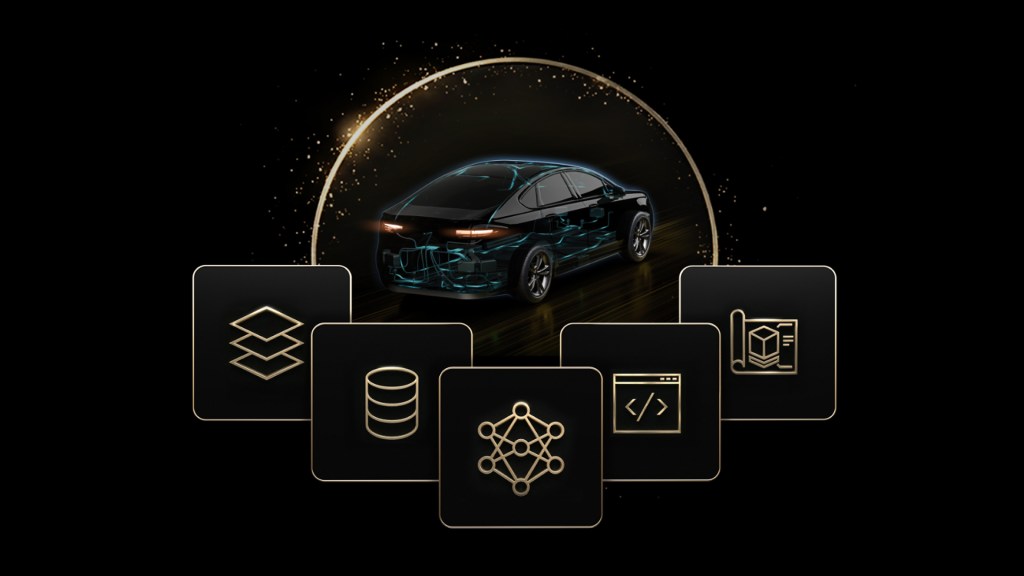
NVIDIA launched at CES 2026 the Alpamayo family featuring open-source AI models, simulation tools and datasets to boost autonomous vehicle (AV) development.
This ecosystem lets developers fine-tune massive teacher models into efficient onboard systems, backed by the NVIDIA Drive platforms.
Alpamayo 1 is a 10-billion-parameter vision-language-action (VLA) model that processes video inputs to output driving paths with step-by-step reasoning explanations.
AlpaSim offers an open-source simulator on GitHub for testing vehicles in realistic scenarios with accurate sensors and traffic.
Available on Hugging Face, Physical AI Open Datasets provide more than 1,700 hours of diverse driving footage from rare edge cases. These elements form a loop where developers fine-tune models, simulate tests and iterate for better performance.
“The ChatGPT moment for physical AI is here — when machines begin to understand, reason and act in the real world. Alpamayo brings reasoning to autonomous vehicles, allowing them to think through rare scenarios, drive safely in complex environments and explain their driving decisions — it’s the foundation for safe, scalable autonomy,” said Jensen Huang, Founder and CEO of NVIDIA.
Alpamayo is named after Nevado Alpamayo, the steep 5,947-metre mountain in Peru’s Cordillera Blanca range known for its treacherous climbing routes.
This reflects the tough “long-tail” scenarios in autonomous driving — such as rare weather or obstacles — that AI must navigate safely, akin to scaling the peak’s difficult terrain.
Companies such as Berkeley DeepDrive, JLR, Lucid Motors, and Uber endorse Alpamayo for tackling “long-tail” challenges — uncommon situations that stump traditional AI.
“The shift toward physical AI highlights the growing need for AI systems that can reason about real-world behaviour, not just process data. Advanced simulation environments, rich datasets and reasoning models are important elements of the evolution,” said Kai Stepper, Vice President of ADAS and Autonomous Driving at Lucid Motors.
“Handling long-tail and unpredictable driving scenarios is one of the defining challenges of autonomy. Alpamayo creates exciting new opportunities for the industry to accelerate physical AI, improve transparency and increase safe level 4 deployments,” said Sarfraz Maredia, Global Head of Autonomous Mobility and Delivery at Uber.
Level 4 autonomy means vehicles can drive on their own without human input, even in difficult conditions.
 Entelechy Asia