Category: Enterprise

Caffe2, anyone?

Facebook is developing new artificial intelligent (AI) systems to help manage the vast amount of information — such as text, images and videos — generated daily so people can better understand the world and communicate more effectively, even as the volume of information increases.

It has worked with NVIDIA on Caffe2, a new AI deep learning framework that allows developers and researchers to create large-scale distributed training scenarios and build machine learning applications for edge devices.

Providing AI-powered services on mobile is a complex data processing task that must happen within the blink of an eye. Increasingly, the processing of lightning-fast AI services requires GPU-accelerated computing, such as that offered by Facebook’s Big Basin servers, as well as highly optimised deep learning software that can leverage the full capability of the accelerated hardware.

No more IDF

After nearly two decades, Intel has decided to bring the curtains down on its annual Intel Developer Forum(IDF). Even the China edition has been canned. A highly anticipated and popular event, IDF was the platform […]

Rise of accelerated computing in data centres

Can’t say this was unexpected as NVIDIA retorts Google’s claim that its custom ASIC Tensor Processing Unit (TPU) was up to 30 times faster than CPUs and NVIDIA’s K80 G for inferencing workloads.

NVIDIA pointed out that Google’s  TPU paper has drawn a clear conclusion – without accelerated computing, the scale-out of AI is simply not practical.

The role of data centres has changed considerably in today’s economy. Instead of just serving web pages, advertising and video content, data centres are now recognising voices, detecting images in video streams and connecting users with information they need when they need it.

Massive shift to hybrid infrastructure services underway

The growth of cloud and industrialised services and the decline of traditional data centre outsourcing (DCO) indicate a massive shift toward hybrid infrastructure services, according to Gartner.

In a report containing a series of predictions about IT infrastructure services, Gartner analysts said that by 2020, cloud, hosting and traditional infrastructure services will come in more or less at par in terms of spending.

“As the demand for agility and flexibility grows, organizations will shift toward more industrialised, less-tailored options. Organisations that adopt hybrid infrastructure will optimise costs and increase efficiency. However, it increases the complexity of selecting the right toolset to deliver end-to-end services in a multisourced environment,” said DD Mishra, Research Director of Gartner.

APAC govt increasing investment in IoT technologies

Governments in Asia Pacific are notably vested in the Internet of Things (IoT) technologies because it enables a broad new range of citizen services, according to IDC’s 2016 Global IoT Decision Maker Survey.

Based on the survey, 40 percent of Asia-Pacific government organisations are investing on IoT solutions in the next 12 months while 50 percent of them are investing in an IoT solution in next 12 to 24 months.

“Improving productivity, improving time to market for products/services and improving energy efficiency reducing costs are the top benefits of an IoT solution. IoT enables access to new and granular data sources, empowered by swift connectivity and quick data gathering capability giving access to a wider range of information that enhances the quality of government services at a scale, which previously has been thought to be unattainable,” said Shreyashi Pal, Market Analyst, IDC Asia/Pacific Government and Education Insights.

Singapore universities deploy deep learning supercomputers

First, it was Singapore Management University (SMU). Now two other Singapore universities — Singapore University of Technology and Design (SUTD) and Nanyang Technological University (NTU) — have also deployed the NVIDIA DGX-1 deep learning supercomputer for their research projects on artificial intelligence (AI).

SUTD will use the DGX-1 at the SUTD Brain Lab to further research into machine reasoning and distributed learning. Under a memorandum of understanding signed earlier this month, NVIDIA and SUTD will also set up the NVIDIA-SUTD AI Lab to leverage the power of GPU-accelerated neural networks for researching new theories and algorithms for AI. The agreement also provides for internship opportunities to selected students of the lab.

“Computational power is a game changer for AI research, especially in the areas of big data analytics, robotics, machine reasoning and distributed intelligence. The DGX-1 will enable us to perform significantly more experiments in the same period of time, quickening the discovery of new theories and the design of new applications,” said Professors Shaowei Lin and Georgios Piliouras, Engineering Systems and Design, SUTD.

NVIDIA and Microsoft to accelerate AI cloud computing

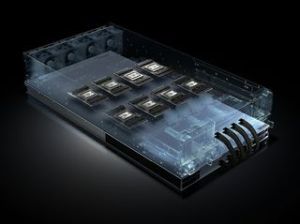
NVIDIA and Microsoft are working on a new hyperscale GPU accelerator that will provide hyperscale data centres with a fast, flexible path for artificial intelligence (AI).

The new HGX-1 hyperscale GPU accelerator is an open-source design released in conjunction with Microsoft’s Project Olympus.

HGX-1 does for cloud-based AI workloads what ATX — Advanced Technology eXtended — did for PC motherboards when it was introduced more than two decades ago. It establishes an industry standard that can be rapidly and efficiently embraced to help meet surging market demand.

Fuji Xerox HK to accelerate IoT growth

fuji-xerox-smart-device-2-0

Fuji Xerox (Hong Kong) aims to ride the Internet of Things (IoT) wave with the introduction of Smart Device 2.0, which comprises three key IoT components — cloud application, big data analytics and integrated business workflow.

The new-generation mobile document management smart device consisting of hardware, software and cloud applications is designed particularly for enterprises that handle and manage excessive documents, such as financial and banking, construction and legal industries.

Smart Device 2.0 also works for enterprises and small-to-medium businesses with staff who always work on their mobile devices, because it enables the same working environment regardless of where they are. This smart device is becoming a workplace necessity that streamline workflow; employees are no longer bound by geographical restrictions and can stay connected to their office all the time, helping enterprises save time and costs, and better use their resources.

Gunning for supercomputing supremacy in Japan

tsubame-3-0

Tokyo Institute of Technology plans to create Japan’s fastest AI supercomputer, which is will deliver more than twice the performance of its predecessor to slide into the world’s top 10 fastest systems.

Called Tsubame 3.0, it will use Pascal-based NVIDIA P100 GPUs that are nearly three times as efficient as their predecessors, to reach an expected 12.2 petaflops of double precision performance.

Tsubame 3.0 will excel in AI computation with more than 47 PFLOPS of AI horsepower. When operated with Tsubame 2.5, it is expected to deliver 64.3 PFLOPS, making it Japan’s highest performing AI supercomputer.

Enter Pascal-based Quadro cards

NvidiaNVIDIA has introduced a range of Pascal-based Quadro products that transforms desktop workstations into supercomputers with breakthrough capabilities for professional workflows across many industries.

Workflows in design, engineering and other areas are evolving rapidly to meet the exponential growth in data size and complexity that comes with photorealism, virtual reality and deep learning technologies.

To tap into these opportunities, the new NVIDIA Quadro Pascal-based lineup – the GP100, P4000, P2000, P1000, P600, and P400 – provides an enterprise-grade visual computing platform that streamlines design and simulation workflows with up to twice the performance of the previous generation, and ultra-fast memory.

Public cloud service in mature APAC region to hit US$10b in 2017

GartnerThe public cloud services market in the mature Asia-Pacific (APAC) region — Australia, New Zealand, Singapore and South Korea — is forecast to grow 17.7 percent in 2017 to total US$10 billion, up from US$8.5 billion in 2016, according to Gartner.

By 2019, Gartner predicts that total public cloud services spending in these countries will rise to US$13.6 billion.

Public cloud services are shared, meterable, elastic and scalable multi-tenanted IT offerings delivered as a subscription-based service to external customers using internet technologies.

1 in 5 user interaction with smartphone will be via VPAs in 2019

google-nowAdvances in various technologies will drive users to interact with their smartphones in more intuitive ways, said Gartner. It expect that, by 2019, 20 percent of all user interactions with the smartphone will take place via virtual personal assistants (VPAs).

“The role of interactions will intensify through the growing popularity of VPAs among smartphone users and conversations made with smart machines,” said Annette Zimmermann, Research Director of Gartner.

Gartner’s annual mobile apps survey conducted in Q4 among 3,021 consumers across three countries (US, UK and China) found that 42 percent of respondents in the US and 32 percent in the UK used VPAs on their smartphones in the last three months. More than 37 percent of respondents (average across US and UK) used a VPA at least one or more times a day.

Read More

SMU uses NVIDIA DGX-1 supercomputer for food recognition project

salted-egg-yolkd-prawnsSingapore is renowned as a food paradise. And with so many mouth-watering dishes to pick from, sometimes even locals have difficulty identifying a specific dish.

Singapore Management University (SMU) is working on a food artificial intelligence (AI) application that is calling on a supercomputer to help with recognising the local dishes to achieve smart food consumption and healthy lifestyle.

The project, developed as part of Singapore’s Smart Nation initiative, requires the analysis of a large number of food photos.

Read More

Fuji Xerox Hong Kong announces Smart Device 2.0

????????????????????????????????????

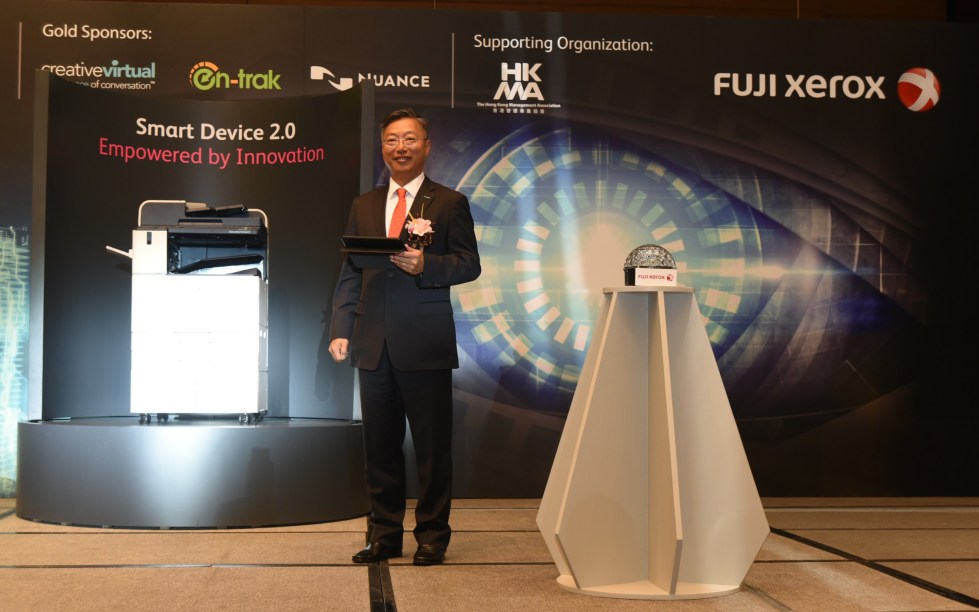
Fuji Xerox (Hong Kong) has launched Smart Device 2.0, a new document management smart device that lets businesses achieve smoother workflow as well as higher operational efficiency and productivity by 25 percent. It also helps companies address information technology challenges in a comprehensive manner.

Smart Work Gateway is a brand-new concept that swiftly interconnects cloud network, Smart Device 2.0 and user’s personal mobile device. Office employees can enjoy unprecedented convenience of connecting to their workplace anytime, anywhere. Work is no longer bounded by time or place.

“The all-new Smart Device 2.0, empowered by Smart Work Gateway, truly redefines the ‘smart workplace’ with user-centric and intuitive features, enabling enterprises to not only work smarter, but also build competitive edge and sustainable growth,” said Herbert Hui, Managing Director, Fuji Xerox (Hong Kong) (above).


As the next generation of Smart Device, the Smart Device 2.0 is analytics enabled, cloud enabled and business process enabled – all without the need for server support. Along with high scanning and printing speed, the redesigned multi-functional smart device features a brand-new Super EA-Eco Toner that delivers unrivaled print quality across large printing volumes, ensuring collateral produced will simultaneously achieve consistent quality, higher productivity and cost optimisation.

NVIDIA DGX SATURNV ranked most efficient supercomputer

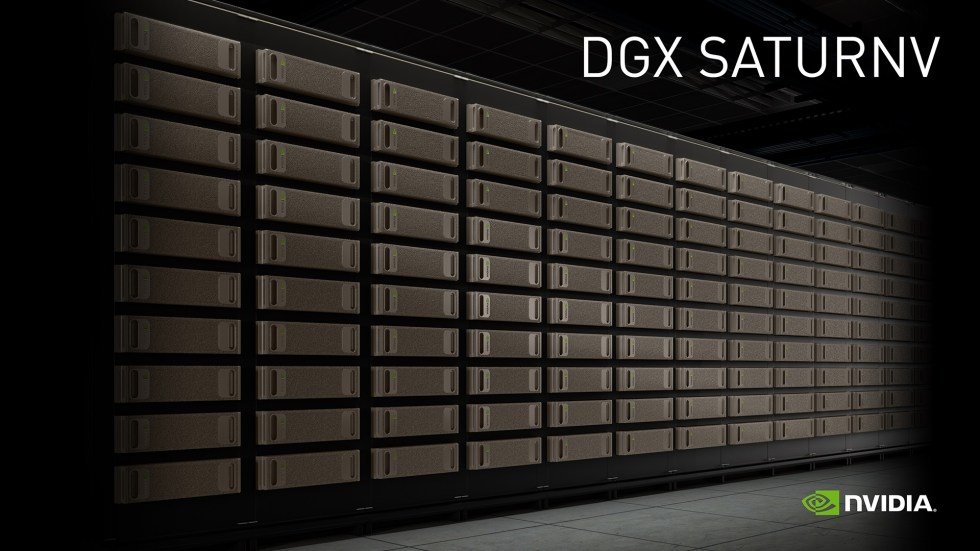
nvidia_dgx_saturnvNVIDIA’s new DGX SATURNV supercomputer is ranked the world’s most efficient — and 28th fastest overall — on the latest Top500 list of supercomputers.

Powered by new Tesla P100 GPUs, it delivers 9.46 gigaflops/watt — a 42 percent improvement from the 6.67 gigaflops/watt delivered by the most efficient machine on the Top500 list released last June.

Compared with a supercomputer of similar performance, the Camphore 2 system, which is powered by Xeon Phi Knights Landing, SATURNV is 2.3x more energy efficient.hat efficiency is key to building machines capable of reaching exascale speeds — that’s 1 quintillion, or 1 billion billion, floating-point operations per second. Such a machine could help design efficient new combustion engines, model clean-burning fusion reactors, and achieve new breakthroughs in medical research.

Worldwide services market to cross US$1 trillion mark by 2018

IDCGlobal IT services and business services revenues are expected to cross the US$1 trillion mark for the first time in 2018, according to IDC.

Worldwide services spending totals for 2016 are expected to stay within the US$900 billion range and by 2020 expected to near US$1.1 trillion.

With more than US$100 million worth of spending each this year, the largest services markets will be key horizontal business process outsourcing (BPO) and systems integration services, which will also generate the largest revenue pools over the 2016-2020 forecast period. Business Consulting Services is forecast to outpace both markets in terms of growth.

Alibaba Cloud rises 128% in Q3

Alibaba Cloud has outpaced cloud service provider leaders with growth of 128 percent to reach US$221 million in Q3. However, AWS increased its lead, accounting for 32.2 percent of total spend, followed by Microsoft Azure with 17.3 percent and Google Cloud with 7.6percent, according to Canalys. Both Microsoft (up 115.6 percent) and Google (up 79.6 percent) grew faster than Amazon.

Global cloud infrastructure services expenditure increased 53.1 percent year on year to reach US$10 billion for the first time in Q.

“Alibaba has established itself as the largest e-commerce business in China and is starting to dominate the provision of cloud infrastructure services in the country,” said Daniel Liu, Research Analyst of Canalys.

Fuji Xerox launches next-generation printers in Hong Kong

fuji-xerox-docuprint-p365-d-and-c315-seriesFuji Xerox (Hong Kong) has introduced three printers — DocuPrint CP315 dw and CM315 z colour printers and the DocuPrint P365 d monochrome laser printer.

Designed for small- to medium-sized enterprises (SMEs), they offer high-performance print technology, outstanding usability and flexibility, and features to reduce their impact on the environment.

“We are thrilled to introduce the DocuPrint C315 series and DocuPrint P365 d, which offer a host of new technology, productivity and cost-saving features for SMEs. Designed with the needs of SMEs in mind, the DocuPrint C315 series leverages Fuji Xerox’s award-winning CCSLED technology and includes a new Super-EA ECO toner to deliver unrivaled print quality in a small, stylish footprint. Meanwhile, with features that mimic those of large enterprise printers, DocuPrint P365 d provides the best of both worlds to ensure lower running costs and efficiency are prioritised,” said Lee Cheung, Director, Printer Channels, Fuji Xerox (Hong Kong) Limited.


Gearing up for the next industrial revolution

BabyX is a computer generated simulation of an infant who learns and interacts in real time using AI.

By Edward Lim

It’s been a long time coming but the next industrial evolution, dubbed the Fourth Industrial Revolution is nearly, if not already here.

Each revolution since the first led by water and steam power used to mechanise production in 1784 has been driven by technology in various forms. The Second Industrial Revolution leveraged electric power for mass production while the Third Industrial Revolution used electronics and information technology to automate production.

The next revolution builds on an increasingly digital economy and the fusion of various technologies, including the Internet, which is shaping the way people live, work, play, and relate to one another.

NVIDIA unleashes palm-sized AI computer for autonomous vehicles

nvidia-drive-px2-for-autocruiseNVIDIA has unveiled a palm-sized, energy-efficient artificial intelligence (AI) computer that car makers can use to power automated and autonomous vehicles for driving and mapping.

The new single-processor configuration of the NVIDIA DRIVE PX 2 AI computing platform for AutoCruise functions — which include highway automated driving and HD mapping — consumes just 10 watts of power and enables vehicles to use deep neural networks to process data from multiple cameras and sensors. It will be deployed by China’s Baidu as the in-vehicle car computer for its self-driving cloud-to-car system.

DRIVE PX 2 enables car makers and their tier 1 suppliers to accelerate production of automated and autonomous vehicles. A car using the small form-factor DRIVE PX 2 for AutoCruise can understand in real time what is happening around it, precisely locate itself on an HD map and plan a safe path forward.

Baidu and NVIDIA team up on self-driving car

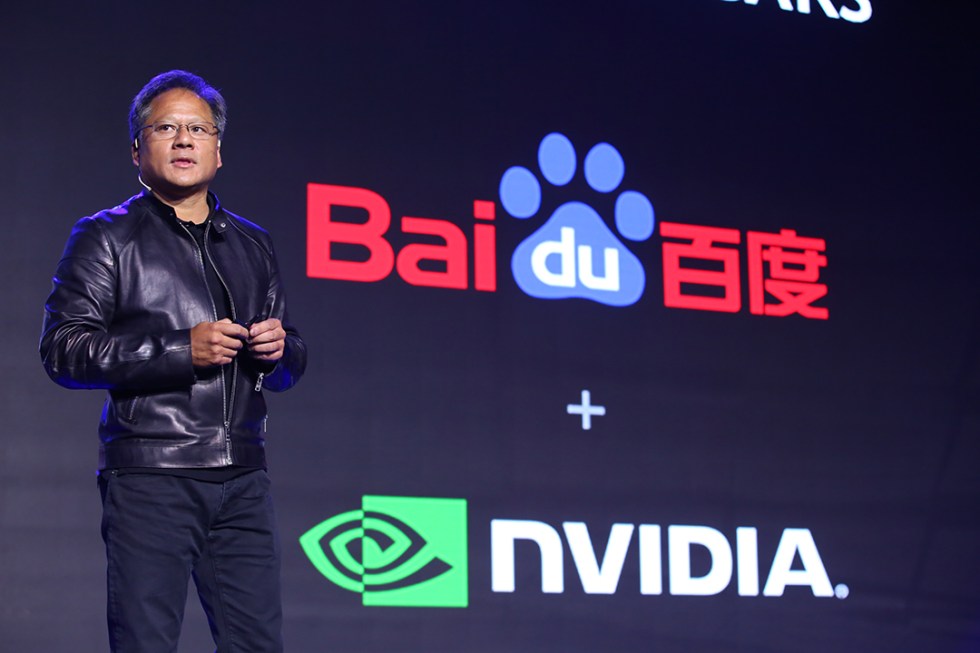
NVIDIA CEO Jen-Hsun Huang makes the announcement at Baidu World Conference in Beijing.

Baidu and NVIDIA are partnering to leverage artificial intelligence (AI) to create a cloud-to-car autonomous car platform for Chinese and global car makers. The partnership combines Baidu’s cloud platform and mapping technology with NVIDIA’s self-driving computing platform to develop solutions for HD maps, Level 3 autonomous vehicle control and automated parking.

Baidu CEO Robin Li and NVIDIA CEO Jen-Hsun Huang announced the collaboration at Baidu World Conference in Beijing yesterday.

“We’re going to bring together the technical capabilities and the expertise in AI and the scale of two world-class AI companies to build the self-driving car architecture from end-to-end, from top-to-bottom, from the cloud to the car,” said Huang .

3D printing market to cross US$35b in 2020

IDC3D printing continues to gain traction globally and the market is expected to more than double to reach US$35.4 billion in 2020, according to IDC.

While 3D printers and materials will represent nearly half the total worldwide revenues throughout the IDC forecast, software and related services will also experience significant growth.

Revenues for computer-aided design (CAD) software are forecast to triple over the five-year forecast period while the market for on-demand parts services will nearly match this growth. The gains in both software and on-demand parts printing are being driven by the rapidly expanding use of 3D printing for design prototyping and products that require a high degree of customization in non-traditional environments.

Worldwide semiconductor spending to dip 0.7% in 2016

GartnerWorldwide semiconductor capital spending is expected to slide 0.7 percent in 2016, to US$64.3 billion, according to Gartner. This is up from the estimated 2 percent decline in Gartner’s previous quarterly forecast.

“Economic instability, inventory excess, weak demand for PC’s, tablets, and mobile products in the past three years has caused slow growth for the semiconductor industry. This slowdown in electronic product demand has driven semiconductor device manufacturers to be conservative in increasing production,” said David Christensen, Senior Research Analyst of Gartner.

“Looking ahead, it appears the second half of 2016 may see improved demand. However, following Brexit, semiconductor inventory levels may rise in the third and fourth quarters, which could lead to reduced production volumes,” he added.

Enterprises driving AR market

Pokemon GoPokemon Go is taking the world by storm with its use of augmented reality (AR). The craze has received widespread publicity across the world as hordes of people go around in search of Pokemon using their mobile devices.

AR is also set to leave footprint in the enterprise market. ABI Research forecasts that AR in enterprise will explode over the next five years, as the technology will add functionality to existing workforces that was not previously possible, with remote assistance to be the primary use case.

Combined with increased safety and efficiency, this will drive investors and project managers to explore AR with smart glasses applications in the healthcare, industry, and government market segments forecast to hit 27 million shipments by 2021.

Security software market up 3.7% in 2015

GartnerWorldwide security software revenue hit US$22.1 billion in 2015, a 3.7 percent increase in from 2014, according to Gartner.

Security information and event management (SIEM) remained the fastest-growing segment in 2015, with 15.8 percent growth, while consumer security software showed the sharpest decline at 5.9 percent year on year.

In 2015, the top five vendors together accounted for 37.6 percent of the security software revenue market share, down 3.1 percentage points from 2014. These vendors also displayed a collective decline of 4.2 percent in 2015, while the rest of the market (Others) grew strongly at 9.2 percent year on year.

Worldwide IT spending to be flat in 2016

GartnerWorldwide IT spending is forecast to be flat in 2016, totaling US$3.41 trillion, according to Gartner, Inc. This is up from last quarter’s forecast of negative 0.5 percent growth. The change in the forecast is mainly due to currency fluctuations.

“The current Gartner Worldwide IT Spending Forecast assumes that the UK would not exit the European Union. With the UK’s exit, there will likely be an erosion in business confidence and price increases which will impact UK, Western Europe and worldwide IT spending,” said John-David Lovelock, Research Vice President of Gartner.

While the UK has embarked on a process to change, that change is yet to be defined. The “leave” vote will quickly affect IT spending in the UK and in Europe while other changes will take longer. Staff may be the largest immediate issue. The long-term uncertainty in work status will make the UK less attractive to new foreign workers. Retaining current non-UK staff and having less access to qualified new hires from abroad will impair UK IT Departments.

India public cloud services to hit US$1.26b in 2016

GartnerThe public cloud services market in India is projected to grow 30.4 percent in 2016 to hit US$1.26 billion, according to Gartner.

The highest growth will come from cloud system infrastructure services (infrastructure as a service [IaaS]), which is projected to grow 32.5 percent in 2016, with platform as a service (PaaS) projected to grow 31.7 percent.

“We are witnessing a shift from legacy IT services to cloud-based services. Cloud services are growing due to organizations pursuing a digital business strategy,” said Sid Nag, Research Director of Gartner.

Half of CEOs expects substantial digital transformation in their industries

GartnerDespite a slowing global economy, CEOs are still making business growth their top priority in 2016, according to a Gartner survey.  After growth (54 percent), the second and third business priorities are customers (31 percent) and workforce (27 percent).

The Gartner CEO and senior business executive survey of 400 senior business leaders in user organisations worldwide was conducted in the fourth quarter of 2015, asking questions about 2016/2017. Most responding organisations were those with annual revenue of US$1 billion or more. The survey results show that while business conditions are challenging, CEOs remain confident enough to sanction strategic investments, particularly when it comes to digital business transformation.

“The big rise of explicit mentions of the word ‘customer’ was very noticeable in the results of this year’s survey, “CEOs seem to be concerned about improving customer service, relationship and satisfaction levels. At the same time, CEOs have become much more concerned about employee issues than a couple of years ago. The emphasis is as much on benefits, retention and training of mainstream staff. It is not constrained only to senior grade ‘talent’ issues,” said Mark Raskino, Vice President and Gartner Fellow.

PC shipment down 9.6% in Q1

GartnerWorldwide PC shipment shed 9.6 percent to 64.8 million in Q1, according to Gartner. This was the sixth consecutive quarter of PC shipment declines, and the first time since 2007 that shipment volume fell below 65 million units.

In the Asia-Pacific, PC shipment dropped 5.1 percent to 23.3 million units. The ongoing fragile Chinese economy and weak global demand continued to dampen consumer sentiment in the region.

With high PC penetration in the major cities, it was a challenge to invoke PC replacements on the appeal of new technology. The PC life cycle is lengthening as many consumers are waiting until their PC breaks down before purchasing a new one.

IBM and Mastercard to collaborate on market analytics for smaller merchants

IBM logoIBM and MasterCard are partnering to offer smaller merchants real-time, analytics-based market insights on revenue, market share, customer demographics and competitors in a particular location and across multiple locations.

The solution integrates IBM Watson Analytics with insights based on aggregated and anonymised MasterCard transaction data through MasterCard Advisors Local Market Intelligence (LMI).

According to MasterCard’s latest research, more than seven out of 10 smaller businesses in Asia-Pacific expect higher business costs in 2016.  With this enhanced analytical platform powered by MasterCard Advisors and IBM, merchants will hence be better equipped to make informed decisions that lower costs based on a deeper knowledge of their business’ financial strengths and pitfalls.

Pascal-based NVIDIA Tesla P100 delivers 12 times performance of previous generation accelerator

NVIDIA Tesla P100NVIDIA has introduced the NVIDIA Tesla P100 GPU, an advanced hyperscale data centre accelerator that can enable a new class of servers that can deliver the performance of hundreds of CPU server nodes.

Today’s data centres process large numbers of transactional workloads, such as web services. But they are inefficient at next-generation artificial intelligence and scientific applications, which require ultra-efficient, lightning-fast server nodes.

Based on the new NVIDIA Pascal GPU architecture, the Tesla P100 provides the performance and efficiency needed to power the computationally demanding applications. It delivers over a 12x increase in neural network training performance compared with a previous-generation NVIDIA Maxwell-based solution.

NVIDIA unveils world’s first deep learning supercomputer

NVIDIA DGX-1

At his opening keynote address at GTC in San Jose, Jen-Hsun Huang, CEO of NVIDIA made a slew of announcements, including the world’s first deep learning supercomputer to meet the unlimited computing demands of artificial intelligence (AI).

As the first system designed specifically for deep learning, the NVIDIA DGX-1 comes fully integrated with hardware, deep learning software and development tools for quick, easy deployment. It is a turnkey system that contains a new generation of GPU accelerators, delivering the equivalent throughput of 250 x86 servers.

The DGX-1 deep learning system enables researchers and data scientists to easily harness the power of GPU-accelerated computing to create a new class of intelligent machines that learn, see and perceive the world as humans do. It delivers unprecedented levels of computing power to drive next-generation AI applications, allowing researchers to dramatically reduce the time to train larger, more sophisticated deep neural networks.

Global semiconductor market drops 2.3 percent in 2015

GartnerWorldwide semiconductor revenue declined 2.3 percent to US$334.8 billion in 2015, according to final results by Gartner.

The combined revenue of the top 25 semiconductor vendors fell by 0.5 percent during 2015. This was a better performance than the rest of the market, however, which saw a 6.9 percent revenue decline. The top 25 vendors accounted for 73.5 percent of the market, down slightly from 74 percent in 2014.

“The worldwide semiconductor market declined in 2015 as slowing demand for key applications combined with strong currency fluctuations to subdue the market. 2015 saw a mixed performance by the different device categories, unlike 2014 when all categories posted positive growth. Non-optical sensors performed best due to increased usage of fingerprint sensors in smartphones, while discretes saw the strongest decline due to a mix of weak demand and currency issues,” said Andrew Norwood, Research Vice President of Gartner.

APAC bucks thin and terminal client down trend

IDCThe economic gloom has hit the global enterprise client device market comprising thin and terminal clients. The market was down 6.8 percent in Q4, bringing 2015 decline to 6.9 percent, according to IDC.

This was due to project cutback or delay in the face of a faltering economic outlook and reduced public budgets.

The Asia-Pacific region (excluding Japan) provided the only bright spark in the downturn, growing just over 10 percent in 2015.

PC revival! Chromebooks and ultraportable PCs to lead charge

abi researchThe personal computer (PC) is still alive and breathing. According to ABI Research, 163 million notebook PCs shipped globally in 2015.

The majority were laptops, which constituted nearly 80 percent of the category. The data suggests that despite a floating myth speculating that it will only be a matter of time before PCs meet their demise, the market is still going strong and shows no sign of slowing down in the immediate future.

“Industry experts greatly exaggerated the death of the PC. The platform is continuing to evolve its designs to provide flexibility for productivity purposes, while also adapting its shape to support tablet-like, touch applications. Chromebooks and ultraportable PCs will continue to drive the most growth within the notebook PC market,” said Jeff Orr, Research Director of ABI Research.

Monash University launches M3 to accelerate research

M3 launch
Australian Chief Scientist Alan Finkel AO and Monash Professor Ian Smith get ready to press the red button to launch M3.

Monash University is taking research to another level with the launch of M3, the third-generation supercomputer available through the MASSIVE (Multi-modal Australian ScienceS Imaging and Visualisation Environment) facility.

Powered by ultra-high-performance NVIDIA Tesla K80 GPU accelerators, M3 will provide new simulation and real-time data processing capabilities to a wide selection of Australian researchers.

“Our collaboration with NVIDIA will take Monash research to new heights. By coupling some of Australia’s best researchers with NVIDIA’s accelerated computing technology we’re going to see some incredible impact. Our scientists will produce code that runs faster, but more significantly, their focus on deep learning algorithms will produce outcomes that are smarter,” said Professor Ian Smith, Vice Provost (Research and Research Infrastructure), Monash University.

Oil gloom, data centre bloom

Oversupply of oil in the global economy is set to accelerate data centre investment, according to Canalys, which forecasted that the large data centre segment will grow eight percent in 2016 as enterprises and service providers become more ambitious with the size of their facilities.

Oil prices have declined more than 70 percent since mid-2014, and will remain low as production ramps up across the US and Middle East. Data centres, with their monolithic energy consumption, will benefit from cheaper electricity as wholesale gas prices decline. Investment will focus on larger facilities, as energy becomes less of a constraint on operating costs.

Cheaper oil will accelerate a market that is already growing. Pre-eminent cloud service providers have already reacted to data sovereignty concerns by investing in the expansion of their global cloud footprint. This will continue and industry standard servers, network security and virtualisation technologies will become key growth categories. Incumbent data centre infrastructure vendors will pivot their focus towards high-end large and hyperscale facilities, but will face stiff competition from cheaper ODM alternatives.

Worldwide IT spending to remain flat this year

GartnerThe global economy is hitting IT spending, with Gartner predicting just a 0.6 percent increase over 2015 spending of US$3.52 trillion.

2015 saw the largest US dollar drop in IT spending since Gartner began tracking IT spending. US$216b less was spent on IT in 2015 than in 2014 and 2014 spending levels won’t be surpassed until 2019.

“The rising US dollar is the villain behind 2015 results. US multinationals’ revenue faced currency headwinds in 2015. However, in 2016 those headwinds go away and they can expect an additional five percent growth,” said John-David Lovelock, Research Vice President of Gartner.

Semiconductor market drops 1.9% in 2015

GartnerWorldwide semiconductor revenue was US$333.7 billion in 2015, a 1.9 percent decrease from 2014 revenue of US$340.3 billion, according to Gartner.

The top 25 semiconductor vendors’ combined revenue increased 0.2 percent, which was more than the overall industry’s growth. They also accounted for 73.2 percent of total market revenue, up from 71.7 percent in 2014.

“Weakened demand for key electronic equipment, the continuing impact of the strong dollar in some regions and elevated inventory are to blame for the decline in the market in 2015,” said Sergis Mushell, Research Director of Gartner.

NVIDIA adds AI and supercomputing prowess to driverless cars

DRIVE PX_illustrationThe new NVIDIA DRIVE PX 2 is set to give driverless cars a major boost.

Touted at the world’s most powerful engine for in-vehicle artificial intelligence, it allows the automotive industry to use artificial intelligence (AI) to tackle the complexities inherent in autonomous driving. NVIDIA DRIVE PX2 utilises deep learning on NVIDIA’s advanced GPUs for 360-degree situational awareness around the car, to determine precisely where the car is and to compute a safe, comfortable trajectory.

“Drivers deal with an infinitely complex world. Modern artificial intelligence and GPU breakthroughs enable us to finally tackle the daunting challenges of self-driving cars,” said Jen-Hsun Huang, Co-founder and CEO of NVIDIA. “NVIDIA’s GPU is central to advances in deep learning and supercomputing. We are leveraging these to create the brain of future autonomous vehicles that will be continuously alert, and eventually achieve superhuman levels of situational awareness. Autonomous cars will bring increased safety, new convenient mobility services and even beautiful urban designs – providing a powerful force for a better future.”

China to surpass the US in 3D printer market

IDCChina is set to overtake the US to become the biggest 3D printer market this year.

3D printer shipments in the China market passed 34,000 units in 2014, and is expected to reach 77,000 units in 2015, a growth rate over 120 percent, according to IDC.

This growth rate is largely driven by sales of desktop 3D printers priced under US$5,000. As the Chinese government continue to promote 3D printer awareness and usage within schools and educational institutions, the desktop 3D printer market is expected to maintain an annual growth trend in the coming years.

First green data centre thermal management solution to debut in Hong Kong

NTTNTT Communications’ new data centre cooling technology will debut at Hong Kong Financial Data Center Tower 2 (FDC2) in December. The first green thermal management solution in Hong Kong will feature a new front-flow cooling system (AHU) designed to optimise both energy usage and cost of the data centre, increasing energy efficiency by more than 20 percent compared with traditional cooling systems.

The innovative front-flow cooling system, a custom air handling and Fay Array CRAH launched in partnership with Emerson Network Power, is designed to keep power consumption to a minimum while ensuring the data center stays online and is reliable at all time. This benefits enterprise users that leverage lower energy costs to build a competitive business edge.

“With power consumption accounting for a major operating expense of data centers today, we have recognised that enhancing energy efficiency would be a top priority when we incorporate a high density design within the soon-to-be launched FDC2. We are confident that our new AHU will change the way data centers are designed, and help our clients drive business performance by optimising costs in the long term,” said Taylor Man, Executive Vice President, Cloud Business Division, NTT Com Asia.

Accelerated systems account for more than 20% of TOP500 supercomputers


NVIDIAAccelerated systems, or GPU-powered systems, for the first time accounted for more than 100 on the list of the world’s 500 most powerful supercomputers. That’s a total of 143 petaflops, over one-third of the list’s total FLOPS.

NVIDIA Tesla GPU-based supercomputers comprise 70 of these systems – including 23 of the 24 new systems on the list – reflecting compound annual growth of nearly 50 percent over the past five years.

There are three primary reasons accelerators are becoming increasingly adopted for high performance computing.

  1. Moore’s Law continues to slow, forcing the industry to find new ways to deliver computational power more efficiently.
  2. Hundreds of applications – including the vast majority of those most commonly used – are now GPU accelerated.
  3. Even modest investments in accelerators can now result in significant increases in throughput, maximising efficiency for supercomputing sites and hyperscale datacentres.

Omni-channel communications gaining traction in APAC

frost and sullivanWhile voice interaction remains the primary communication channel in contact centres, the concept of an omni-channel is gaining popularity in Asia-Pacific, according to Frost & Sullivan.

With smartphone penetration and social media usage on the rise, an increasing number of organisations are working closely with system integrators and independent software vendors to implement the omni-channel platform. Their objective is to overcome the existing silo nature of communication channels and provide a consistent and seamless customer experience across voice, email, SMS, Web-chat, social media and real-time video interactions. In response, contact centers are transforming into ‘customer engagement centers’ with multi-channel strategies that are tightly integrated with mobile applications and self-service capabilities.

According to Frost & Sullivan, the market earned revenues of US$699.5 million in 2014 and is estimated to reach US$952.9 million in 2021 with a compound annual growth rate of 4.5 percent. The study covers automatic call distributors, outbound systems, computer telephony integration, interactive voice response, workforce management, call monitoring, speech technology and multimedia systems. Workforce optimisation and analytics are expected to lead revenue growth across these segments, driven by the continuous focus on contact centre operation performance management.

NVIDIA Jetson TX1 powers machine learning

Jetson_TX1 moduleAs the first embedded computer designed to process deep neural networks, the new NVIDIA Jetson TX1 is set to enable a new wave of smart devices. Drones will evolve beyond flying by remote control to navigating through a forest for search and rescue. Security surveillance systems will be able to identify suspicious activities, not just scan crowds. Robots will be able to perform tasks customised to individuals’ habits.

That’s what the credit-card sized module can do. It can harness the power of machine learning to enable a new generation of smart, autonomous machines that can learn.

Deep neural networks are computer software that can learn to recognise objects or interpret information. This new approach to program computers is called machine learning and can be used to perform complex tasks such as recognising images, processing conversational speech, or analysing a room full of furniture and finding a path to navigate across it. Machine learning is a groundbreaking technology that will give autonomous devices a giant leap in capability.

Alibaba joins Microsoft and AWS as leaders in China cloud market

ForresterThe public cloud market in China will more than double in the next five years, from US$1.8 billion this year to US$3.8 billion in 2020, according to Forrester.

Two-thirds of Chinese software decision-makers surveyed by Forrester are making increased use of public cloud platforms a top priority over the next 12 months.

Enterprise public cloud platform vendors in China are improving in terms of their service diversity, simple abstraction for operational efficiency, and operational autonomy for on-demand elasticity. Forrester has evaluated the strengths and weaknesses of 11 cloud vendors Alibaba, AWS, ChinaC, DaoCloud, JD.com, Microsoft, MoPaaS, QingCloud, Tencent, UCloud, and UnitedStack.

NetApp Data Fabric enables seamless data management in hybrid cloud

NetAppNetApp has announced new Data Fabric solutions and services that deliver the data management capabilities organisations need to accelerate success in the hybrid cloud era.

With the new offerings, organisations can seamlessly manage data across whatever IT resource they choose, speeding innovation and enabling better business decisions.

“Management of digital data is essential for organisations to innovate faster and capture new revenue opportunities in a fast changing technology landscape,” said Lee Caswell, Vice President, Product, Solutions and Services Marketing, NetApp.

NVIDIA GRID 2.0 available in Australia

NVIDIAFollowing its announcement at VMworld in August, NVIDIA GRID 2.0 is now available in Australia.

The performance, efficiency and flexibility improvements in the latest release of NVIDIA GRID mean enterprise businesses can now deliver even the most graphics-intensive applications to any connected device virtually.

With NVIDIA GRID 2.0, employees can work from almost anywhere without delays in downloading files, increasing their productivity. IT departments can equip workers with instant access to powerful applications, improving resource allocation. And data can be stored more securely in a central server, rather than on individual systems.


9 IT CEOs make Harvard Business Review Top 100 list

HBRHarvard Business Review has included nine CEOs of IT companies among its Top 100 Best Performing CEOs in the world.

Slotting in among the top 50 are Cisco’s John Chambers (#2), Seagate Technology’s Stephen Luczo (#5), Canon’s Fujio Mitarai (#10), NVIDIA’s Jen-Hsun Huang (#29), and  Hon Hai Precision Industry’s Terry Gou (#33).

The new study in the November issue of Harvard Business Review rated CEOs based on an 80-20 weighting between the company’s financial performance and its performance on environmental, social and governance criteria.