
NVIDIA and Microsoft are teaming up on new hardware and Windows software to run AI agents locally, as enterprises and developers seek greater control over data, costs and model performance.
At a Microsoft event in San Francisco, the companies announced the pre-order of NVIDIA RTX Spark laptop, which will be available from October 16. The system is designed to run advanced AI models without sending data to the cloud. Compact desktop versions are expected to go on sale in November.
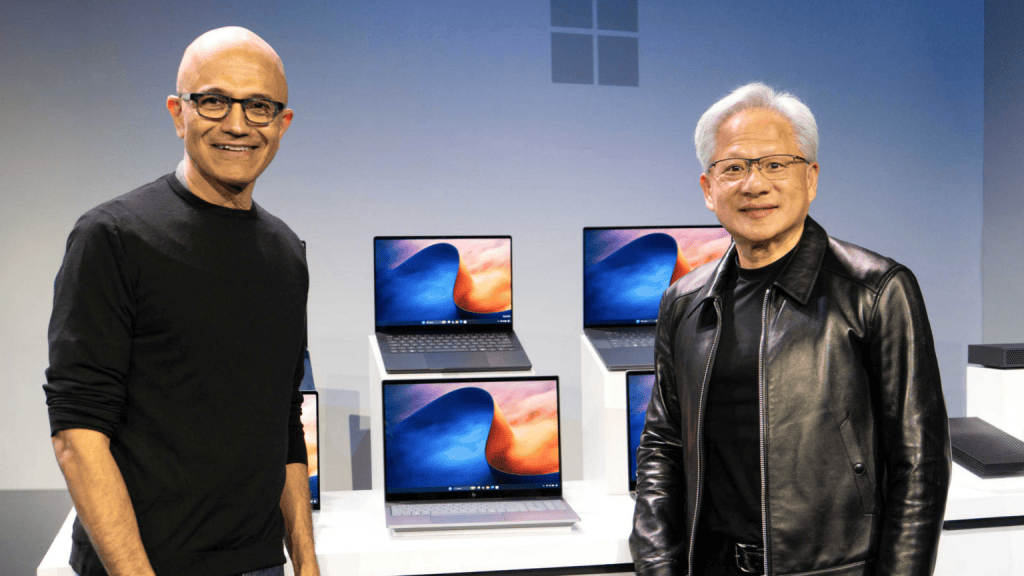
NVIDIA CEO Jensen Huang (top right) and Microsoft CEO Satya Nadella (top left) outlined plans to make Windows a platform for persistent, locally running AI agents.
“The personal computer is the ultimate tool, it’s my ultimate tool, and for a whole generation of people, it’s our ultimate tool,” said Huang. “What happens in the era of agents, when the agent is on your computer? It is now your personal assistant.”
Nadella said the companies had focused on making Windows a secure environment for autonomous software. “We needed to make the desktop the most secure place for agents to execute.”
RTX Spark systems will combine an NVIDIA Blackwell RTX GPU with up to 6,144 cores and an NVIDIA Grace CPU with up to 20 cores. Components are connected at up to 600GB per second and support up to 128GB of unified memory.
The systems can deliver up to one petaflop of FP4 AI performance, which will allow users to run large models locally, including Qwen 3.8 Flash Next, a 125-billion-parameter model.
Acer, Asus, Dell, HP, Lenovo, Microsoft, MSI, and Gigabyte are among those that offering the RTX range of laptops and compact desktops.
Microsoft’s Executive Vice President of Windows and Devices Pavan Davuluri said the Surface Laptop Ultra was built around NVIDIA’s RTX Spark platform. “With up to 128 gigs of unified memory and up to a petaflop of AI compute, you can run models on this laptop that simply don’t fit on a traditional machine,” he said.
NVIDIA is positioning RTX Spark for developers, creators and gamers. Developers will be able to use the CUDA software stack, while creators will get support for features including NVFP4, AV1 video and RTX ray tracing. Gamers will be able to run triple-A games at 1440p at more than 100 frames per second with DLSS 5, Reflex and G-SYNC.
DGX Station on Windows
NVIDIA also previewed DGX Station for Windows, a deskside AI system based on its GB300 Grace Blackwell Ultra Desktop Superchip.
The system will offer 748GB of coherent memory and up to 20 petaflops of FP4 AI performance. It is designed to run models with up to one trillion parameters locally to give enterprise developers access to high-end AI compute without relying entirely on rented cloud clusters.
“Capabilities that once required renting a cluster, now in a deskside supercomputer,” Davuluri said.
The move addresses a long-standing divide between Windows productivity environments and Linux-based AI development infrastructure. Development teams will be able to run AI agents alongside Windows applications, while retaining access to Linux toolchains through the Windows Subsystem for Linux.

