Tag: Lenovo

Samsung keeps lead in tablet space

abi researchSamsung has retained its pole position in ABI Research’s tablet vendor Competitive Assessment. In the analysis of 23 leading tablet vendors, ABI Research ranked companies on several criteria for product implementation and vendor innovation. The Korean giant prevailed in the innovation category and finished second in the implementation strategy.

Close behind Samsung in second place is Apple. Clearly dominating in shipment volume, Apple has been a strong contender in the tablet ecosystem. Apple places number one in implementation strategy but comes in close second for innovation. The two leading tablet makers have managed to stay ahead of other tablet OEM vendors.

In third place is Lenovo, which has done a great job of expanding its tablet portfolio by marketing to a large audience range and providing unique user interfaces.

India PC market sluggish in Q1

IDCThe India PC market continued to slide in Q1, largely due to poor end-user demand, according to IDC. Overall PC shipment was 2.03 million units, representing a year-on-year drop of 25.2 percent over Q1 2013.

The Commercial PC segment accounted for 1.02 million units, showing a marginal increase of 4.1 percent sequentially over Q4 2013.

“The overall Commercial PC market showed first signs of improvement over the last 9-10 months as investment activities have improved in the banking and government verticals. Vendors are optimistic about the overall market sentiments and believe it will pick up gradually among other verticals too in the course of 2014,” said Kiran Kumar, Research Manager of Client Devices at IDC India.

PC shipment up 5% but tablet growth slows in Q1

Worldwide client PC shipment rose five percent year on year to hit 123.7 million units in Q1 , according to Canalys. Growth in tablet shipments slowed to 21 percent, yet at 50.8 million units they continue to outship notebooks. Tablets accounted for 41 percent of the market while notebooks had 38 percent.

Notebooks and desktops in China declined 13 percent and six percent respectively compared with the previous year.

In the tablet market, there was strong growth in the Middle East (100 percent) and Greater China (74 percent). The US market was adversely affected by a drop in Apple iPad shipment, which fell 40 percent. This was offset somewhat by 20 percent growth in China, Apple’s second largest market. Worldwide, iPad shipments in Q1 fell 16 percent year on year to 16.4 million and accounted for 80 percent of Apple’s total PC shipments. Despite this, Apple continued to lead the global PC market. Its share fell both sequentially and year on year from 20 to 17 percent, due chiefly to the increasingly competitive tablet market.

Global tablet shipment misses target

IDCWorldwide tablet plus 2-in-1 shipments slipped to 50.4 million units in Q1, according to preliminary data from IDC. The total represents a sequential decline of 35.7 percent from the high-volume holiday quarter and just 3.9 percent growth over the same period a year ago. The slowdown was felt across operating systems and screen sizes and likely points to an even more challenging year ahead for the category.

“The rise of large-screen phones and consumers who are holding on to their existing tablets for ever longer periods of time were both contributing factors to a weaker-than-anticipated quarter for tablets and 2-in-1s,” said Tom Mainelli, IDC Program Vice President, Devices and Displays. “In addition, commercial growth has not been robust enough to offset the slowing of consumer shipments.”

Apple maintained its lead in the worldwide tablet plus 2-in-1 market, shipping 16.4 million units. That’s down from 26.0 million units in the previous quarter and well below its total of 19.5 million units in Q1 of 2013. Despite the contraction, the company saw its share of the market slip only modestly to 32.5 percent, down from the previous quarter’s share of 33.2 percent.

APAC PC market dips for 8th consecutive quarter

IDCThe Asia/Pacific (excluding Japan) PC market declined eight percent sequentially and 11 percent year-on-year in 2014 Q1 to reach 23.8 million units, according to preliminary results from IDC.

Elections in some of the bigger markets contributed to the region’s overall decline. In India, an ongoing large education project was postponed due to the upcoming elections, shaving off about half a million units from the commercial PC segment. In Thailand, political unrest continued to have an adverse impact on the economy, while in Indonesia, government funds were diverted in the run-up to the elections, resulting in lower commercial spending in PCs there this quarter.

“However, as these markets stabilise after the elections, IDC expects commercial activity to resume in the second half as a result of pent-up demand,” said Handoko Andi, Research Manager for Client Devices of IDC Asia/Pacific. “On the consumer side, ongoing distractions from smartphones and tablets as well as cautious channel intake impacted most markets in the region, especially in Southeast Asia.”

Worldwide PC shipment dips 1.7% in Q1

GartnerGlobal PC shipment dipped 1.7 percent to 76.6 million units Q1, compared to the same period last year, according to  apreliminary results by Gartner.

“The end of XP support by Microsoft on April 8 has played a role in the easing decline of PC shipments,” said Mikako Kitagawa, Principal Analyst of Gartner. “All regions indicated a positive effect since the end of XP support stimulated the PC refresh of XP systems. Professional desktops, in particular, showed strength in the quarter. Among key countries, Japan was greatly affected by the end of XP support, registering a 35 percent year-over-year increase in PC shipments. The growth was also boosted by sales tax change. We expect the impact of XP migration worldwide to continue throughout 2014.”

“While the PC market remains weak, it is showing signs of improvement compared to last year. The PC professional market generally improved in regions such as EMEA. The US saw the gradual recovery of PC spending as the impact of tablets faded.” said Kitagawa.

More power and better performance with new NVIDIA GeForce 800M

The Razor Blade packs the GeForce GTX 870M.

NVIDIA has launched its GeForce 800M line-up of notebook GPUs that deliver up to 60 percent performance improvement over the previous generation.

The new mobile GPUs sport a multitude of new features designed just for gamers, first of which is NVIDIA Battery Boost, which delivers up to double the gaming battery life.

Instead of pushing every notebook component to its max, Battery Boost targets a user defined frame rate, such as 30 FPS. The driver level governor takes over and operates all system components, including CPU, GPU, and memory at peak efficiency, while maintaining a smooth, playable experience.

China vendors to account for half of global handset sales next year

abi researchThe Red Wave is spreading from China to the rest of the mobile world. Huawei, ZTE and Lenovo may not be the leading names that come to mind when it comes to handset vendors today but their influence is spreading. As it Xiaomi, which is taking East Asia by storm with sellouts every time it puts its phones for sale online.

ABI Research has reported that Chinese handset vendors will account for more than half of mobile handsets in 2015. Chinese vendors already accounted for 38 percent of mobile handset shipments in 2013 and the ongoing shift in growth to low cost handsets, especially smartphones, will increase their market share.

Many oChinese OEMs have focused almost exclusively on the huge Chinese market, with little activity beyond its borders, but this is set to change. Huawei (6th in worldwide market share for 2013) and ZTE (5th) have already made an impact on the world stage, but other Chinese handset OEMs like Lenovo — the Motorola acquisition is a clear statement of intent — and Xiaomi are set to join them.

Tablets account for half of PC shipment in Q4

CanalysTablet shipment grew 65.2 percent year-on-year to reach 76.3 million units in Q4, according to Canalys. This represents nearly half (48.3 percent) of the global PC market, which increased 17.9 percent during that period. Excluding tablets, shipment declined 6.9 percent year-on-year with falls in all regions. 

Apple remained the PC market leader in Q4, shipping 30.9 million units to take a 19.5 percent share of the market. It shipped 26.0 million iPads, which accounted for 84.3 percent of its total shipment in Q4. Apple’s share of the overall tablet market increased sequentially from 27.3 percent to 34.1 percent, with the launch of the iPad Air and iPad mini with Retina display providing a much needed boost. The original iPad mini also fell in price, down to US$299 in the US, making it cheaper than ever to buy an iPad. But competition is mounting and Android tablets are falling in price, which will put pressure on Apple’s market share in 2014.

Lenovo secured an 11.8 percent share in Q4, narrowly holding onto second place. Lenovo’s PC shipments increased 25.5 percent year-on-year, driven by growth outside of its core Chinese market, where its shipment declined. Lenovo’s 11.7 percent decline in notebook shipments in China was offset by impressive growth in other regions, notably EMEA, where shipments grew 30.4 percent. Shipments in Latin America also grew strongly, following the acquisition of CCE in the first quarter of 2012.Lenovo was early to embrace Android as a tablet OS, while the likes of HP and Dell waited for Windows 8 and prioritized margin over volume. Lenovo’s strategy has paid off, not only in its home market but worldwide.


Samsung is top global semiconductor buyer

GartnerSamsung Electronics is the world’s top semiconductor buyer, and together with second placed Apple, increased their combined semiconductor demand by 17 percent in 2013, according to Gartner.
The two companies consumed US$53.7 billion of semiconductors in 2013, an increase of $7.7 billion from 2012.

“Samsung Electronics and Apple have topped the semiconductor consumption table for three years running, with their share of the design total available market (TAM) rising from 12 per cent in 2011, to 17 per cent in 2013,” said Masatsune Yamaji, Principal Research Analyst of Gartner. “This increase clearly shows how fast the presence of these two companies has expanded over the last three years and why their decisions have technology and pricing implications for the whole semiconductor industry.”

APAC PC market shrank 10% in 2013

IDCThe Asia/Pacific (excluding Japan) PC market declined 10 percent in 2013 to reach 108 million units, according to preliminary results from IDC.

The economic sluggishness in big emerging markets in the region adversely affected buying sentiments, with education sector projects being a lone bright spot in the commercial space, without which the region could have dropped even further. On the consumer side, smartphone and tablet distractions spread throughout the region this year, further contributing to the sharp decline in the PC market.

In Q4, the market came in two percent below IDC’s initial forecasts with a nine percent year-on-year decline. While most of the region was generally in line with forecasts, Thailand stood out as an exception, as the market there was plagued by the ongoing political turmoil. Shipment volumes this quarter will likely be the lowest in Thailand in the last four years.

Innovation and brand equity key for China smartphone makers in global market

frost and sullivanChina smartphone makers looking to take their domestic success globally need to carefully consider their expansion strategies, according to Frost & Sullivan.

While the China market has been driven by demand for cheap devices that offer a unique range of services such a virtual goods, messaging apps, and photo sharing, the more mature Western markets are very different, with carrier relationships, strong brand equity, and innovative features crucial to success.

Along with Huawei and ZTE, three interesting China companies have ambitions to take their smartphone businesses international: Lenovo, Yulong Coolpad and Xiaomi. The first and most successful China smartphone company is Lenovo, which has the largest smartphone market share of China companies, second only to Korean giant Samsung in China. Lenovo is also one of the most diversified China electronics companies, with a broad portfolio. The company has already achieved success on the global stage with its PC business, now the world’s largest after overtaking HP in 2012.

APAC PC shipment down 11.2% in Q3

GartnerAPAC PC shipment continued to head south with 28.1 million units in Q3, an 11.2 percent decline from Q3 of 2012, according to Gartner. Factors contributing to the drop were currency volatilities, especially in India and Indonesia, where currencies plunged to record lows. Vendors were careful in managing inventory, bearing in mind Windows 8.1 and new models based on Intel’s Bay Trail that will start shipping the following quarter.

Globally, PC shipment totaled 80.3 million units in Q3, an 8.6 percent decline from the same period last year. This marks the sixth consecutive quarter of declining worldwide shipments.

“The third quarter is often referred to as the ‘back-to-school’ quarter for PC sales, and sales this quarter dropped to their lowest volume since 2008,” said Mikako Kitagawa, Principal Analyst of Gartner. “Consumers’ shift from PCs to tablets for daily content consumption continued to decrease the installed base of PCs both in mature as well as in emerging markets. A greater availability of inexpensive Android tablets attracted first-time consumers in emerging markets, and as supplementary devices in mature markets.”

Local smartphone makers best Apple in China market

abi researchTo most people around the world, Coolpad, Lenovo and Xiaomi don’t quite ring a bell when it comes to smartphones. But, in China, these three Chinese smartphone OEMs outsold Apple in Q2, according to ABI Research.

Only Samsung managed to hold its own but snaring a 17 percent market share. Lenovo was next with 13 percent, Coolpad with 10 percent and Xiaomi edged out Apple with 6.5 percent.

“Even though these OEMs are only selling into the Chinese market, the size of the market has allowed them to achieve shipment volumes that place these OEMs in the top 12 globally. It is not hard to imagine these OEMs as global competitors within the next two years,” said Michael Morgan, Senior Analyst of ABI Research.

Asian brands boost APAC smartphone shipment

IDC APEJ Q2 smartphone
Source: IDC

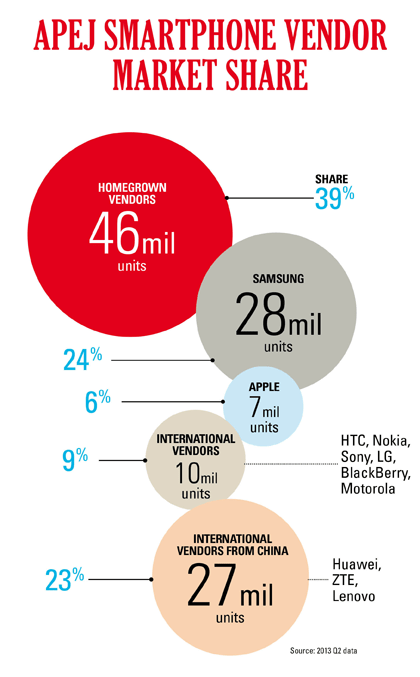
Homegrown brands are gaining more market share in the Asia-Pacific (excluding Japan) (APEJ) smartphone market. While Samsung continues to lead the smartphone pack, Apple fell out of the top five in the region for the first time. Chinese players — Lenovo, Coolpad, Huawei and ZTE — all outshipped Apple in the Q2, according to the IDC Asia/Pacific Quarterly Mobile Phone Tracker.

Aside from the top-tier international brands or Chinese brands that also ship globally such as Huawei and ZTE, there is also a rising segment of homegrown brands, which as a group have been steadily rising in shipments and prominence. This group of players comprised 38 percent of Q2 volume, up from 20 percent in the same quarter of 2012, and 7 percent in Q2 2011.
“There is clearly a market maturity story at play here, where the trends could not be more different between mature markets and emerging markets,” said Melissa Chau, Senior Research Manager with IDC AP’s Client Devices team. “Seasonally, second quarter usually shows an uptick in mature markets, but this round shipments dropped by 12 percent quarter-on-quarter, while emerging markets increased by 13 percent.

Samsung tops ABI Research’s tablet competitive assessment

abi researchKorean giant Samsung has nudged aside all competition in ABI Research’s assessment of 19 top tablets.

The  competitive assessment ranked companies on several criteria related to both product implementation and vendor innovation.

Samsung bested all other tablet vendors in the innovation category while scoring second overall in the implementation category. Clearly king of the hill when it comes to tablet shipment volumes, Apple trailed Samsung on tablet Innovation landing in second.

Tablets fail to lift flat PC market in Q2

Tablet shipment’s growth 42.9 percent iwas not enough to lift a sluggish PC market in Q2. Desktop and notebook shipments fell 7.4 percent and 13.9 percent respectively, according to Canalys, which believes that tablets will outsell notebooks by Q4.

PC shipment in the Asia Pacific region declined 0.5 percent year-on-year to just over 40 million units. The region was badly affected by slow shipment in China, which accounted for almost 45 percent of the region’s shipment and declined by about six percent.

Demand for smartphones and tablets is increasing around the world. Faced by an industry in transition, channel partners are exercising caution when planning and placing orders.

China’s top five vendors grab 20% of the world’s smartphone market

CanalysSamsung and Apple grew smartphone shipment by 55 percent and 20 percent respectively to maintain first and second place in Q2, according to Canalys.

However, both lost market share to Chinese vendors as the top 5 China vendors (Lenovo, Yulong, Huawei, ZTE, and Xiaomi) now account for 20 percent of the  market, up from less than 15 percent a year ago.

Altogether, some 238.1 million units were shipped in Q2, an impressive 50 percent year-on-year gain.

Android-based tablets outship iPads in Q2

Three in 10 PC shipped in Q2 were tablets. According to Canalys, more than 34 million tablets were shipped in Q2, a 43 percent year-on-year increase. Even more impressive is the fact that tablets now account for 31 percent of worldwide PC shipments.

The charge is led by Android-based tablets as Apple’s tablet shipments declined 14 percent in Q2 and saw its market share shaved to 43 percent. The chasing pack of Samsung, Amazon, Lenovo, and Acer each grew annually by over 200 percent, driven by increasing demand for small-screen tablets.

Canalys estimates that 68 percent of tablets shipped in Q2 had a screen size smaller than nine inches. “Consumers have been evaluating tablets and the results are now in,” said Tim Coulling, Senior Analyst at Canalys . “With touchscreens contributing to a high proportion of the build cost of a tablet, small-screen products can be priced very aggressively.”

Global mobile phone market up 6% in Q2

IDCDemand for mobile phones continue to grow. In Q2, the worldwide mobile phone market grew six percent year over year, according to the IDC Worldwide Quarterly Mobile Phone Tracker.

Vendors shipped a total of 432.1 million mobile phones in Q2 compared to 407.7 million units in the corresponding quarter of 2012. The Q2 total was also slightly higher than the 428.8 million units shipped in Q1.

The growth in the mobile phone market was partly driven by vendors from outside the Top 5 who experienced torrid shipment growth that outpaced the overall market. Several vendors, including Alcatel and Huawei, had high double- and triple-digit growth rates in Q2 for their Android-based offerings shipped to high-growth countries such as China and India. These vendors from outside the Top 5 accounted for 44.8 percent of the overall shipment volume, up from 42.2 percent in the same quarter one year ago.

China pulls down APAC PC market in Q2

IDCThe PC market slowdown continued in Q2 with Asia/Pacific (excluding Japan) dropping one percent last quarter and 11 percent year-on-year in Q2 to reach 26.7 million units, according to IDC’s preliminary results.

Weak sell-in amid ongoing consumer distractions, such as phones and tablets, as well as a slowing economy affected the PC market performance in China, which pulled the entire region down. While consumer sentiment in the rest of region was also tepid, a higher-than-expected shipment for a large education notebook project in India helped to offset some of this decline.

“The second half of this year still faces a number of challenges such as economic and channel conditions in China as well as uncertainty around an education project in India,” said Handoko Andi, Research Manager at IDC Asia/Pacific. “It’s possible for the market to bottom out and recover by 2014 as technology evolves, but IDC confidence is low at the moment given all of the forces tugging at each other right now.”

Lenovo nudges HP off global PC perch

IDCLenovo became the number one PC vendor in Q2 as HP slid to second with Dell coming in third.

According to IDC‘s Worldwide Quarterly PC Tracker, Lenovo continued its streak of gains following channel expansion and solid product development. In Q2, it made impressive gains outside of Asia Pacific except Japan (APeJ). However, the headwinds in China continued to affect its home turf significantly. Lenovo ended the quarter with a double-digit decline in APeJ. Overall growth has slowed from prior quarters, and slipped into negative territory this quarter, but still outpaced the market and top competitors.

HP slipped to second place, but growth improved from recent quarters. It was boosted by shipments to India as part of large education projects. Despite ongoing uncertainty surrounding its restructuring, Dell performed above market with a decline of 4.5 percent. As with HP, this was a significant improvement from the past year that was aided by improving growth in the US. It managed to perform above market in all key regions except APeJ.

Thailand’s PC market declines 20% in Q1

IDCSluggish demand in Thailand’s consumer market helped drive PC shipment down 20 percent in Q1, compared to the same period last year.

According to IDC’s Asia/Pacific Quarterly PC Tracker, PC shipment reached only 800,000 units in Q1.

“Channel partners reacted quickly to the slowdown by reducing PC buy-in to make room for faster-moving devices like tablets” said Jarit Sidhu, Market Analyst for Client Devices Research at IDC Thailand. 

Malaysia’s PC market down 18% in Q1

IDCThe PC market in Malaysia dropped 18 percent in Q1, compared to the same period last year, according to IDC’s Asia/Pacific Quarterly PC Tracker. However, the 898,000 units sold in the quarter represented an 18 percent growth in sequential quarter.

A major delivery of mini-notebooks nationwide under the government’s Malaysian Communications and Multimedia Commission (MCMC) project was the only notable event in an otherwise lacklustre quarter. The education and enterprise segments both posted declines after flushing their budgets last quarter.

Retail spending on PCs was also curtailed by distractions from Chinese New Year festivities and the influx of smartphones and tablets into the market. However, the positive response to touch-based notebooks in retail was a notable silver lining in a gloomy retail climate. 

PC sales in ANZ dip in Q1

IDCThe PC market is weakening as demand for tablets and other mobile devices strengthen. In Australia and New Zealand (ANZ), the PC market closed Q1 with a 21 percent and 27 percent dip respectively compared to the same quarter last year, according to IDC.

This decline is all the more ominous in view of recent cuts to the Australian Federal interest rate and the quarter being the end of financial year in New Zealand.

“The softness in PC sales across the consumer and commercial space reflects a declining demand for PCs,” said Amy Cheah, Market Analyst of IDC Australia. “More consumers are skipping or delaying PC purchase as tablets become the more common alternative for mobile access. Vendors, as a result, took a more cautious approach this quarter, cutting back on shipments given the slow moving inventory situation.”

New NVIDIA GeForce 700M GPUs extend battery life, enhance performance, enrich experience

GeForce 700MFive new NVIDIA notebook GPUs deliver a trifecta of technologies that seamlessly and automatically maximise a consumer’s notebook performance and experience. With no effort or input from the notebook user, the technologies work in the background to save battery life, enhance performance and enrich the visual experience — providing the best notebook experience the GPU can deliver. They include:

  • New NVIDIA GPU Boost 2.0 technology, which intelligently adjusts GPU clock speed to maximise graphics performance.
  • NVIDIA Optimus technology, which enables extra-long battery life by switching the GPU on and off so it runs only when needed.
  • GeForce Experience™ software, which adjusts in-game settings for the best performance and visual quality specific to a user’s notebook and keeps GeForce drivers up to date.

Gartner: Declining worldwide PC shipments in Q4 of 2012 signal structural shift

GartnerWorldwide PC shipments totaled 90.3 million units in the fourth quarter of 2012, a 4.9 percent decline from the fourth quarter of 2011, according to preliminary results by Gartner. Analysts said the PC industry’s problems point to something beyond a weak economy.

PC shipments in Asia/Pacific totalled 29.9 million units in the fourth quarter of 2012, a 1.8 percent decline from the fourth quarter of 2011. Vendors struggled to offer compelling products to convince buyers to upgrade and attract new buyers as consumers’ interest continues to be on smartphones and tablets. The introduction of Windows 8 met with lukewarm response and availability was primarily on the higher-end models, which were priced beyond the mainstream price point for volume sales.

“Tablets have dramatically changed the device landscape for PCs, not so much by ‘cannibalizing’ PC sales, but by causing PC users to shift consumption to tablets rather than replacing older PCs,” said Mikako Kitagawa, principal analyst at Gartner. “Whereas as once we imagined a world in which individual users would have both a PC and a tablet as personal devices, we increasingly suspect that most individuals will shift consumption activity to a personal tablet, and perform creative and administrative tasks on a shared PC. There will be some individuals who retain both, but we believe they will be exception and not the norm. Therefore, we hypothesise that buyers will not replace secondary PCs in the household, instead allowing them to age out and shifting consumption to a tablet.”

Gartner’s Top 5 IT predictions for China in 2013 and beyond

GartnerGartner has published its top five IT predictions for China in 2013 and beyond, as China’s IT market undergoes major transformation, especially in cloud and mobility. Analysts said that although China’s IT market has similarities with the global IT market, it also faces challenges and opportunities that are very specific to the Chinese marketplace.

Enterprise spending on IT in China is forecast to grow from US$117.8 billion in 2013 to reach $172.4 billion in 2016, representing a compound annual growth rate of 8 percent, compared to a global growth rate of 3 percent over the same period, according to Gartner.

“In common with many emerging markets, cloud and mobile initiatives are hot and enterprises are also making progress in adopting virtualisation technologies, a key stepping stone in the journey to cloud,” said Matthew Cheung, principal research analyst at Gartner. “Without the legacy systems that hamper many western enterprises, Chinese organisations have an opportunity to leapfrog in the adoption of new technologies. However, the current hype around cloud could also result in its failure to live up to market expectation in a few years time. In mobility, China is a market characterised by strong local flavors, especially in the fast growing smartphone and tablet markets.”