
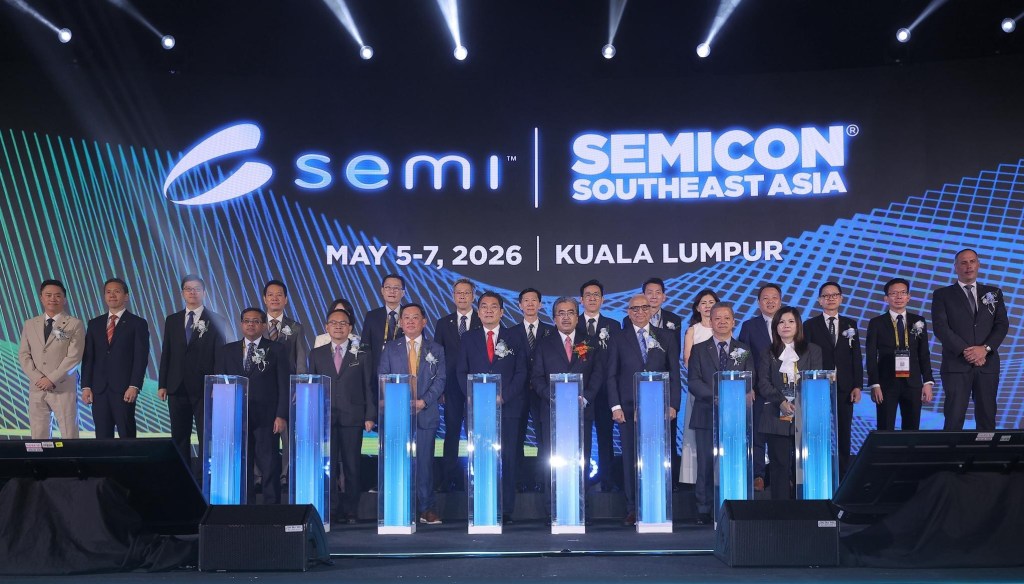
Semicon Southeast Asia 2026 kicked off yesterday at Malaysia International Trade and Exhibition Centre (Mitec) in Kuala Lumpur. The three‑day summit, running till May 7, brings together more than 20,000 global participants, including industry executives, technology providers, government leaders, and investors.
Themed Transform Tomorrow, the event is co‑organised by the Malaysia External Trade Development Corporation (Matrade) and SECA, and is positioned as a key regional hub for the global semiconductor ecosystem.
Companies from silicon materials and advanced packaging to equipment, design and AI‑driven manufacturing are showcasing capabilities.
Speakers at the opening highlighted how geopolitical and trade dynamics are reshaping semiconductor manufacturing geography, with Malaysia and broader Asean increasingly viewed as a strategic node.
The Malaysian government has been actively courting chipmakers and suppliers, touting advantages such as a skilled workforce, established manufacturing infrastructure, and a stable regulatory environment to attract wafer fabs, advanced packaging lines and R&D labs.
According to Datuk Sikh Shamsul Ibrahim Sikh Abdul Majid, Chief Executive Officer of MIDA, Malaysia is approaching the next phase of semiconductor growth as an active builder rather than a beneficiary of global trends.
“Under the Madani Economy Framework and the New Industrial Master Plan 2030, we are not simply maintaining our position in the global semiconductor supply chain, we are deliberately reshaping it. What we are now building is the ecosystem to match that confidence, through supply chain integration, local capability development and the kind of high-value partnerships that platforms like Semicon Southeast Asia are uniquely placed to catalyse,” he said.

