
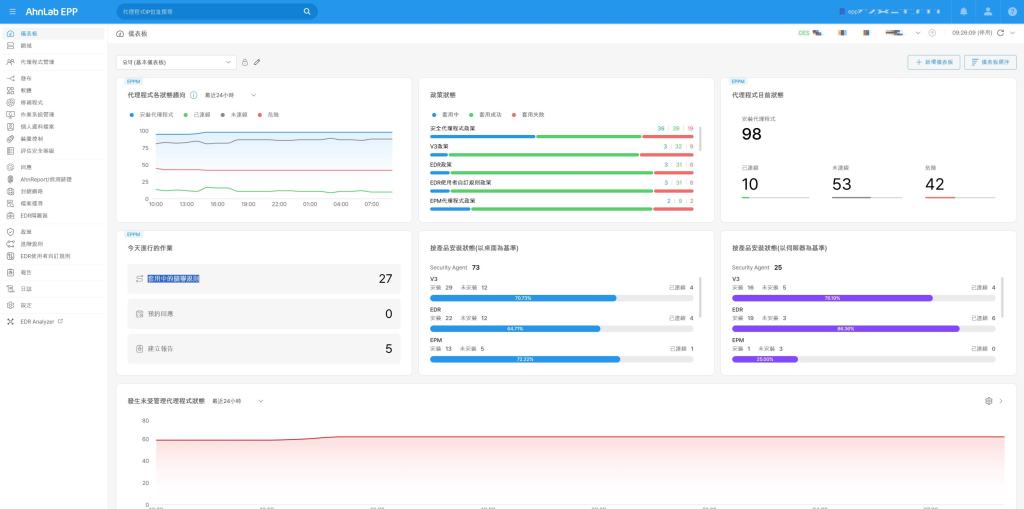
South Korean cybersecurity specialist AhnLab has added Traditional Chinese language support for its endpoint protection platform (EPP) to enhance usability and accessibility for Chinese-speaking cybersecurity teams across Asia.
The new feature targets key markets such as Taiwan, Hong Kong and Macau, where Traditional Chinese is widely used in enterprise and government environments. By enabling users to operate the platform in their native language, AhnLab aims to reduce complexity in managing endpoint security and improve response times to cyber threats.
With localised interfaces, security teams can more easily navigate critical functions such as patch management, data protection, device control, and malware detection. This is especially valuable in high-pressure security operations where language barriers can slow down decision-making or lead to misconfigurations.
The Traditional Chinese support extends across AhnLab EPP’s core plug-ins, including its unified management console, patch management, data protection, device control, and V3 anti-malware solutions for macOS and Linux systems. This ensures a consistent, end-to-end localised experience across the entire security workflow.
“We expect to enhance product usability and position AhnLab EPP as a more compelling option in the Chinese-speaking markets, including Taiwan by offering a localised user experience tailored to customers in the region. We will continue to strengthen our global competitiveness by proactively addressing customer needs through localisation strategies in high-demand markets,” said Vincent Sang Kook Lee, Chief Growth Officer of AhnLab.
With the latest addition, AhnLab EPP now supports five languages — Korean, English, Japanese, Simplified Chinese, and Traditional Chinese. The company plans to further expand language support and will roll out Traditional Chinese for Windows-based V3 solutions in June.





Leave a Reply