
AMD has announced a full-stack compute platform comprising new hardware and software capabilities for the agentic AI era.
At its Advancing AI 2026 event in San Francisco, the company outlined a strategy to deliver end-to-end infrastructure for agentic AI workflows that spans from edge devices to cloud data centres.
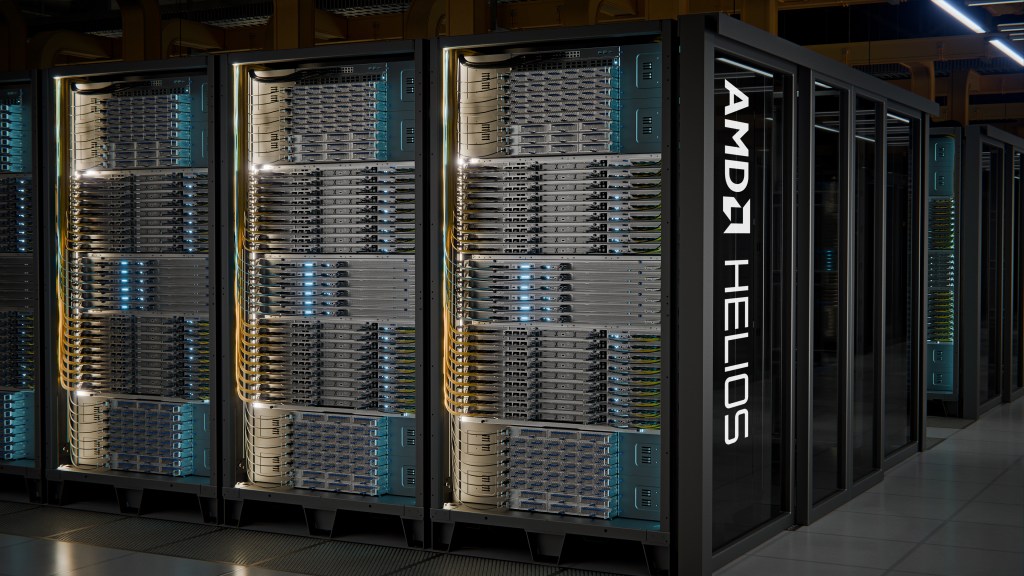
A key component of the full-stack strategy is the Helios rack-scale AI platform, a 72-GPU, double-width rack-scale system powered by AMD Instinct MI455X GPUs, 6th Gen AMD EPYC Venice CPUs, and AMD Pensando networking technologies, all unified by the open AMD ROCm software stack.
Designed for the era of agentic AI, Helios enables cloud service providers, hyperscalers and enterprises to deliver large-scale AI workloads, including sovereign AI, LLM training, inference, and fine-tuning, with efficiency and scalability. It delivers up to 2.9 exaFLOPS of FP4 compute, up to 1.4 exaFLOPS of FP8 compute, and up to 31 terabytes of HBM4 memory per rack.
Helios is built on the OCP Open Rack Wide specification for simplified deployment and streamlined scalability for rapidly evolving AI research and commercial needs. Inside is the UALink over Ethernet that provides fast scale-up across all 72 GPUs, while standards-based Ethernet scale-out connects Helios into larger clusters while preserving openness, flexibility and ecosystem choice.
Other elements of the full-stack approach include:
- AMD Instinct GPUs and EPYC CPUs: High-performance accelerated compute infrastructure optimised for agentic AI inference and multi-agent orchestration.
- ROCm software ecosystem: Open runtime software enabling developers to build and deploy agentic AI applications across AMD hardware.
- AMD enterprise AI platform: Integrated software stack for lifecycle management, model deployment and orchestration of AI agents in enterprise environments.
- Ryzen AI PCs: On-device agentic AI capabilities for local inference, including offline RAG workflows and privacy-focused automation.
AI ecosystem partnerships
AMD also reinforced its commitment to an open AI ecosystem through partnerships with enterprise infrastructure providers. In February 2026, it announced a multi-year strategic partnership with Nutanix to jointly develop an open, full-stack AI infrastructure platform for agentic AI applications.
“Enterprise customers need the freedom to run the models and workloads that matter most to their business, without compromise,” said Dan McNamara, Senior Vice President and General Manager of Compute and Enterprise AI at AMD.
The Nutanix partnership includes a US$150 million strategic investment by AMD and up to US$100 million in joint engineering and go-to-market funding. The first jointly developed agentic AI platform is expected to hit the market beginning in late 2026.
“Our partnership with AMD reflects a shared vision for scalable, production-ready AI infrastructure,” said Tarkan Maner, President and Chief Commercial Officer of Nutanix.
Strategic pivot
AMD’s AAI 2026 announcement signals a strategic pivot in the AI infrastructure market where agentic AI workloads are expected to dominate enterprise deployments by 2027.
By emphasising openness, interoperability and flexibility across the full compute stack, it is positioning itself as a third-way alternative to vertically integrated AI ecosystems. This is a significant move as the broader industry shifts to where customers increasingly demand architectural choice and the ability to mix and match hardware and software components.
AMD’s full-stack platform provides an option for enterprises to reduce vendor lock-in and optimise for cost, performance and workflow requirements across diverse AI use cases.
According to AMD Chair and CEO Lisa Su, the next phase of AI will span frontier models, agents and physical AI, creating new opportunities to bring intelligence everywhere.
“Realising that potential will take the entire industry working together. AMD is partnering across the ecosystem to deliver leadership compute and open platforms that give customers the performance, flexibility and choice to scale AI from the data centre to the edge,” she added.

