
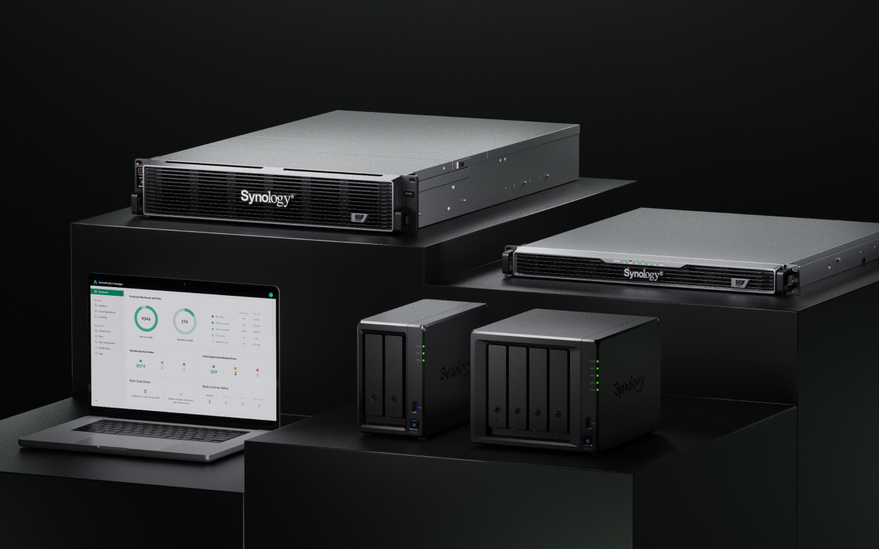
Synology has updated its ActiveProtect Manager to help enterprises protect hybrid infrastructure, recover workloads across platforms, and reduce dependence on on-premises hardware during disaster recovery.
Available at no additional cost for all DP-Series appliances, ActiveProtect Manager 2.0 (APM 2.0) adds protection for Amazon EC2, Azure VM, Proxmox VE, Nutanix AHV and Google Workspace. Its cross-platform recovery capabilities allow enteprises to back up workloads in one environment, and restore them to another, supporting both disaster recovery and workload migration.
“Managing fragmented backup infrastructure drives up costs and slows recovery. The ActiveProtect appliance unites purpose-built storage with powerful data management software into a single, predictable investment,” said Jia-Yu Liu, Executive Vice President of Synology’s Data Protection Group. “APM 2.0 builds on that value, enabling organisations to safeguard their entire hybrid infrastructure through one centralized, scalable solution.”
The update also expands backup destination options with ActiveProtect Vault now supporting a wider range of Synology NAS models, while Azure Blob Storage has been added as a supported copy and tiering target.
For enterprises using public cloud infrastructure, backups stored in Amazon S3 Storage or Azure Blob Storage can be restored directly into Amazon EC2 or Azure VM. This enables a cloud-based disaster recovery strategy without first routing data through on-premises hardware to potentially reduce recovery times and infrastructure dependencies.
APM 2.0 also introduces software-based, volume-level storage encryption that protects data at rest, and keeps backup data and system configurations inaccessible if drives are stolen or hardware is lost.
Anomaly detection with next update
The planned ActiveProtect Manager 2.1 update will extend these protections with AI and machine learning-based anomaly detection. It will monitor backup versions for changes in change rates, file modifications, mass deletions and entropy, moving suspicious copies into quarantine for administrator investigation.
APM 2.1 is also expected to scan backups for malware before restoration using integrated third-party antivirus software, including Microsoft Defender, Bitdefender and ESET. If malware is found in the latest backup, an Auto Fallback capability will restore the latest clean version instead.
For enterprises, the combined roadmap points to a more centralised approach to backup management, with broader workload coverage, cloud recovery options and additional safeguards against compromised backup copies.

