
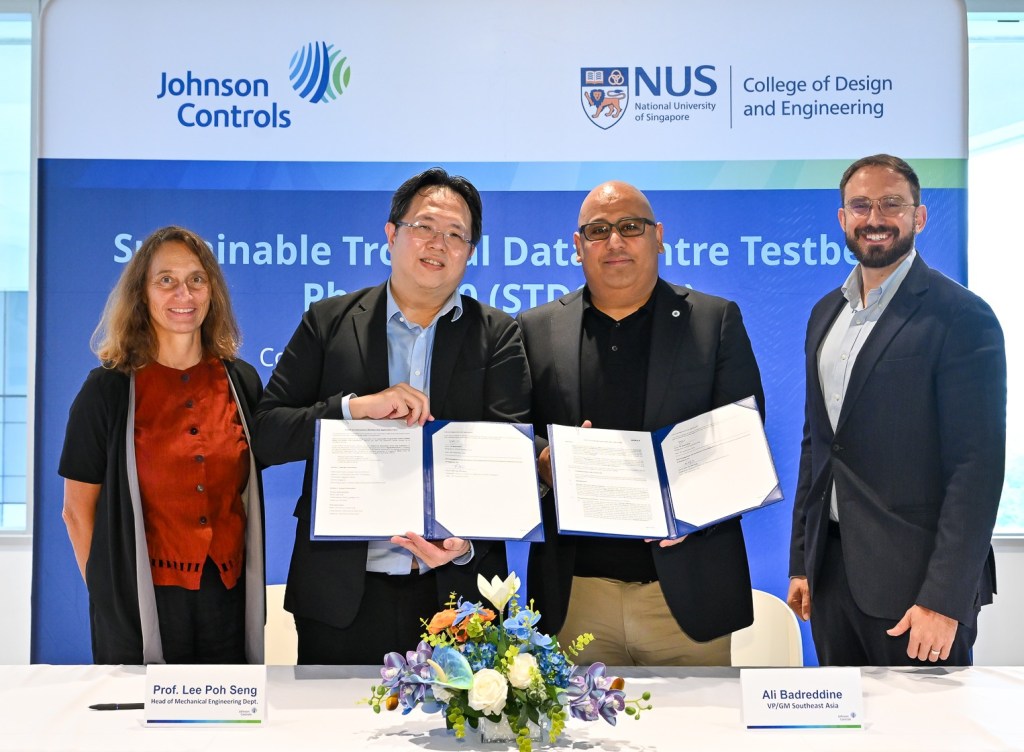
Johnson Controls has joined the National University of Singapore-led Sustainable Tropical Data Centre Testbed 2.0 programme that examines how AI and data centre infrastructure can operate more efficiently in tropical conditions.
Hosted by NUS’ College of Design and Engineering and located on Jurong Island, the testbed will evaluate next-generation data centre technologies under real-world conditions. The initiative is part of a broader effort involving JTC Corporation and industry partners to develop low-carbon, AI-ready infrastructure.
The collaboration will explore ways to reduce power and water consumption while increasing computing capacity in environments constrained by energy, water and space. Johnson Controls will contribute thermal management technologies, smart controls, engineering expertise, and operational experience.
“Meeting the demands of advanced computing requires a new way of thinking about infrastructure. As AI workloads continue to grow, success will depend not only on computing power, but on how efficiently we manage the resources behind it,” said Austin Domenici, President of Data Centre Solutions at Johnson Controls.
An integrated approach to thermal management can halve non-IT energy consumption compared with conventional cooling methods in a modelled design.
Absorption chiller design
In a separate one-gigawatt data centre blueprint, Johnson Controls has introduced an absorption chiller reference design that converts waste heat from onsite power generation into cooling. The design demonstrated the potential to support up to 97MW of additional AI computing capacity from existing power infrastructure, while reducing cooling-related electrical demand by up to 44 percent.
“AI is fundamentally changing the design envelope for data centres, with much higher rack densities placing unprecedented demands on cooling, power, controls and resource efficiency,” said Lee Poh Seng, Programme Director of the Sustainable Tropical Data Centre Testbed and Head of NUS CDE’s Department of Mechanical Engineering. “STDCT 2.0 is designed to move beyond individual technologies and evaluate how these systems can be integrated and optimised as one infrastructure platform under real tropical operating conditions.”
The programme will support advanced research, workforce training, innovation, and knowledge sharing between Johnson Controls and NUS CDE.
“As AI drives a new wave of infrastructure demand across Asia Pacific, advancing research, developing talent and strengthening industry collaboration will be critical to meeting that growth responsibly,” said Ali Badreddine, Vice President and General Manager of Southeast Asia Business and Asia Pacific Data Centre Solutions at Johnson Controls.
PHOTO CAPTION: (From left) Ursula Oesterle, Vice President (Industry) of NUS; Lee Poh Seng, Programme Director of the STDCT and Head of Department of Mechanical Engineering at the College of Design and Engineering at NUS; Ali Badreddine, Vice President and General Manager of Southeast Asia Business and Asia Pacific Data Centre Solutions at Johnson Controls; and Austin Domenici, President of Data Centre Solutions at Johnson Controls.

