
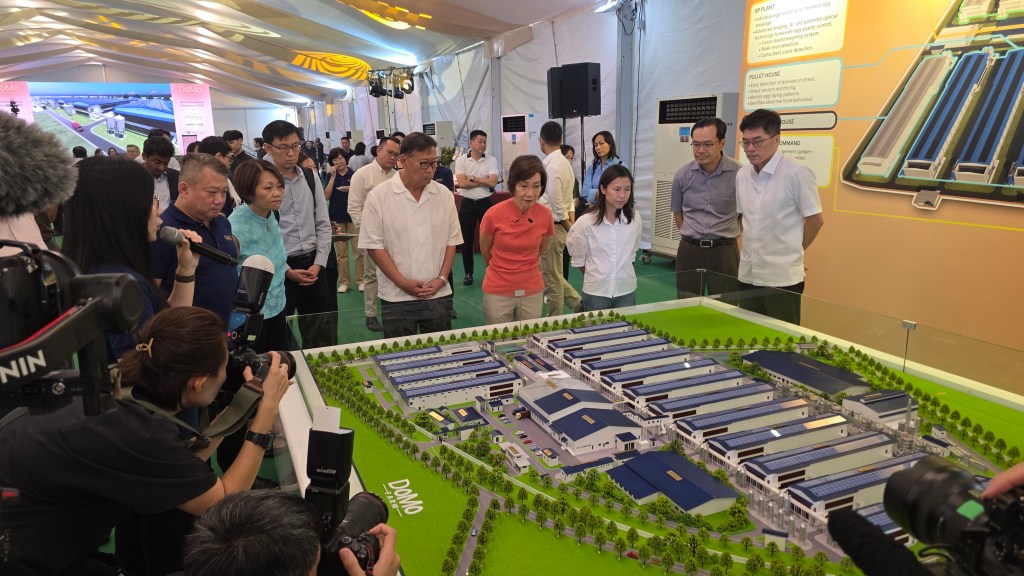
Singapore’s newest egg farm is turning to AI, IoT and real-time data to strengthen the country’s food resilience.
DoMo Farm has broken ground in Kranji with plans to produce more than 500 million eggs annually when fully developed. The high-technology facility is expected to begin supplying eggs to stores in 2028.
Owned by ISE Foods Holdings, a subsidiary of Ellipsiz, with Unicore Agri and Vertex Exploratory Fund as co-investors, the farm will house up to 1.8 million laying hens and 600,000 pullets.
Its first phase will include nine layer houses and three pullet houses capable of producing about 380 million eggs a year. The farm’s capacity will be expanded progressively in line with market conditions.
DoMo Farm’ is designed based on an operating model built around “One Farm, One Central Command and One Intelligent Control System”.
The model is intended to connect the farm’s automation, IoT devices, AI systems, and operational technologies into a single integrated platform. A central command centre will monitor operations in real time to allow teams to identify issues earlier and respond quicker.
Advanced optics and heat-detection sensors will work with AI models to capture and analyse operational data. The technology is expected to give farm operators greater visibility into conditions across the facility, while supporting productivity, workforce efficiency, climate resilience, and sustainability.
Rather than treating automation as a collection of standalone systems, DoMo Farm is placing technology as the operating backbone of the entire facility.
More resilient supply chain
Singapore consumed more than 2.2 billion eggs in 2025 with local farms supplied about one-third of domestic demand.
DoMo Farm plans to make a meaningful and lasting contribution to local egg supply and food resilience. Its also plans to establish parent-stock and hatchery capabilities in a later phase to reduce reliance on imported day-old chicks and create a more resilient source of egg-laying hens.
The move upstream could give the farm greater control over its production pipeline, from breeding and hatching to egg production. The farm is designed for 12 layer houses and four pullet houses when fully developed.
“DoMo reflects our pursuit of excellence and our ambition to do more with less: to produce more food while making better use of our limited resources,” said David Ong, Chairman of ISE Foods Holdings.

