
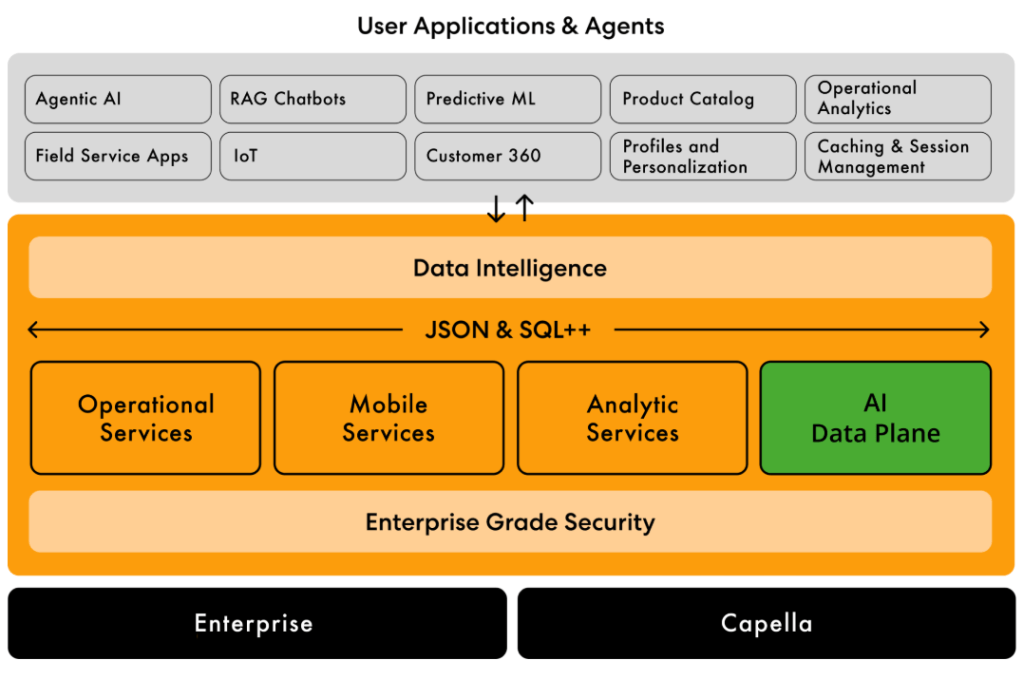
Couchbase has introduced its AI Data Plane to help enterprises move AI agents from pilot projects into production.
This unified data layer gives AI systems the memory, context and governed data access they need to remember past interactions, retrieve real-time information, and take action consistently across cloud, edge, and mobile environments.
According to Barry Morris, Chief Product and Strategy Officer of Couchbase, the database layer is where agentic AI either scales or stalls, and most of the industry is still treating agent memory as an afterthought.
“Agent Memory gives them a unified, framework-agnostic persistence layer that operates identically in cloud and self-managed environments from cloud to edge, and runs at the latency their agents actually need,” he said.
AI Data Plane serves as the operational foundation for enterprise AI. Instead of forcing teams to stitch together separate vector stores, document databases, caches, and analytics systems, Couchbase is packaging those capabilities into one governed platform. The benefits are fewer integration headaches, tighter control over data access, and a simpler path to deploying AI agents that can make better decisions and deliver more consistent customer experiences.
The platform also supports persistent agent memory, an agent catalogue and a self-managed MCP server, which are intended to standardise how agents connect to enterprise tools and data.
The launch also includes Enterprise Analytics 2.2, which extends Couchbase into lakehouse environments with Apache Iceberg federation and, later, a Trino adapter. Operational data in Couchbase can be queried alongside lakehouse tables without moving or duplicating data, reducing complexity and preserving governance. Designed to work across Couchbase Capella and self-managed deployments, the platform provides teams with a single operational surface for AI workloads.

