
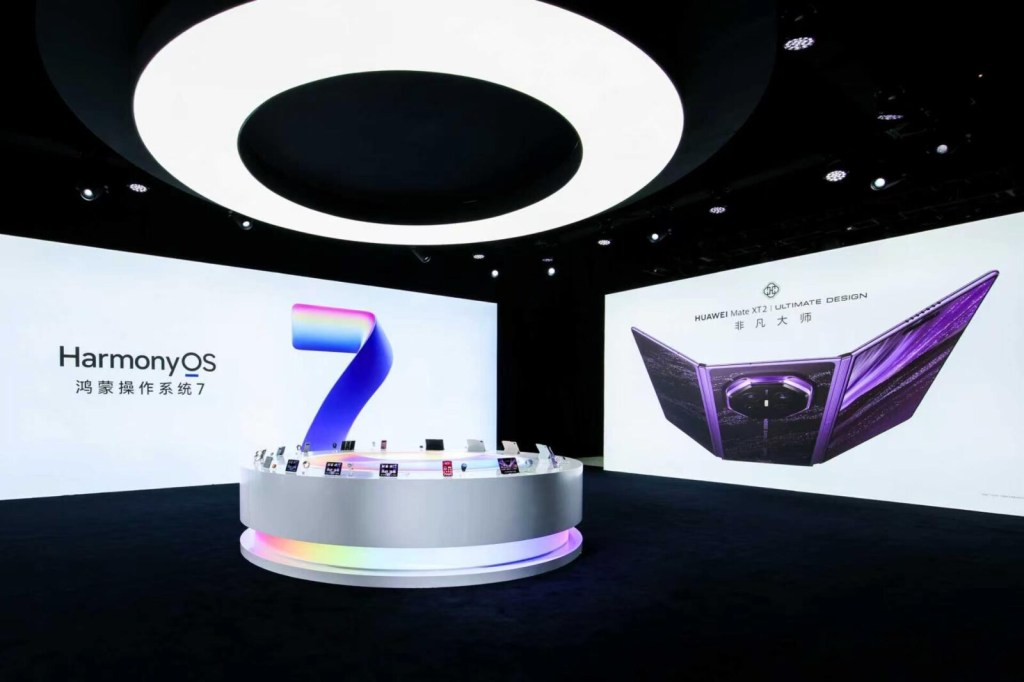
Huawei has launched the Mate XT 2 | Ultimate Design smartphone that is the first to mass‑commercialise its LogicFolding Tau (τ) chip architecture via the new Kirin 9050 Pro SoC.
The Kirin 9050 Pro is the world’s first mobile chipset built on Huawei’s Tau Scaling Law, which prioritises cutting signal propagation delay (τ) over relentless transistor shrinking.
Its key enabler, LogicFolding, stacks and folds logic circuits vertically inside the die, effectively turning a single‑floor layout into a duplex with vertical interconnect elevators. This shortens signal paths and raises effective transistor density.
The approach lifts transistor density by about 55 percent, trims performance‑core power draw by about 41 percent, and nudges peak clocks up by around 12.7 percent versus conventional planar SoCs, delivering a 42 percent performance gain over the prior Mate XT generation. The phone’s GPU adds hardware‑accelerated real‑time ray tracing (up to 50 million rays) and its NPU supports on‑device inference for multiple large AI models.
The Mate XT 2 moves to an inward, G‑shaped tri‑fold that protects all three panels when closed and introduces a cover screen for quick tasks when folded. A privacy screen option limits side‑angle visibility, alongside improved water resistance and a redesigned hinge mechanism.
In China, the Ultimate Design line starts at RMB19,999 for 16GB+256GB, scaling to RMB29,999 for a 16GB+2TB privacy screen bundle with stylus. The first four variants go on sale September 12 with the top‑spec stylus bundle avaialable from September 23. There’s no indication of international availability yet.

