
Tag: Huawei

Philippines is fastest growing smartphone market in SEA

IDCThe Philippines smartphone market jumped 20 percent in Q1, according to IDC. With a projected annual growth of 25 percent this year, this makes the country the fastest growing smartphone market in Southeast Asia (SEA).

“While many of the more mature smartphone markets of the world already displayed signs of saturation, the Philippines smartphone market continues to enjoy robust growth owing to a relatively low smartphone penetration rate (30 percent in 2015), active local brand presence, and healthy consumer spending,” said Jerome Dominguez, Market Analyst for Mobile Devices of IDC Philippines.

Local vendors continue to dominate the Philippines smartphone market as they flood it with the most affordable smartphone options.

Smartphone market in historic drop

It’s almost unthinkable but the smartphone market has dipped for the first time in its history.

According to Canalys, worldwide smartphone shipment fell from 324 million units in Q1 2015 to 321 million units in Q1 2016. The top two vendors both posted shipment declines, with Apple the worse hit.

Excluding Apple and Samsung, smartphone shipment grew five percent despite some of the big named international vendors outside the top five also faring badly. LG, Lenovo and TCL-Alcatel posted significant declines, while Sony plummeted by around 57 percent.

China smartphone sale hit record high in Q4

IDCSmartphone sale hit a record 117.3 million in China in Q4. This represents an eight percent growth compared to the same period last year.

The phenomenal increase was partly driven by China’s annual singles day online shopping festival in November and Huawei’s strong shipments in the quarter. China’s Q4 growth boosted the calendar year 2015 growth to three percent.

“Xiaomi, Huawei and Apple are the top smartphone players in 2015. This is a stark contrast to the top players in 2013, which was Samsung, Lenovo and Coolpad – with Samsung clearly dominating other players. With operators reducing smartphone subsidy and given the volatility of consumers’ brand preference in the market, the smartphone scene has changed significantly since then,” said Tay Xiaohan, Senior Market Analyst of IDC Asia/Pacific’s Client Devices team.

Apple conquers smart watch market

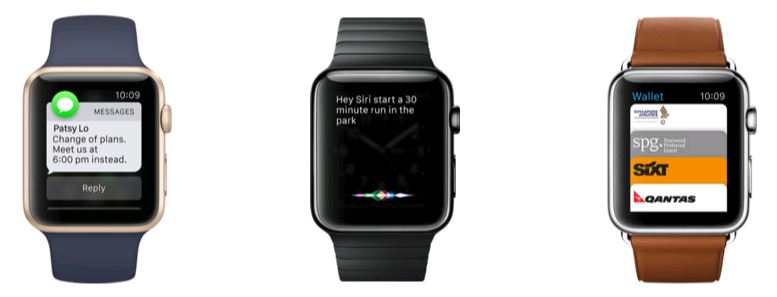
Apple Watch threeApple is top of the league in the smart watch market in 2015, accounting for over 12 million units and two-thirds of all shipment, according to Canalys.

Samsung returned to second place in Q4, as the improved design of the Gear S2 saw a much better consumer reception than previous wearable efforts by the company. Pebble came third and Huawei fourth, establishing itself as the leading Android Wear vendor.

Basic bands exceeded 37 million shipments for the year. Fitbit set a quarterly shipment record as it comfortably led the category. Xiaomi held second place, shipping 12 million Mi Bands during 2015.

Tablet sale slides 12.6% in Q3

IDCTablet sale continued its decline for the fourth straight quarter, according to IDC. Q3 shipment of 48.7 million units represented a 12.6 drop year on year, further highlighting the challenges the tablet market is facing.

At the close of 2014, IDC estimated the installed base of tablets to be 581.9 million globally, which was up 36 percent from 2013 but slowing quickly. With mature markets such as North America, Western Europe, and Asia/Pacific well past 100 million active tablets per region, the opportunities for growth are getting fewer.

“We continue to get feedback that tablet users are holding onto devices upwards of four years. We believe the traditional slate tablet has a place in the personal computing world. However, as the smartphone installed base continues to grow and the devices get bigger and more capable, the need for smaller form factor slate tablets becomes less clear. With shipment volumes slowing over four consecutive quarters, the market appears to be in transition,” said Ryan Reith, Program Director of IDC.

Tablet vendor landscape evolving

IDCThe worldwide tablet market shed seven percent in Q2 to 44.7 million units, according to IDC. Quarter on quarter, the drop was 3.9 percent.

The market was not helped with the lack of hardware innovation and new products.

“Beyond the decline, we are seeing a profound shift in the vendor landscape as the top two vendors, Apple and Samsung, lose share in the overall market. In the first quarter of the year, Apple and Samsung accounted for 45 percent of the market and this quarter, with the growth of vendors like LG, Huawei, and E FUN, their combined share dropped to 41 percent,” said Jean Philippe Bouchard, Research Director for Tablets of IDC. .

Huawei and Volkswagen to collaborate on smart cars

Volkswagen LamandoHuawei and Volkswagen are working together on car connectivity. They have unveiled technology that integrates smartphone functions with vehicle-mounted systems and allows drivers to use those functions safely while driving at the International Consumer Electronics Show Asia in Shanghai this week.

The partners have demonstrated a series of apps that safely allow drivers to use GPS navigation systems, play music, send and receive messages, and make phone calls while behind the wheel. The apps support MirrorLink, an open technology standard designed to maximise interoperability between smartphones and vehicle-mounted systems. They cover multiple services including phone calls, SMS, navigation, multimedia, and payment that are all centered on smartphones.

“Our cooperation with Huawei will seamlessly blend the capabilities of users’ smartphones with the systems in their cars. All content on the phone will be shown in real time on the car’s infotainment touch screen. The result is smart and convenient interaction between phone and car,” said Sven Patuschka, Executive Vice President for Research and Development of Volkswagen Group China.

China Telecom Sichuan launches commercial 4K ultra-HD iTV service

China TelecomChina Telecom Sichuan has launched the first commercial 4K ultra-HD iTV network service in China. It has teamed up with Huawei to release a 4K ultra-HD intelligent smart set top box, making China Telecom Sichuan the first telecommunications company in China to use 4K STBs for carrying video services.

By combining fibre broadband, 4K ultra-HD video capabilities, and a 4K ultra-HD network construction, the 4K ultra-HD iTV service aims to deliver better quality picture and smoother 4K video experience.

China Telecom Sichuan has adopted the H.265 video coding standard for a better user experience, and also deployed leading technologies to optimize the code stream, coding quality, delay, and algorithm complexity.

More mobile broadband spectrum needed for APAC economic growth

GSMARising demand for broadband will spur economies in the Asia-Pacific region (APAC).

According to a new GSMA report, increased broadband connections in APAC will generate US$1.2 trillion of GDP growth and create up to 35 million new jobs by 2020.

However, this opportunity can only be realised if governments act now to fully release existing harmonised mobile spectrum bands and allocate more spectrum for mobile to meet rising consumer demand and support the development of new mobile services in the longer term.

Global smartphone shipment soars past 300m mark in Q3

Q3 is a stunninCanalysg quarter for smartphones as global shipment broke the 300 million unit barrier for the first time. This represented year-on-year growth of 23 percent, according to Canalys.

While Samsung and Apple remain the market leaders, the tussle for the third spot is heating up with was Xiaomi (six percent) followed closely by Lenovo and Huawei at five percent each.

“The global market is becoming more competitive, with vendors beyond Samsung and Apple enjoying growing success. A year ago, in Q3 2013, Samsung and Apple together accounted for 48 percent of worldwide smart phone shipments. While still impressive, in Q3 2014 this had slipped to 38 percent. This trend is likely to continue. It is down to the strong value proposition and increasing quality of products offered across all price points by competing vendors, most notably Chinese companies. In fact, six of the top 10 global vendors in Q3 are based in China,” said Chris Jones, Vice President and Principal Analyst of Canalys.

Huawei introduces IP Video Solution 2.0

HuaweiHuawei has launched IP Video Solution 2.0, which integrates diverse features and a new user experience to improve video business platform facilitation from Internet Protocol TV (IPTV) to Video Everywhere.

The platform is part of Huawei’s video everywhere strategy to enable video@home, video@move and video@enterprise. Over the next few years, more than 80 percent of total internet traffic will be in video format.

Leveraging cloud technology, the solution provides a disruptive new user experience by supporting 4K and Evolved Multimedia Broadcast Multicast (eMBMS) over LTE on one convergent platform, delivering five key values for operators.

Chinese smartphone vendors outpace market

IDCApple and Samsung, beware! Chinese smartphone vendors are hot on your heels. According to IDC, a wide range of Chinese OEMs more than outpaced the market in Q2, with Huawei nearly doubling its shipment from a year ago, followed by Lenovo.

Huawei’s growth is spurred by 4G LTE pick up, particularly in China, as all three national carriers subsidised 4G handsets to encourage consumers to upgrade from 3G. Outside of China, large volumes of its lower-cost Y series fueled growth across most regions. The company continues to focus on broadening its global reach and the Q2 results show that the momentum is undoubtedly there.

Lenovo had a record quarter in China despite tremendous pressure from local brands. During the quarter, Lenovo saw increased success from the A788T and the 3G A388T. While its Motorola acquisition is undergoing approval, Lenovo continued to gain traction in international markets. Though less than five percent of Lenovo’s shipments were registered outside of China in Q2 2013, this share nearly tripled this Q2, with emerging markets, particularly BRIC countries, picking up the largest volumes.

Huawei secures railway LTE project

SHRHuawei has won the bid for the Shenhua Group Corporation’s Shuo Huang Railway (SHR) LTE project.

One of the largest coal supplying and trading companies, Shenhua has developed and implemented the world’s first LTE network for heavy-haul railways. SHR, with an operating route length of 594km, is a critical railway section for China’s West-to-East Coal Transfer project.

Shenhua hopes to expand the railway’s capacity to transfer 350 million tons of coal and needed to maintain efficient and safe operations of 20,000-ton capacity heavy-haul trains. A wireless broadband system was required to communicate between the master-slave locomotives located at both ends of trains, which could be up to 2.5km apart. The railway’s 800MHz and 400kHz communications system would not be able to support the expansion with its limited coverage distance and low reliability.

Huawei successfully tests 10Gbps wi-fi

HuaweiJust as consumers are enthusing about 1Gbps fibre broadband, Huawei has upped the ante in wi-fi speed with the successful testing of 10Gbps wi-fi  in laboratory trials at its Shenzhen campus.

This is a significant milestone, as it is marks the dawn of a new era in big data applications using ultra-fast wi-fi technology to boost data rates to 10Gbps.

The 10Gbps prototype achieved a record transmission data rate of 10.53Gbps on 5GHz frequency bands. The success of this prototype development, and the tenfold increase in spectrum efficiency that made it possible, paves the way for the validation of technologies needed to support the creation of next generation wi-fi.

Huawei maintains dominance in mobile broadband modem market

abi researchEven as mobile broadband modems and hotspot router shipments fell 21 percent year-on-year to nearly 73 million units, Huawei continued to lead the market with nearly 61 percent share. Together with fellow China company ZTE, the pair shipped more than 85 percent of all mobile broadband modems, according to ABI Research.

The overall drop in the market could be attributed to the declining PC market. USB modem sticks and embedded modem modules led the two-year slide while mobile hotspot routers increased 32 percent.

As the computing marketing continues to evolve with more performance and choices than ever before, mobile broadband modems were not impervious to the transition.

China vendors to account for half of global handset sales next year

abi researchThe Red Wave is spreading from China to the rest of the mobile world. Huawei, ZTE and Lenovo may not be the leading names that come to mind when it comes to handset vendors today but their influence is spreading. As it Xiaomi, which is taking East Asia by storm with sellouts every time it puts its phones for sale online.

ABI Research has reported that Chinese handset vendors will account for more than half of mobile handsets in 2015. Chinese vendors already accounted for 38 percent of mobile handset shipments in 2013 and the ongoing shift in growth to low cost handsets, especially smartphones, will increase their market share.

Many oChinese OEMs have focused almost exclusively on the huge Chinese market, with little activity beyond its borders, but this is set to change. Huawei (6th in worldwide market share for 2013) and ZTE (5th) have already made an impact on the world stage, but other Chinese handset OEMs like Lenovo — the Motorola acquisition is a clear statement of intent — and Xiaomi are set to join them.

Samsung is top global semiconductor buyer

GartnerSamsung Electronics is the world’s top semiconductor buyer, and together with second placed Apple, increased their combined semiconductor demand by 17 percent in 2013, according to Gartner.

The two companies consumed US$53.7 billion of semiconductors in 2013, an increase of $7.7 billion from 2012.

“Samsung Electronics and Apple have topped the semiconductor consumption table for three years running, with their share of the design total available market (TAM) rising from 12 per cent in 2011, to 17 per cent in 2013,” said Masatsune Yamaji, Principal Research Analyst of Gartner. “This increase clearly shows how fast the presence of these two companies has expanded over the last three years and why their decisions have technology and pricing implications for the whole semiconductor industry.”

Telecom New Zealand launches ultra mobile 4G LTE network

Telecom NZTelecom New Zealand has launched a new 4G LTE network that can provide speeds of up to 150 Mb/s to mobile subscribers in parts of Auckland, Wellington and Christchurch.

The telco has made access to the 4G network free for all of its current subscribers who have 4G-capable devices. It recognises that the network’s faster data will quickly become the “new normal” for New Zealanders who have embraced smart devices.

According to Tim Miles, CEO of Telecom’s enterprise business arm Gen-i, 4G would help to feed growing demand for new applications which leverage the high speeds, while the seamless integration of the 4G network with 3G, fibre and Wi-Fi into a single platform for mobility would deliver a superior overall experience for customers.

Huawei turbocharges LTE speed and revenue

XL Axiata representatives demonstrating Turbo Button. Inset: The Turbo Button mobile app.

Huawei has demonstrated a Turbo Button solution for dramatically boosting delivered LTE speeds with a simple push of a button on a mobile app.

Turbo Button allows mobile subscribers to easily accelerate their data speeds on demand from 1 Mb/s up to 70 Mb/s over a set period of time with just one touch on a downloadable app. The service is especially useful for improving the experience of high-speed web surfing, online gaming, large file uploads and downloads, and HD video streaming among other bandwidth intensive services.

The demo was conducted by Indonesian mobile operator XL Axiata at the recent 2013 Asia-Pacific Economic Cooperation (APEC) forum in Indonesia and made exclusive use of Huawei’s Networker solution for LTE. XL

Huawei launches evaluation platform for mobile app developers

HuaweiHuawei has announced MBB Insider Online, a cloud-based mobile platform for evaluating mobile broadband (MBB) app network friendliness.

Developed by mLAB, Huawei’s wireless network innovation lab, MBB Insider Online allows app developers and other third-party MBB ecosystem companies to take unique advantage of evaluation tools that accurately determine the impact their services will have in terms of consumption of traffic, signaling, device power and delivered user experience when installed on a smart device connected to a live mobile network.

These developers can then better fully utilise network resources to considerably enhance their delivered service experience. MBB Insider Online also provides app optimisation recommendations to improve delivered user experience and optimise utilisation of network resources.

Innovation and brand equity key for China smartphone makers in global market

frost and sullivanChina smartphone makers looking to take their domestic success globally need to carefully consider their expansion strategies, according to Frost & Sullivan.

While the China market has been driven by demand for cheap devices that offer a unique range of services such a virtual goods, messaging apps, and photo sharing, the more mature Western markets are very different, with carrier relationships, strong brand equity, and innovative features crucial to success.

Along with Huawei and ZTE, three interesting China companies have ambitions to take their smartphone businesses international: Lenovo, Yulong Coolpad and Xiaomi. The first and most successful China smartphone company is Lenovo, which has the largest smartphone market share of China companies, second only to Korean giant Samsung in China. Lenovo is also one of the most diversified China electronics companies, with a broad portfolio. The company has already achieved success on the global stage with its PC business, now the world’s largest after overtaking HP in 2012.

Huawei lab head first Chinese to receive AAAI fellowship

HuaweiDr Qiang Yang, Head of Huawei’s Noah’s Ark Lab, has been elected a fellow of AAAI (the Association for the Advancement of Artificial Intelligence).

AAAI Fellow is the highest honour in the artificial intelligence (AI) community, recognising a small group of AAAI members who have made significant and sustained contributions to the field of artificial intelligence. This year, AAAI elected eight fellows from across the world.

Yang is the 1st AAAI Fellow in Greater China and first among Chinese Scientists worldwide. He was elected “for significant contributions to AI planning, data mining and case-based reasoning” in AI. Yang is already a fellow of the institute of Electrical and Electronics Engineers, International Association for Pattern Recognition, and The American Association for the Advancement of Science.

Asian brands boost APAC smartphone shipment

IDC APEJ Q2 smartphone
Source: IDC

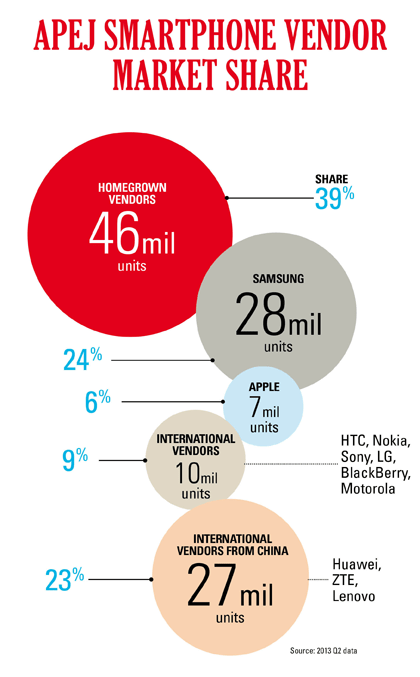
Homegrown brands are gaining more market share in the Asia-Pacific (excluding Japan) (APEJ) smartphone market. While Samsung continues to lead the smartphone pack, Apple fell out of the top five in the region for the first time. Chinese players — Lenovo, Coolpad, Huawei and ZTE — all outshipped Apple in the Q2, according to the IDC Asia/Pacific Quarterly Mobile Phone Tracker.

Aside from the top-tier international brands or Chinese brands that also ship globally such as Huawei and ZTE, there is also a rising segment of homegrown brands, which as a group have been steadily rising in shipments and prominence. This group of players comprised 38 percent of Q2 volume, up from 20 percent in the same quarter of 2012, and 7 percent in Q2 2011.
“There is clearly a market maturity story at play here, where the trends could not be more different between mature markets and emerging markets,” said Melissa Chau, Senior Research Manager with IDC AP’s Client Devices team. “Seasonally, second quarter usually shows an uptick in mature markets, but this round shipments dropped by 12 percent quarter-on-quarter, while emerging markets increased by 13 percent.

China’s top five vendors grab 20% of the world’s smartphone market

CanalysSamsung and Apple grew smartphone shipment by 55 percent and 20 percent respectively to maintain first and second place in Q2, according to Canalys.

However, both lost market share to Chinese vendors as the top 5 China vendors (Lenovo, Yulong, Huawei, ZTE, and Xiaomi) now account for 20 percent of the  market, up from less than 15 percent a year ago.

Altogether, some 238.1 million units were shipped in Q2, an impressive 50 percent year-on-year gain.

Global mobile phone market up 6% in Q2

IDCDemand for mobile phones continue to grow. In Q2, the worldwide mobile phone market grew six percent year over year, according to the IDC Worldwide Quarterly Mobile Phone Tracker.

Vendors shipped a total of 432.1 million mobile phones in Q2 compared to 407.7 million units in the corresponding quarter of 2012. The Q2 total was also slightly higher than the 428.8 million units shipped in Q1.

The growth in the mobile phone market was partly driven by vendors from outside the Top 5 who experienced torrid shipment growth that outpaced the overall market. Several vendors, including Alcatel and Huawei, had high double- and triple-digit growth rates in Q2 for their Android-based offerings shipped to high-growth countries such as China and India. These vendors from outside the Top 5 accounted for 44.8 percent of the overall shipment volume, up from 42.2 percent in the same quarter one year ago.

Huawei introduces MediaPad 7 Vogue

When Samsung launched the 5.3-inch Galaxy Note in October 2011, critics scorned at the size of the phablet and wondered if people would actually buy the product. In under two years, the Galaxy Note has not only proven to be a success but has become the trailblazer to bigger-screen phones.

The latest iteration is the Huawei MediaPad 7 Vogue, which sports a 7-inch display, aluminum unibody and quad-core processor.

We’re delighted to introduce the MediaPad 7 Vogue, our call-enabled tablet with world-class entertainment capabilities and long-lasting battery power,” said Richard Yu, Chief Executive Officer of Huawei Consumer Business Group. 

Huawei unveils slim Ascend P6 smartphone

Huawei Ascend P6Claimed to be the world’s slimmest smartphone at 6.18mm, the Huawei Ascend P6 weighs just 120g. Packed into this sleek design are a 1.5GHz quad-core processor, Android 4.2.2 operating system, 2000mAh battery, 4.7-inch HD in-cell LCD screen technology, and ‘MagicTouch’ for enhanced screen responsiveness even when wearing gloves.

As the flagship smartphone of the Huawei Ascend P series, it is targeted at the fashion conscious. The smartphone’s brushed metallic look with a naturally curved base is both elegant and intuitive.

“The Huawei Ascend P6 is a star among smartphones with its industry-leading design, high-quality camera, and intuitive user interface, Huawei’s proprietary Emotion UI,” said Richard Yu, Chief Executive Officer of Huawei Consumer Business Group.

Huawei and ZTE lead in global ON market

ovumZTE has overtaken Alcatel-Lucent to slot just behind leader Huawei in the global optical networking (ON) market. This is the first time that Chinese vendors are holding the top two ranks in ON, according to Ovum.

Ovum’s analysis of Q1 results in the US$14.5b global ON market has highlighted that growth in 100G remains a bright spot as annualised revenues exceeded $1b for the first time ever. However, market growth overall remains difficult and challenging equipment vendors with only Fujitsu posting sequential and year-over-year gains.

“While it is not uncommon for the market to decline going into the first calendar quarter, the decline is worrisome as this is the fifth straight time the market has declined versus the prior year’s quarter, and quarterly revenues are the lowest they’ve been in six years,” said Ron Kline, Network Infrastructure Analyst at Ovum.

IDC: Smartphones top feature phone shipment in Q1

IDCSamsung led the smartphone market as smartphones outshipped feature phones for the first time in Q1. According to IDC (see table below), Samsung not only maintained its pole position but widened its market share lead over Apple in the smartphone market. However, LG showed the most percentage improvement in this category with a 110 percent jump year-on-year.

Top Five Smartphone Vendors, Shipments, and Market Share, Q1 (Units in Millions) 

Vendor

1Q13 Unit Shipments

1Q13 Market Share

1Q12 Unit Shipments

1Q12 Market Share

Year-over-year Change

Samsung

70.7

32.7%

44.0

28.8%

60.7%

Apple

37.4

17.3%

35.1

23.0%

6.6%

LG

10.3

4.8%

4.9

3.2%

110.2%

Huawei

9.9

4.6%

5.1

3.3%

94.1%

ZTE

9.1

4.2%

6.1

4.0%

49.2%

Others

78.8

36.4%

57.5

37.7%

37.0%

Total

216.2

100.0%

152.7

100.0%

41.6%


The worldwide mobile phone market grew 4 percent year over year in the seasonally slow Q1. IDC’s Worldwide Quarterly Mobile Phone Tracker reports that vendors shipped a total of 418.6 million mobile phones in Q1 compared to 402.4 million units in Q1 of 2012 and 483.2 million units in Q4 of 2012.