
ZTE has launched the Net Sphere home networking solution, which comprises multiple home networking terminals including a wireless router, portable APs and wireless PLC adapters to let users build high-quality home networks. The solution uses a wired […]
1m out-of-school Filipinos to get access to mEducation
 GSMA is collaborating with the Philippines government agencies and all mobile network operators across the K-12 spectrum to provide up to one million Filipino out-of-school youths (OSYs) with additional opportunities to access education, including technical vocational (tech-voc) education, via mobile media.
The ground-breaking cooperation on mEducation involves government partners including the Philippines Department of Education (DepEd) and the Technical Education and Skills Development Authority (TESDA), and mobile operators Digitel Mobile Philippines Inc. (DMPI), Globe Telecom and Smart Communications.
The operators are co-operating to complement the efforts of multiple government agencies by extending knowledge to OSYs, especially those in underserved areas and geographically isolated communities, with the support and reach of mobile technology. The National Statistics Office of the Philippines reports that in 2011, there were at least 6.24 million out-of-school youths in the country.
China ships 110 million mobile phones in Q2
China’s mobile phone shipments reached 110 million in Q2, with smartphones accounting for 86 million units, according to IDC. “The smartphone market has maintained a two-digit quarter-on-quarter growth rate in Q2 due to two reasons. First, […]
ZTE launches world’s largest capacity data centre switches
 ZTE has released the BigMatrix 9900 series, the world’s largest-capacity data centre switches designed for large cloud computing and big data scenarios.
The new switches will helpscustomers achieve higher-density deployment in data centres. Each single slot can support up to 144 10G ports, 36 40G ports, or 12 100G ports. The Big Matrix 9900 series comprises four models, 9916, 9912, 9908, and 9904, with each unit supporting maximum switching capacity of 84.48T. Big Matrix 9900 meets the oriented service architecture (OSA) standards.
For big data systems, BigMatrix 9900 provides customers the capability to extract non-structurised and non-relevant data from existing databases. BigMatrix 9900 also adopts modular system design, and can be used to build a super-resilient non-blocking bi-directional forwarding platform with the switching capacity of 1.4P (1,440T) in Fat-Tree mode.
Blackberry to change hands
 Blackberry has agreed to be sold to Fairfax Financial Holdings for US$4.7 billion.
Fairfax, which already owns around 10 percent of BlackBerry, will pay US$9 per share for Blackberry, and take the company private. However, the deal is not done yet as Fairfax can walk away any time under the terms of the agreement.
“Unless Fairfax plans to radically change or accelerate BlackBerry’s strategy, it’s unlikely to be able to turn the company around. And that means we’re likely seeing the beginning of the end for one of the most iconic brands in mobile technology,” said Jan Dawson, Chief Telecoms Analyst of Ovum.
Microsoft introduces Surface 2 powered by NVIDIA Tegra 4
 Microsoft has introduced Surface 2, the successor to the ill-fated Surface RT, for which the company booked a US$900 million loss. So, what’s the difference between the first iteration and this new version?
“Surface 2 is not subtle, but is a revamp. It is not the simple changes that everybody wants, but it’s the changes people need,” said Panos Panay, Surface Chief of Microsoft.
It’s powered by the NVIDIA Tegra 4, which should provide a major performance boost over the first-generation Surface RT tablet. The chip’s ARM Cortex-A15 quad-core CPU and 72 GeForce GPU cores should help the device fly across web browsing, zip through Office applications and deliver immersive DirectX gaming experiences.
Promotions help drive ANZ inkjet market
 The ANZ inkjet printer market expanded in Q2, thanks largely to heavy price and bundling promotions particularly within the entry level segment, according to IDC. This augmentation was further supported by the growth of high-end machines that served as a replacement for colour laser printers.
Unit shipments increased 2 percent to about 443,000 although they dropped by 3 percent on a year-on-year basis
“The second quarter of 2013 saw aggressive promotions on various levels including price, bundling, cash back, catalogue promotions as well as TV commercials. Continued traction within the photographic printer segment and augmentation of A4 inkjet printers that could print A3 added to the positive development. However, with the close of financial year in March for certain vendors, this expansion was offset due to the limited in-take of new stock on the back of already existing stock in their channel,” said Arunachalam Muthiah , Market Analyst of Peripherals Research of IDC New Zealand.
Samsung rolls out Galaxy Tab 3 (10.1-inch) with LTE in Singapore
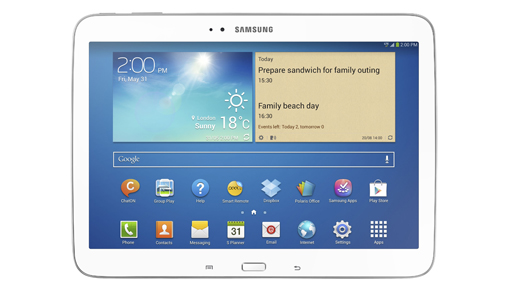 Just when you thought that the Galaxy line-up was packed, Samsung has unleashed yet another model — the Galaxy Tab 3 (10.1-inch) with LTE in Singapore.
Offering an expanded range of options along with previously announced 7-inch and 8-inch versions, the Galaxy Tab 3 (10.1-inch) with LTE is packed with enhanced content and intuitive design for viewing or sharing content.
Stacked with a 1.6 GHz Dual Core processor, it features a comprehensive suite of video, music, and photo software, making it ideal for mobile entertainment.
Apple and Samsung clamouring for attention with new colours
Apple and Samsung are slugging it out for attention in Singapore and across Asia. Yesterday, Apple fans in Singapore queued to be among the first to lay their hands on the Apple iPhone 5s and […]
ViewSonic launches new projectors with dual pen interactivity and advanced connectivity
 ViewSonic has introduced a new PJD8 series of projectors — PJD8653ws, PJD8333s and PJD8633ws — that features dual pen interactivity and advanced connectivity functionality.
“When it comes to ultra short throw projector solutions, it’s common that manufacturers will offer either reflective mirror technology or direct projection technology, but we feel it is important to offer our customers both. Paired with advanced interactive and connectivity features, our brand new PJD8 series delivers the opportunity of choice, not chance.,” said Roger Chien, Product Manager of ViewSonic
This new ultra short throw, networkable series allows the projector to be mounted right above a whiteboard or screen without creating hot spots, shadows or casting bright light in front of the presenter, making it perfect for smaller or difficult projection spaces like classrooms and meeting rooms.
kalahari.com accelerates market expansion with hybris
k alahari.com has selected hybris Commerce Suite to power its retail vision forward, strengthen its position as an innovative market leader, and fast-track market growth selling both digital and physical goods via its online stores and marketplaces.
As Africa’s leading online retailer of electronics, toys, appliances, games and books, kalahari.com will leverage hybris Commerce Suite to respond to growth opportunities and further extend its market share in the fast growing Southern African commerce market.
Providing a true omni-channel experience, the scalability of the hybris Commerce platform will enable kalahari.com to support its rapidly expanding online operations, which include consumer-to-consumer (C2C) and business-to-consumer (B2C) retail, and deliver a feature-rich experience to a growing number of mobile shoppers. This will include selling digital goods such as eBooks, via kalahari.com’s own e-reader device the Gobii, and a large expansion of its online catalogue of digital and physical goods.
NVIDIA Tegra Note coming soon
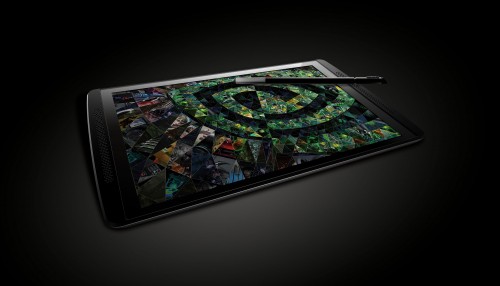 At this year’s Computex, NVIDIA gave a preview of a tablet, tentatively called Tegra Tab, that leverages the NVIDIA DirectStylus technology, which significantly improves passive stylus performance.
That device is now called NVIDIA Tegra Note and will be available in the next few months. Designed by NVIDIA, it will be marketed by NVIDIA partners including Colorful, Shenzhen Homecare Technology, XOLO, and ZOTAC XOLO in Asia-Pacific.
The suggested retail price for the Android-based device is US$199, making it highly competitive in the growing tablet space.
Local smartphone makers best Apple in China market
 To most people around the world, Coolpad, Lenovo and Xiaomi don’t quite ring a bell when it comes to smartphones. But, in China, these three Chinese smartphone OEMs outsold Apple in Q2, according to ABI Research.
Only Samsung managed to hold its own but snaring a 17 percent market share. Lenovo was next with 13 percent, Coolpad with 10 percent and Xiaomi edged out Apple with 6.5 percent.
“Even though these OEMs are only selling into the Chinese market, the size of the market has allowed them to achieve shipment volumes that place these OEMs in the top 12 globally. It is not hard to imagine these OEMs as global competitors within the next two years,” said Michael Morgan, Senior Analyst of ABI Research.
Samsung Galaxy Note 3 available in HK on Sep 25
 The much awaited Samsung Galaxy Note 3 will be available in Hong Kong on September 25. Coming in black and white, the suggested retail price of the 3G and 4G LTE versions are HK$5,998 andHK$6,198 respectively.
The phablet packs innovative features where users can enjoy captivating viewing experience on the 5.7-inch full HD Super AMOLDED screen that offers a stunning and divine viewing experience with a clear canvas for content creation. It also comes with an enhanced S Pen and multitasking features.
“Some people may often feel that the latest gadgets out there offer a contradicting feeling to our users because while you’re very engaged with your product, you tend to neglect the things around you. With the latest Galaxy Note 3, you will be able to enjoy a delightful mobile experience that brings passion to life,” said Yiyin Zhou, Director of Telecom Business, Samsung Electronics Hong Kong Limited.
NVIDIA appoints new CFO
NVIDIA has named Colette Kress, a 24-year veteran of the tech industry, as Executive Vice President and Chief Financial Officer. The appointment takes effect later this month. Kress most recently served for three years as Senior […]
ZTE unveils world’s first flexible reconfigurable terabit router
ZTE has unveiled the world’s first flexible reconfigurable terabit router to enable customers to build the highest-performance broadband networks.
The terabit router supports the deployment of multiple line cards with processing capability of 10 gigabits per second to 1T, and modules that offer scalable throughput of 200G to 18T. To enable convenient installation in a wide variety of environments, the flexible interfaces and loose-coupled component design of the router allow customers to configure networks that are customised for their needs, promoting adaptability, consistency and continuity.
The superior performance of the terabit router is built on two proprietary ZTE technology solutions, cloud routing and intelligent system resource scheduling. Cloud routing builds system control plane based on distributed modular technology to ensure efficient network resource utilisation, offering network scalability and support for simultaneous deployment of multiple transmission protocols. Intelligent system resource scheduling enables physical and logic system resource sharing and flexible scheduling to ensure automatic matching of system load and resource allocation, driving superior power-consumption performance of 0.8W/Gbps.
1 in 4 homes watching TV with Cisco
 Cisco has an innovative approach to pay TV that has enabled it to gain and maintain its industry leading position. With more than 300,000,000 homes around the world watching TV with Cisco, nearly a quarter of all global TV homes are now enjoying improved viewing experiences.
While 80 percent of the world’s homes have access to TV, fewer than half of them are benefiting from digital and the additional functionality that it can enable. At the other end of the spectrum, the amount of video traversing IP networks is set to reach a record 88 exabytes a month by 2017, with 914,100 minutes of video streamed or downloaded every second – all with less than 50 percent of the world’s population connected to the Internet.
Building on over 20 years of experience driving new services and profitable growth for pay-TV operators and the media and entertainment industry, Cisco can help the industry capture the huge opportunities being generated as every network attached device becomes video capable and consumers seek ubiquitous video access.
Philippines CRM outsourcing market still attractive
 The Philippines continues to be one of the most attractive destinations for outsourcing, fuelled largely by competitive price points and significant pools of labour with English language skills, according to Ovum.
New research focused on CRM suppliers in the Philippines found potential within the industry as a non-voice and non-English-speaking delivery center. Furthermore, as the country’s economy continues to expand, outsourcers will see greater opportunities to serve the increasingly sophisticated domestic market.
“Following our visit to the country and our on-the-ground research, it is clear to us that the Philippines will remain one of the powerhouses among offshore front-office outsourcing destinations,” said Margaret Goldberg, Associate Analyst, IT Services at Ovum and co-author of the report. “The combination of a significant cultural disposition towards customer service and affinity to Western cultures, strong English language capabilities and competitive price points will ensure that the outsourcing industry in the country will continue to see strong growth for years to come.”
Tablets to outship PCs in Q4
Tablets and smartphone shipment will continue to drive growth in 2013, according to IDC, which expects tablet shipment to surpass total PC shipment (desktop plus portable PCs) in Q4. The worldwide smart connected device market, comprising PCs, tablets, and smartphones, is forecast to grow 27.8 percent year over year in 2013, slightly lower than the 30.3 percent growth in 2012.
PCs shipment is still expected to be greater than tablet shipment for the full year, but IDC forecasts tablet shipments will surpass total PC shipments on an annual basis by the end of 2015. Smartphones will continue to ship in high volumes, surpassing 1.4 billion units in 2015 and accounting for 69 percent of all smart connected device shipments worldwide.
In terms of shipment value, the worldwide smart connected device market will again exhibit double-digit year-over-year growth of 10.6 percent in 2013, but this growth will gradually slow to just 3.1 percent in 2017. The tapering revenue forecast reflects the increasing impact of low-cost smartphones and the white box tablet market.
ZTE Grand Memo LTE to become first 4G device in China
ZTE’s Grand Memo LTE is poised to become the first 4G device available for sale in China, after it became the first to be awarded a TD-LTE handset permit by the Ministry of Industry and […]
Global smartphone shipment to hit 1b in 2013
 One billion smartphones are expected to be shipped this year, helping the global mobile phone market to rebound from just 1.2 percent growth in 2012 to 7.3, percent in 2013, according to IDC Worldwide Quarterly Mobile Phone Tracker.
The overall mobile phone market is growing faster than previously forecast thanks to a stronger-than-expected first half of the year driven by strong gains in emerging markets and the sub-US$200 smartphone segment. IDC previously projected 5.8 percent growth for the year. Vendors are now forecast to ship more than 1.8 billion mobile phones this year, growing to over 2.3 billion mobile phones in 2017.
Worldwide smartphone shipment is forecast to grow 40.0 percent year over year to more than one billion units this year. High smartphone growth is the result of a variety of factors, including steep device subsidies from carriers, especially in mature economic markets, as well as a growing array of sub-US$200 smartphones. Total smartphone shipment is forecast to reach 1.7 billion units in 2017.
Xiaomi introduces world’s first NVIDIA Tegra 4-powered super phone
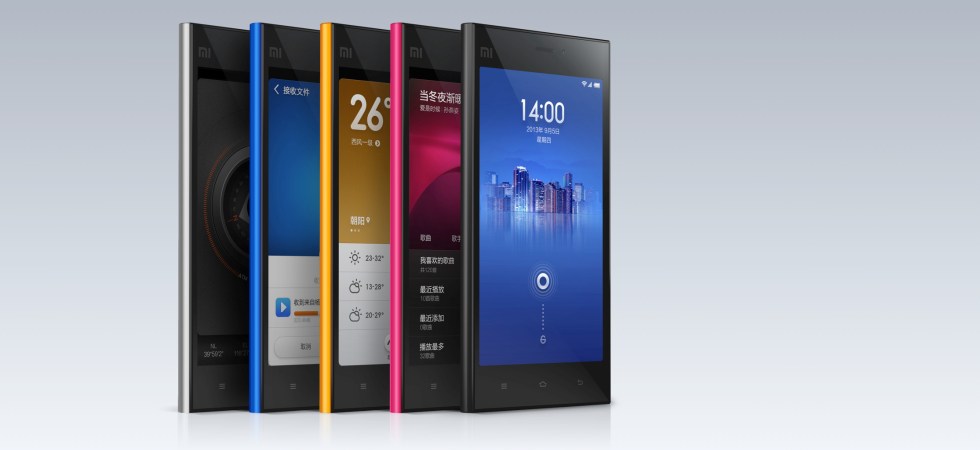 China mobile device maker Xiaomi has announced the Xiaomi Mi3, the world’s first to be based on the NVIDIA Tegra 4 mobile processor.
Delivering superb gaming and lightning-fast web browsing, the flagship phone represents the first collaboration between NVIDIA and Xiaomi. The Mi3 will launch on China Mobile, the world’s largest carrier, in October.
Based on the Tegra 4 – the world’s fastest mobile processor — the phone combines premium specs and features with all-day battery life. In addition to Tegra 4, it includes a 5-inch 1080p full HD display with 441ppi, 2GB RAM and up to 64GB of storage. The Tegra 4 processor offers record levels of performance and battery life with its 72-core NVIDIA GeForce GPU, quad-core ARM Cortex-A15 and fifth battery-saver CPU core, also based on Cortex-A15.
Android mobile app revenue to hit US$6.8b this year
 Android’s smartphone mobile app revenues are projected to reach almost US$6.8 billion by the end of 2013, nearly doubling its revenues from the previous year, according to ABI Research.
The Android platform has some way to go before catching iOS’s smartphone revenues but the smartphone app market will be Android’s most fruitful hunting ground compared to other devices.
ABI Research estimates that Android smartphone app revenues will increase from 59.1 percent to 65.9 percent when compared to iOS smartphone app revenues over the next 12 months.
Mobile privacy concern could limit widespread adoption of mobile apps in Malaysia and Indonesia
Mobile users in Malaysia and Indonesia are concerned with mobile privacy, according to a new research by GSMA and local mobile operators.
The study of more than 1,500 Malaysian and Indonesian mobile users shows that increased transparency and choice in how their personal data is collected and shared could boost take-up of mobile apps in Indonesia. The mobile apps market globally is worth US$29 billion and growing at 36 per cent per annum. The research was presented at a Data Protection and Privacy Conference hosted by the GSMA, Celcom Axiata and DiGi in Kuala Lumpur.
“It is clear that mobile users are concerned about their privacy and are more likely to interact with apps and receive targeted promotions if they feel it is respected,” said Tom Phillips, Chief Government and Regulatory Affairs Officer of GSMA.
ViewSonic introduces full HD 3D projector for office and home entertainment
 ViewSonic has announced the new Full HD 1080p 3D projector for office and home entertainment in Singapore. The ViewSonic PJD7820HD offers best in class price-performance Full HD 1080p 3D projector with 3,000 ANSI lumens and 15,000:1 contrast ratio.
It comes integrated with 3,000 lumens for a clear, bright image even in well lit rooms – perfect for watching sports or playing on games consoles during daylight. The 15,000:1 contrast ratio ensures black colours don’t appear grey while BrilliantColour technology delivers breathtaking colour reproduction.
“As more and more business applications run on high definition resolution, the demand for 1080p projectors in the business world has been on the rise,“ said Vincent Hung, Product Manager of ViewSonic. “Our new PJD7820HD offers best in class price-performance for a Full HD 1080p 3D projector on the market today, making it the ideal crossover model for SMBs, corporate and home office consumer use.”
Asian brands boost APAC smartphone shipment
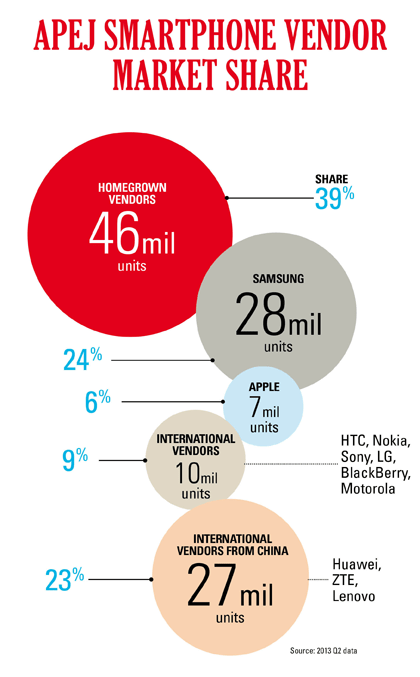
Homegrown brands are gaining more market share in the Asia-Pacific (excluding Japan) (APEJ) smartphone market. While Samsung continues to lead the smartphone pack, Apple fell out of the top five in the region for the first time. Chinese players — Lenovo, Coolpad, Huawei and ZTE — all outshipped Apple in the Q2, according to the IDC Asia/Pacific Quarterly Mobile Phone Tracker.
Aside from the top-tier international brands or Chinese brands that also ship globally such as Huawei and ZTE, there is also a rising segment of homegrown brands, which as a group have been steadily rising in shipments and prominence. This group of players comprised 38 percent of Q2 volume, up from 20 percent in the same quarter of 2012, and 7 percent in Q2 2011.
“There is clearly a market maturity story at play here, where the trends could not be more different between mature markets and emerging markets,” said Melissa Chau, Senior Research Manager with IDC AP’s Client Devices team. “Seasonally, second quarter usually shows an uptick in mature markets, but this round shipments dropped by 12 percent quarter-on-quarter, while emerging markets increased by 13 percent.
Hong Kong to stay as key Asia Pacific data centre market
 Limited land availability and high real estate prices are unlikely to make Hong Kong lose its status as a key data centre market in Asia Pacific, according to Frost & Sullivan.
The limitations are countered by the Hong Kong Government’s continuous support for the sector.
“Hong Kong’s strong political connection to Mainland China allows it to act as a gateway for global companies that seek to tap into opportunities in China’s market,” said Danni Xu, Research Analyst, ICT Practice, Asia Pacific at Frost & Sullivan. “Moreover, Hong Kong’s business-friendly and free-trade environment has drawn a number of multinational corporations (MNCs) to set up their regional headquarters in the country. This has brought in numerous investments and job opportunities, and created demand for data center services.”
NVIDIA and Ubisoft team up for latest games
 NVIDIA has formed an alliance with Ubisoft to offer PC gamers the best gaming experiences possible for Ubisoft’s biggest fall titles, including Tom Clancy’s Splinter Cell Blacklist, Assassins Creed IV Black Flag and Watch Dogs.
NVIDIA’s developer technology team is working closely with Ubisoft’s development studios on incorporating graphics technology innovations to create game worlds that deliver new heights of realism and immersion. One example is NVIDIA® TXAA™ antialiasing, which provides Hollywood-levels of smooth animation, soft shadows, HBAO+ (horizon-based ambient occlusion) and advanced DX11 tessellation.
“PC gaming is stronger than ever and Ubisoft understands that PC gamers demand a truly elite experience — the best resolutions, the smoothest frame rates and the latest gaming breakthroughs,” said Tony Tamasi, Senior Vice President of Content and Technology at NVIDIA. “We’ve worked closely with Ubisoft’s incredibly talented creative team throughout the development process to incorporate our technologies and deliver the most immersive and visually spectacular game worlds imaginable.”
Tommy Bahama partners hybris to seize market opportunities

Tommy Bahama, which has an outlet in Wisma Atria, Singapore, has selected hybris Commerce Suite to improve its omni-channel commerce capabilities and create a more agile response to expanding market opportunities.
A leading retailer of island-inspired apparel and home furnishings, the brand has achieved rapid growth in online commerce over the past few years. In addition to the web, Tommy Bahama offers in-store kiosks, a commerce channel that enables an “endless aisle” of products available through the e-commerce warehouse, allowing shoppers to access out-of-stock or online exclusive items directly in-store.
To ensure the brand’s continued global expansion and establish a foundation for market and channel growth, Tommy Bahama needed a robust commerce platform capable of integrating with its existing Adobe Experience Manager solution to deliver a world-class, end-to-end user experience across all channels. hybris not only complements the Adobe Experience Manager but enables it to further create and deliver a heavily optimised user experience.
Samsung tops ABI Research’s tablet competitive assessment
Korean giant Samsung has nudged aside all competition in ABI Research’s assessment of 19 top tablets.
The competitive assessment ranked companies on several criteria related to both product implementation and vendor innovation.
Samsung bested all other tablet vendors in the innovation category while scoring second overall in the implementation category. Clearly king of the hill when it comes to tablet shipment volumes, Apple trailed Samsung on tablet Innovation landing in second.
WeChat soars past 100m registered users milestone
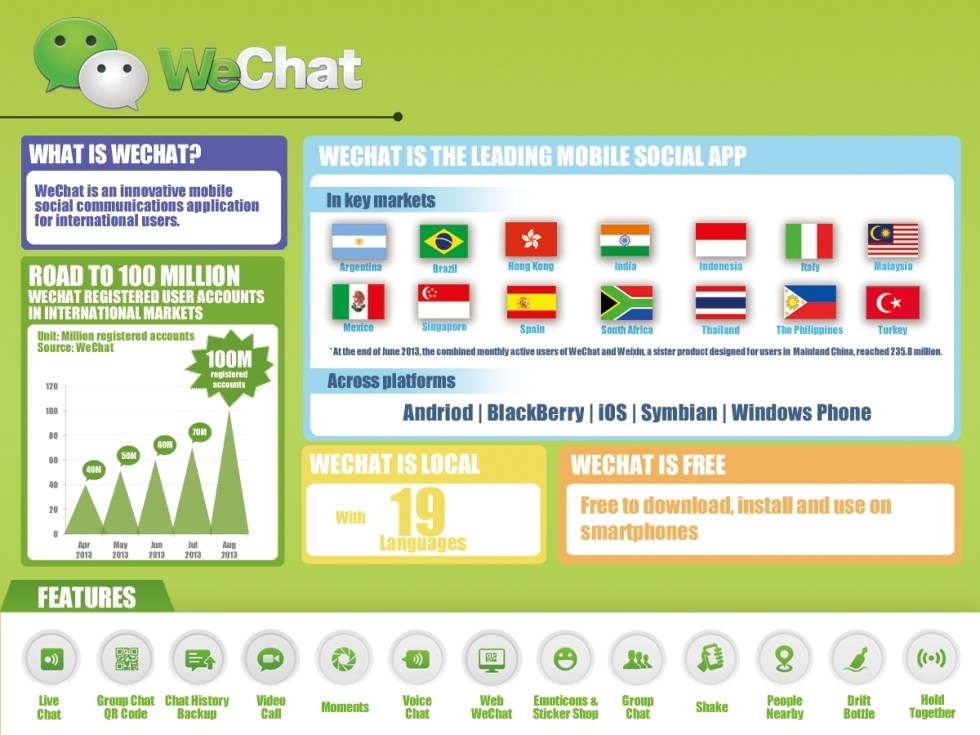 WeChat has surpassed the 100 million registered user account milestone. That’s remarkable considering the strong competition it is up against.
In the last three months, it doubled its registered user account base reaching the 100 million milestone shortly after an independent survey found that the platform was the fifth most used smartphone app worldwide.
Since its international debut, WeChat has been well received in Asia, quickly becoming the most popular mobile social app in Hong Kong, India, Indonesia, and Malaysia across multiple smartphone OS platforms, where the user base has recently gained tremendous growth.
Low cost smartphone shipment to exceed 750m in 2018
Shipment of smartphones costing under US$200 are expected to grow from 238 million in 2013 to 758 million by 2018, driven by the low penetration of smartphones and large subscriber bases found in BRIC countries, according […]
SAP and hybris to tap “customer engagement” market
Customer engagement — that’s what SAP and hybris hope to deliver as a new category of enterprise software. It’s about providing customers with a consistent unified experience. Leveraging the omnicommerce expertise of hybris and the enterprise […]
Tablets fail to lift flat PC market in Q2
Tablet shipment’s growth 42.9 percent iwas not enough to lift a sluggish PC market in Q2. Desktop and notebook shipments fell 7.4 percent and 13.9 percent respectively, according to Canalys, which believes that tablets will outsell notebooks by Q4.
PC shipment in the Asia Pacific region declined 0.5 percent year-on-year to just over 40 million units. The region was badly affected by slow shipment in China, which accounted for almost 45 percent of the region’s shipment and declined by about six percent.
Demand for smartphones and tablets is increasing around the world. Faced by an industry in transition, channel partners are exercising caution when planning and placing orders.

China’s top five vendors grab 20% of the world’s smartphone market
 Samsung and Apple grew smartphone shipment by 55 percent and 20 percent respectively to maintain first and second place in Q2, according to Canalys.
However, both lost market share to Chinese vendors as the top 5 China vendors (Lenovo, Yulong, Huawei, ZTE, and Xiaomi) now account for 20 percent of the market, up from less than 15 percent a year ago.
Altogether, some 238.1 million units were shipped in Q2, an impressive 50 percent year-on-year gain.
Samsung dominates almost every device price point
Samsung has a device for every price point, giving it leadership in all, bar one category — the high end where it faces Apple.
According to ABI Research’s Device Portal sales channel analysis, the balance of power remains with Samsung/Android and Apple and looks set to remain so in the foreseeable future.
“This leaves little room for the other vendors to compete, especially the other Android vendors and those using uncompetitive operating system ecosystems. Despite some carrier’s efforts to create a more balanced smartphone device vendor industry with their use of subsidy, ultimately they are obliged to fulfill consumer demand and at the moment that means Samsung/Android and Apple,” said Nick Spencer, Senior Practice Director of ABI Research.
Samsung expands ATIV lineup
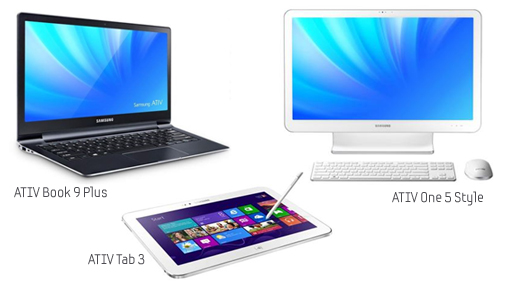 Samsung has boosted its ATIV lineup with four new Windows 8 devices — ATIV Book 9 Plus and ATIV Book 9 Lite notebooks, ATIV Tab 3 tablet and ATIV One 5 Style all-in-one desktop PC.
Also introduced is a new feature called HomeSync Lite, which transforms the PC’s hard drive into a personal cloud server. HomeSync Lite lets users to backup their personal files, photos and videos from portable devices to PCs and access them remotely via a mobile device anytime, anywhere.
The ATIV Book 9 Plus is the next generation of the ATIV Book 9, which is ultra thin and light. Its aluminium, uni-body design features several enhancements from the previous model, including a Windows 8 optimised touchscreen to give users a choice of inputs and a panel that flips 180 degrees so that users can change or share their perspective easily. The notebook will be available in mineral ash black from Q4 at major consumer electronics and IT stores and Samsung Experience Stores.
Android-based tablets outship iPads in Q2
Three in 10 PC shipped in Q2 were tablets. According to Canalys, more than 34 million tablets were shipped in Q2, a 43 percent year-on-year increase. Even more impressive is the fact that tablets now account for 31 percent of worldwide PC shipments.
The charge is led by Android-based tablets as Apple’s tablet shipments declined 14 percent in Q2 and saw its market share shaved to 43 percent. The chasing pack of Samsung, Amazon, Lenovo, and Acer each grew annually by over 200 percent, driven by increasing demand for small-screen tablets.
Canalys estimates that 68 percent of tablets shipped in Q2 had a screen size smaller than nine inches. “Consumers have been evaluating tablets and the results are now in,” said Tim Coulling, Senior Analyst at Canalys . “With touchscreens contributing to a high proportion of the build cost of a tablet, small-screen products can be priced very aggressively.”

SAP completes hybris acquisition
 SAP is investing in the future of commerce and customer engagement with its acquisition of hybris. The two companies plan to combine the agile omni-channel commerce solutions of hybris with robust enterprise technology and industry leading in-memory, cloud and mobile innovations from SAP to help facilitate new levels of customer insight and engagement.
“SAP and hybris will deliver the next-generation customer experience for businesses and consumers in a world where digital and physical converge seamlessly,” said Bill McDermott and Jim Hagemann Snabe, co-CEOs, SAP AG. “With the addition of the hybris commerce platform, we intend to help enterprises achieve unprecedented intimacy with customers in real time and across all devices, delivery channels and touchpoints.”
The rules of engagement have changed and customers are in control. Modern businesses need systems that can predict and adapt in real time to customers wherever and however they engage. hybris expands SAP solutions that address customer engagement comprehensively across marketing, sales, service and commerce. As part of SAP, hybris is expected to take advantage of mobile, cloud and big data innovations from the company while continuing to drive forward the most modern, agile commerce platform in the market today.
ZTE corners 5% of global smartphone market
ZTE has grabbed five percent of the global smartphone market, catapulting it into fourth worldwide, according to Strategy Analytics. The 11.5 million smartphones shipped in Q2 represented a 79 percent year-on-year increase. The China smartphone maker will […]
Samsung debuts Galaxy Tab 3
Samsung has announced the new eight-inch GALAXY Tab 3 that sports a slim bezel that makes it easier to read and have a more engaging multimedia experience. The physical keys on the bezel at the bottom […]
NVIDIA acquires PGI
NVIDIA has made further inroads into high performance computing (HPC) with the acquisition of The Portland Group (PGI), a leading independent supplier of compilers and tools. Founded in 1989, PGI has a long history of innovation […]
Rhythm & Hues Studios creates award-winning visual effects with NVIDIA GPUs
 By Edward Lim, Managing Consultant, CIZA Concept
Founded in 1987, Rhythm & Hues Studios is a visual effects company with corporate headquarters in El Segundo, California and production facilities in India, Malaysia, Canada, and Taiwan.
The studio has won the Academy Award for Best Visual Effects for Babe (1995), The Golden Compass (2008) and Life of Pi (2013), on top of four Scientific and Technical Academy Awards from the Academy of Motion Picture Arts and Sciences (AMPAS).
Computing power and unified platform needed
Lots of computing power are needed to create computer graphics imagery (CGI) in films. Besides this requirement, Rhythm & Hues also needed to standardize on a platform that can be used in its studios around the world. This unified platform is critical as work is shared and done concurrently in different parts of the world.
Global printing dips but APeJ bucks trend
Worldwide page volume from digital hardcopy devices has dipped to 2.98 trillion in 2012 from 3.03 trillion in 2011, a decline of 1.5 percent year over year, according to IDC.
However, in spite of the decline, the world continues to print at a good clip. Developed countries continued their negative page growth trend, driven by digital workflows, adoption of managed print services (MPS) and anemic economies. The silver lining for print volume in developed economies appears to be net new incremental pages from mobile devices.
While it may seem counter intuitive, smartphone and tablet users are generating more print volume compared to non-tablet/smartphone users.
ZTE introduces MF253 LTE wireless router with customised versions for different markets
 ZTE has launched the MF253 LTE wireless router that enables 4G mobile data access for homes, retail stores and offices.
With a sleek upright design, the MF253 supports data downlink speeds of 100Mbps, and 50Mbps for uplink, delivering high-speed mobile Internet access for up to 32 users simultaneously. It comes with a streamlined white chassis and blue indicator lights.
Customised versions for markets in the Americas, Europe and China ensure comprehensive support for a broad range of LTE spectrum used in different markets globally. Support for an external antenna will allow the MF253 to be deployed in areas of poor mobile signals.
Global mobile phone market up 6% in Q2
Demand for mobile phones continue to grow. In Q2, the worldwide mobile phone market grew six percent year over year, according to the IDC Worldwide Quarterly Mobile Phone Tracker.
Vendors shipped a total of 432.1 million mobile phones in Q2 compared to 407.7 million units in the corresponding quarter of 2012. The Q2 total was also slightly higher than the 428.8 million units shipped in Q1.
The growth in the mobile phone market was partly driven by vendors from outside the Top 5 who experienced torrid shipment growth that outpaced the overall market. Several vendors, including Alcatel and Huawei, had high double- and triple-digit growth rates in Q2 for their Android-based offerings shipped to high-growth countries such as China and India. These vendors from outside the Top 5 accounted for 44.8 percent of the overall shipment volume, up from 42.2 percent in the same quarter one year ago.
Sensors and gesture recognition are major smartphone differentiators
Accelerometers, vision-based gesture recognition, gyroscopes, and NFC are predicted to be the feature set big winners in smartphones in 2013, according to ABI Research.
“Gesture recognition is soon going to become a key differentiator in high-end flagship smartphones. Samsung’s latest Galaxy S4 has already incorporated the technology within its handset and has received significant plaudits for its new innovative user experience. Today’s consumers are becoming much savvier with their smartphones and they’re looking for new interesting ways to communicate with each other and their devices,” said Joshua Flood, Senior Analyst of ABI Research.
In 2013, almost 12 percent of smartphones shipped will have vision-based gesture recognition capabilities. It is unsure if Apple will include the technology in its next generation iPhone but the company is expected to include a full array of MEMS sensors and NFC.
Twistcode leverages GPU power for big data
By Edward Lim, Managing Consultant, CIZA Concept
F ounded in 2006, Twistcode does research and development in high performance computing technology, especially massive-parallel computing and applications using central processing units (CPUs) and graphics processing units (GPUs). It thrives in accelerating any repetitive algorithm and/or process in most environments.
With its focus on high performance computing, the young and dynamic company hopes to let its clients – enterprises and government organisations – concentrate on what’s important to them. It provides services such as rendering and modelling, and tweaks technologies and twist codes to adapt to customers’ needs.
Frustration over cell architecture
It was frustration over Sony’s cell architecture that prompted Twistcode to consider other options for its work.
NVIDIA unveils Quadro K6000 GPU

NVIDIA has unveiled the NVIDIA Quadro K6000 GPU and a new line of professional graphics GPUs for mobile workstations.
The Quadro K6000 GPU delivers five times higher compute performance and nearly double the graphics capability of its predecessor, the NVIDIA Quadro 6000 GPU, and features the world’s largest and fastest graphics memory.
Combining breakthrough performance and advanced capabilities in a power-efficient design, it enables leading organisations such as Pixar, Nissan, Apache Corporation, and the Weather Channel’s WSI division to tackle visualisation and analysis workloads of unprecedented size and scope.
NVIDIA Shield to ship on July 31
It’s official! NVIDIA has informed those who pre-ordered the NVIDIA Shield gaming portable that the product would be shipped to US and Canada customers on July 31. This is more than a month off its […]
China pulls down APAC PC market in Q2
The PC market slowdown continued in Q2 with Asia/Pacific (excluding Japan) dropping one percent last quarter and 11 percent year-on-year in Q2 to reach 26.7 million units, according to IDC’s preliminary results.
Weak sell-in amid ongoing consumer distractions, such as phones and tablets, as well as a slowing economy affected the PC market performance in China, which pulled the entire region down. While consumer sentiment in the rest of region was also tepid, a higher-than-expected shipment for a large education notebook project in India helped to offset some of this decline.
“The second half of this year still faces a number of challenges such as economic and channel conditions in China as well as uncertainty around an education project in India,” said Handoko Andi, Research Manager at IDC Asia/Pacific. “It’s possible for the market to bottom out and recover by 2014 as technology evolves, but IDC confidence is low at the moment given all of the forces tugging at each other right now.”
Allen Ma is new CEO of HKSTPC
 Hong Kong Science and Technology Parks Corporation (HKSTPC) has appointed Allen Ma as its new Chief Executive Officer (CEO), succeeding E Anthony Tan, who has held the position since April 2008.
Joining as CEO-designate on July 22 and taking office on August 1 , Ma believes technology plays a key role in fuelling Hong Kong’s economic transformation and will draw on his 30 years of industrial and business experience to increase the competitiveness of the city as a regional hub for science and technology innovation while building ever stronger collaboration with the Mainland.
His key focus will be to advance HKSTPC’s mission to provide world-class infrastructure and services and promote Hong Kong as a regional hub of innovation and technology.
Cellebrite introduces PC-based wireless retail solution
 Cellebrite has introduced Cellebrite DeskTop, a PC-based version of its suite of applications that increase revenue, boost margins and improve customer satisfaction in the store and beyond.
Cellebrite DeskTop includes fast phone-to-phone content transfer, back-up, and restore, a fully automated phone trade-in programme, application content and delivery, and robust diagnostics to “detect and correct” phone problems, in an integrated solution running in a Microsoft Windows environment.
It reduces total cost of ownership (TCO) by offering retailers the flexibility of running on a general-purpose PC, eliminating the added cost associated with dedicated hardware. Users will also benefit from unprecedented system performance, including fast content transfer.
Worldwide IT outsourcing market to grow to US$288b in 2013
 The worldwide IT outsourcing (ITO) market is predicted to reach US$288 billion in 2013, a 2.8 percent increase from 2012, according to Gartner. Compared with Gartner’s previous forecast, nearly all ITO segments are now forecasted to grow more slowly this year.
Gartner’s forecast includes slight upward revisions for both custom application outsourcing and infrastructure utility services (IUS) for 2014 through 2017. Although software as a service (SaaS) impacts the ITO market, it is forecasted as part of the software market, rather than as part of the ITO market.
“We continue to see overall market growth being constrained by near-term market factors, such as evolving ITO delivery models, economic, political and labor conditions, and service provider financial performance,” said Bryan Britz, Research Vice President at Gartner. “Mature Asia/Pacific and Western Europe are the regions where the outlook is most tempered, partly due to currency but also reflective of our view that 2013 is likely to be similar to 2012 in these regions.”
NVIDIA launches world’s first GPU-accelerated platform for geospatial intelligence analysts
 NVIDIA has launched the NVIDIA GeoInt Accelerator, the world’s first GPU-accelerated geospatial intelligence platform to enable security analysts to find actionable insights quicker and more accurately than ever before from vast quantities of raw data, images and video.
The platform provides defence and homeland security analysts with tools that enable faster processing of high-resolution satellite imagery, facial recognition in surveillance video, combat mission planning using geographic information system (GIS) data, and object recognition in video collected by drones.
It offers a complete solution consisting of an NVIDIA Tesla GPU accelerated system, software applications for geospatial intelligence analysis, and advanced application development libraries.
Cyber security for critical infrastructure to reach US$46b
Cyber security spending for critical infrastructure will hit US$46 billion by the end of 2013, according to ABI Research. Increased spending over the next five years will be driven by a growing number of policies […]
Huawei MediaPad 7 Youth tablet targets connected generation
Huawei is banking on the popularity of tablets among the younger generation with the launch of the Huawei MediaPad 7 Youth. Compact, sturdy and stylish with its aluminum metal unibody measuring just 9.9mm and weighing […]
Smart watches poised to take off in 2014
 Fancy a new accessory? How about a smart watch? It looks like smart watches are going to be the next “must have” item. According to Canalys, the worldwide smart watch market will exceed five million units in 2014.
Canalys estimates that over 330,000 smart watches were shipped in 2012, led by Sony and Motorola. Kickstarter-backed Pebble Technology has joined Sony as a market leader in 2013. More than half a million units will be shipped this year. Smart watches are then set to explode by the end of 2014, growing tenfold as a new generation of devices from Apple, Google, Microsoft, Samsung, and others are launched.
Unlike earlier products, these smart watches will provide more sophisticated software and more elegant hardware. Glanceable information, integration across sensors and hooks into web services will be key features. These companion devices will not replace smart phones, but rather complement them as ‘appcessories’.
ASOS leverages hybris for China e-commerce business
 UK online fashion and beauty store ASOS has selected the hybris Commerce Suite to launch its new e-commerce business in China. Providing an omni-channel experience for those 420 million potential customers, the site will include a fully-integrated, feature-rich mobile version.
With six million active customers, ASOS stocks more than 60,000 branded and own-label products through each of its websites: UK, USA, France, Germany, Spain, Italy, Australia, and Russia. It ships to 241 countries and territories from its 1.1 million square foot global distribution centre in the UK.
According to a report from eMarketer released in February 2013, this year’s B2C e-commerce sales are expected to grow 18.3 percent to US$1.298 trillion worldwide as Asia-Pacific (APAC) surpasses North America to become the world’s No. 1 market for B2C e-commerce.
Australia big on cloud computing
Australian enterprises are taking to cloud computing. According to IDC’s 2013 Australia End-User Cloud Survey, 86 percent of Australian enterprises were currently using cloud computing, up from 71 percent in 2012.
IDC observed that line-of-business (LOB) managers in leading-edge enterprises had begun to add to CIO’s cloud spending by direct acquisition of cloud services as a delivery mechanism for new competitive offerings within their own industries and marketplaces. This was validated by the survey results where the business unit (69.6 percent) was ranked higher than the IT department (59.8 percent) by the respondents when it came to the responsibility for selection of the service providers in their most recent cloud computing projects.
“Until 2012, cloud was primarily an IT label for IT infrastructure services delivered as a service. Now, cloud is no longer just an IT infrastructure play. Cloud-based business services being acquired by LOB managers will now drive growth in the use of externally sourced services. Cloud in 2013 is now business as usual for CIOs, IT managers, and LOB managers. By 2015, cloud will be just another delivery model for a range of “as-a-service” offerings that are based on infrastructure as a service (IaaS), platform as a service (PaaS), and software as a service (SaaS),” said Raj Mudaliar, Senior Analyst, Cloud Services Research at IDC Australia.
 Entelechy Asia