Category: Virtualisation

NVIDIA announces EGX edge supercomputing platform for AI, IoT and 5G

NVIDIA has announced the NVIDIA EGX Edge Supercomputing Platform which lets organisations deliver next-generation AI, IoT and 5G-based services at scale and with low latency. Along with annoucing this at his keynote address at the opening of Mobile World Congress in Los Angeles, NVIDIA Founder and CEO Jen-Hsun Huang declared that we have entered a new era, where billions of always-on IoT sensors will be connected by 5G and processed by AI.

IBM seals Red Hat deal

IBM has acquired Red Hat for US$34 billion, one of the biggest technology deals of all time — bettered only by Dell’s purchase of EMC for US$65 billion and Avago’s buyout of Broadcom for US$37 billion, both in 2015.

Private equity firm acquires Corel

Corel WordPerfect OfficeHands up if you’ve not heard of Corel before. Does the company sound vaguely familiar? Founded in the 1980s, this is a company that is well past its glory days. Corel used to be a well-known brand in the PC era with products such as Corel Draw and WinZip.

NVIDIA AI Conference keynotes: Transforming industries, creating AI infrastructure

The first NVIDIA AI Conference in Sydney on September 4 will kick off with two keynote addresses. Marc Hamilton, Vice President of Solutions Architecture and Engineering, NVIDIA, will talk about Transforming Industries With AI. Jason Humphrey (right), Head of Retail Risk, ANZ Bank, will then share on Creating the Infrastructure to Undertake Deep Learning.

VRgineers ups the notch in enterprise VR

VRgineers is harnessing the potential of the new NVIDIA Quadro GV100 GPU for its high-resolution virtual reality (VR) headset, enabling even complex 3D scenes, high-poly models and high-resolution textures to perform smoothly at full refresh rates.

NVIDIA DGX-2: Insanely powerful

NVIDIA CEO Jensen Huang (above) dubbed it the “world’s biggest GPU”. And he certainly wasn’t kidding as the NVIDIA DGX-2 is a massive 350-pounder that delivers an amazing two petaflops of computational power.

Emtech Asia: AI, quantum computing and more

Leonard wants to see more research become productised and commercialised.

Marina Bay Sands Expo and Convention Centre was a hive of activities of a different sort as more than 700 technologists from 21 countries converged for EmTech Asia on January 30 and 31.

Singapore’s AI agenda gets double boost!

NVIDIA Fellow Dr David Kirk
NVIDIA Fellow Dr David Kirk delivers the keynote address at the NVIDIA AI Conference.

Singapore’s aim to be an artificial intelligence (AI) hub has been boosted with two initiatives — the setting up of a shared AI platform for researchers and the awarding of scholarships to develop AI talents.

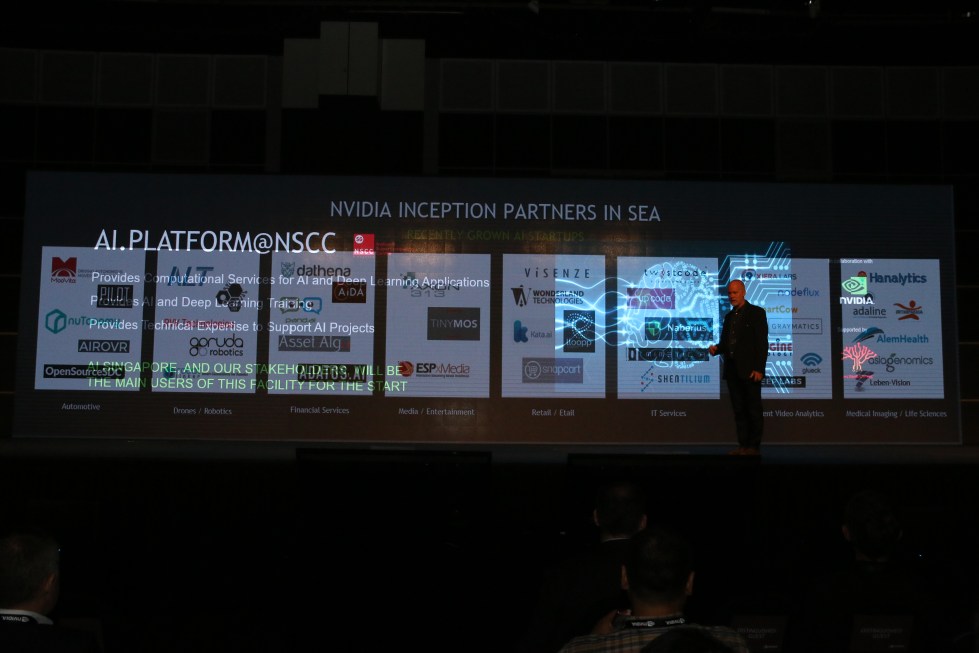
At the NVIDIA AI Conference in Singapore yesterday, NVIDIA and Singapore’s National Supercomputing Centre (NSCC) agreed to establish a platform to bolster AI capabilities among its academic, research and industry stakeholders and in support of AI Singapore (AISG), a national programme set up in May to drive AI adoption, research and innovation in Singapore.

Called AI.Platform@NSCC, it will provide AI training, technical expertise and computing services to AISG, which brings together all Singapore-based research and tertiary institutions, including the National University of Singapore (NUS), Nanyang Technological University (NTU), Singapore University of Design and Technology (SUTD), Singapore Management University (SMU), as well as research institutions in the Agency for Science, Technology and Research (A*STAR).

Tantalising line-up of speakers at NVIDIA AI Conference

More than 1,000 participants attending the NVIDIA AI Conference in Singapore next week are in for a treat as the organisers are bringing in a tantalising line-up of speakers.

The two keynote speakers are Dr David B Kirk, NVIDIA Fellow and inventor of more than 60 patents and patent applications relating to graphics design; and Dr Wanli Min, AI scientist of Alibaba Cloud, who will touch on A Revolutionary Road to Data Intelligence.

Besides these two, there are special guest-of-honour Chng Kai Fong, Managing Director of Singapore’s Economic Development Board, and a panel discussion on AI for the Future of Singapore Economy.

ICML: Gathering of the brightest in AI

“I’m amazed at the quality of the papers presented. The project teams’ line of thinking and breakthrough concepts are refreshing,” exclaimed a leading artificial intelligence (AI) scientist at the International Conference on Machine Learning (ICML) in Sydney.

International Convention Centre Sydney was a massive hive of activities as 3,000 of the world’s top researchers, developers and students in AI gathered for ICML. The participants moved rapidly from one workshop to another and took great interest in the exhibition booths of top deep learning proponents such as NVIDIA, Google and Facebook.

With so many bright young talents. the event proved to be a good fishing ground for vendors as they held recruitment interviews at their booths, as well as posted openings on the board.

Fujitsu announces new Xeon-based servers

Fujitsu has introduced its fully refreshed range of Xeon-based dual- and quad-socket Primergy servers and octo-socket Primequest business critical server systems.

These new servers are powerful and flexible, enabling enterprises to build secure, agile, multi-cloud data centres.

Featuring the new Intel Xeon scalable processors, the Fujitsu Server Primergy and Primequest business model server systems are designed for exceptional workload-specific performance and hardware-enhanced security. Built for trusted data service delivery, the new models represent significant leaps in I/O, memory, storage and network technologies.

OpenSynergy’s virtualisation platform now supports ARMv8-A architecture

OpenSynergy’s COQOS SDK v9.0 virtualisation platform now supports ARMv8-A architectures.

The 64-bit bus width of the ARMv8-A processors makes it possible to meet the high performance requirements of the next generation automotive ECU’s such as cockpit controllers or driver assistance systems.

“With COQOS SDK v9.0, we enable our customers to take full advantage of the newest automotive system-on-chips (SoCs),” said Stefaan Sonck Thiebaut, CEO of OpenSynergy.

Massive shift to hybrid infrastructure services underway

The growth of cloud and industrialised services and the decline of traditional data centre outsourcing (DCO) indicate a massive shift toward hybrid infrastructure services, according to Gartner.

In a report containing a series of predictions about IT infrastructure services, Gartner analysts said that by 2020, cloud, hosting and traditional infrastructure services will come in more or less at par in terms of spending.

“As the demand for agility and flexibility grows, organizations will shift toward more industrialised, less-tailored options. Organisations that adopt hybrid infrastructure will optimise costs and increase efficiency. However, it increases the complexity of selecting the right toolset to deliver end-to-end services in a multisourced environment,” said DD Mishra, Research Director of Gartner.

NVIDIA and Microsoft to accelerate AI cloud computing

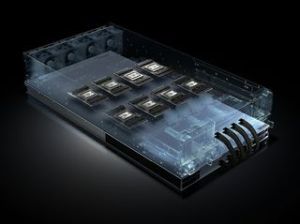
NVIDIA and Microsoft are working on a new hyperscale GPU accelerator that will provide hyperscale data centres with a fast, flexible path for artificial intelligence (AI).

The new HGX-1 hyperscale GPU accelerator is an open-source design released in conjunction with Microsoft’s Project Olympus.

HGX-1 does for cloud-based AI workloads what ATX — Advanced Technology eXtended — did for PC motherboards when it was introduced more than two decades ago. It establishes an industry standard that can be rapidly and efficiently embraced to help meet surging market demand.

Oil gloom, data centre bloom

Oversupply of oil in the global economy is set to accelerate data centre investment, according to Canalys, which forecasted that the large data centre segment will grow eight percent in 2016 as enterprises and service providers become more ambitious with the size of their facilities.

Oil prices have declined more than 70 percent since mid-2014, and will remain low as production ramps up across the US and Middle East. Data centres, with their monolithic energy consumption, will benefit from cheaper electricity as wholesale gas prices decline. Investment will focus on larger facilities, as energy becomes less of a constraint on operating costs.

Cheaper oil will accelerate a market that is already growing. Pre-eminent cloud service providers have already reacted to data sovereignty concerns by investing in the expansion of their global cloud footprint. This will continue and industry standard servers, network security and virtualisation technologies will become key growth categories. Incumbent data centre infrastructure vendors will pivot their focus towards high-end large and hyperscale facilities, but will face stiff competition from cheaper ODM alternatives.

NVIDIA supercharges Microsoft Azure

Azure

Virtualisation just got a little turbo charge with the introduction of NVIDIA GPU-enabled professional graphics applications and accelerated computing capabilities to the Microsoft Azure cloud platform.

Microsoft is the first to leverage NVIDIA GRID 2.0 virtualised graphics for its enterprise customers.

Businesses will have a range of graphics prowess — depending on their needs. They can deploy NVIDIA Quadro-grade professional graphics applications and accelerated computing on-premises, in the cloud through Azure, or via a hybrid of the two using both Windows and Linux virtual machines.

NVIDIA joins VMware in APAC vForums

NVIDIA GRID vGPU vSphereImagine the power of shared GPUs? NVIDIA and VMware are showcasing how enterprises can leverage the power of shared GPU using VMware vSphere and NVIDIA GRID vGPU at vForums currently on in Singapore, Sydney and Tokyo.

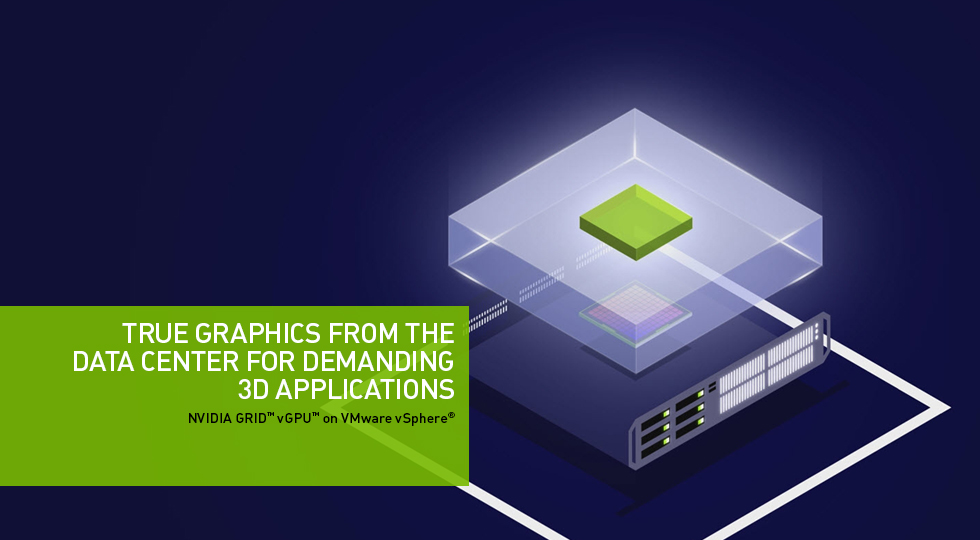
NVIDIA GRID vGPU technology allows multiple virtual machines to share the power of a single GPU to deliver rich graphics experiences with professional 2D and 3D applications.

The partners are also pushing an early access programme that provides a technology preview of these technologies. Enterprises can try the GPU virtualisation and virtual application and desktop infrastructure, ahead of its general availability by signing up at www.nvidia.com/grid-vmware-vgpu. Those selected get to work directly with the engineering teams from both NVIDIA and VMware.

VMware and NVIDIA preview NVIDIA GRID vGPU

NVIDIA_GRID_vGPUVMware and NVIDIA have announced that Airbus Group, CH2MHILL and MetroHealth are among the first to join their early access programme to try the latest technology for GPU virtualisation and virtual application and desktop infrastructure, ahead of its general availability.

Customers selected to participate in the programme have deployed a technology preview of the solution. They get to work directly with the engineering teams from both NVIDIA and VMware, and provide direct input about their experiences — influencing future products, training, documentation and services.

NVIDIA GRID vGPU technology allows multiple virtual machines to share the power of a single GPU to deliver rich graphics experiences with professional 2D and 3D applications. Combined with VMware Horizon, the technology can deliver a great user experience and the scalability that IT teams require for the most demanding users in their organizations.

VMware, NVIDIA and Google to deliver graphics-rich applications to Chromebooks

Google Chromebook
The Google Chromebook is often associated with simplicity — a simple and affordable notebook that offers connectivity and provides access to everyday applications. Well, that’s about to change with a collaboration between VMware, NVIDIA and Google.

The three tech giants are working together to deliver high-performance virtual desktops and workstation-class graphics to Google Chromebooks. This would give the humble Chromebooks power to handle even the most demanding visual computing applications.

“We are breaking down traditional barriers to adopting virtual desktops and offering new economics for the delivery of graphics-intensive applications through the power of the cloud. Organisations of all industries and requirements will soon be able to embrace the mobile-cloud using a solution that offers a new way to work from three proven industry leaders.,” said Sanjay Poonen, Executive Vice President and General Manager of End-User Computing at VMware.

NVIDIA GRID Test Drive comes to SEA and Australia

NVIDIANVIDIA has availed GRID Test Drive in Southeast Asia and Australia. GRID Test Drive is a simple and secure way to test the power of NVIDIA’s GRID technology for cloud-delivered graphics acceleration.

NVIDIA GRID technology allows knowledge workers and high-end graphics users such as engineers and designers to utilise graphics-rich applications through the cloud anywhere on any device – with the same quality and performance they would have on a professional workstation.

As the demand for virtualised desktop infrastructure (VDI) continues to grow, NVIDIA’s GRID Test Drive allows anyone considering VDI, or those frustrated with the performance of their current VDI deployment, to easily test GRID for free and experience the difference of having powerful graphics behind their remote desktops and applications, without first having to build a proof-of-concept private cloud.

Violin Memory boosts enterprise flash storage with data services software

Concerto 7000

Violin Memory has given enterprises a boost with its new Concerto™ 7000 All Flash Array, which comes with comprehensive data services software for synchronous and asynchronous replication, stretch metro cluster, storage snapshots, thin provisioning, logical unit number (LUN) and capacity expansion, advanced data protection, and storage scaling.

With these data services, enterprises and cloud service providers can have greater business agility, consolidate data centre resources and leverage new business opportunities.

Critical elements of Violin’s Concerto enterprise data services software include continuous data protection, WAN optimised replication and in-flight encryption that can all be configured on a LUN-by-LUN basis, giving enterprises the ability to tailor the solution to their unique deployment and data centre requirements.

NVIDIA clinches Computex Best Choice Awards for Tegra K1 and GRID

Best Choice AwardNVIDIA has done the double by snaring the Computex Best Choice Award for its NVIDIA GRID technology and the Golden Award for the NVIDIA Tegra K1 mobile processor.

This is the sixth year running that NVIDIA has picked up the award, marking the  longest winning streak of any international Computex exhibitor. More than 475 technology products from nearly 200 vendors competed for this year’s recognition.

Tegra K1 is a 192-core super chip, built on the NVIDIA Kepler architecture — the world’s most advanced and energy-efficient GPU. Tegra K1’s 192 fully programmable CUDA cores deliver the most advanced mobile graphics and performance, and its compute capabilities open up many new applications and experiences in fields such as computer vision, advanced imaging, speech recognition and video editing.

Violin Memory and Microsoft develop and avail all-flash array solution

WFAViolin Memory has teamed up with Microsoft to develop and avail Windows Flash Array (WFA), the first all-flash high-performance storage array powered by Windows Storage Server 2012 R2. WFA is a tightly integrated combination of Windows Storage Server 2012 R2 and Violin’s award-winning hardware and software into a single solution that delivers high performance all-flash array storage for enterprise and cloud customers.

The solution is claimed to transform the datacentre by dramatically reducing server overhead and application response times through improved storage performance, fundamentally altering the cost structure of enterprise applications. It enables enterprise and cloud workloads, such as SQL Server, Microsoft SharePoint and Windows Server with Hyper-V virtualised applications, to meet the needs of global enterprises, while satisfying IT operational demands for maximised agility, automation, and orchestration between network, storage and compute resources.

“Microsoft technologies, such as Windows Server, SQL Server, and Microsoft SharePoint, are already adopted by enterprises worldwide and growing dramatically,” said Bill Laing, Corporate Vice- President of Microsoft. “By jointly developing this highly integrated solution with Violin Memory, we are working together to provide enterprise and cloud customers with dramatically improved performance, scalability, and economics for their Windows applications – virtualised, physical, and cloud.”

NetApp announces unified scale-out storage systems and virtualisation software

NetAppNetApp has introduced a new line of enterprise storage systems and enhanced software designed to accelerate the broadest range of virtualised applications.

The new NetApp FAS8000 series unifies SAN, NAS and storage virtualisation into a single hybrid array. It is NetApp’s first FAS platform designed specifically for scale-out storage environments built on clustered Data ONTAP.

The new FlexArray virtualisation software enables existing storage to be managed by Data ONTAP for a greater return on investment and makes legacy storage cloud-ready. The software enables the FAS8000 to virtualise and manage third-party arrays and delivers a nine-month payback guarantee.

IMS deployments to reach US$4b by 2017

abi researchIMS Core Network deployments are edging up as operators put the necessary infrastructure and capacity in place for planned 2014 VoLTE launches, according to ABI Research.

Spending for the core network products (HSS, CSC, Media Controllers and Gateways, MSF, IBCF, SBC and P-CSCF) integral to a functioning IMS network will reach US$4 billion by 2017. “We see increasing IMS Core Network revenues through 2017, after which IMS revenues will flatten and reflect capacity expansion,” said Joe Hoffman, Research Director of ABI Research.

IMS spending for mobile 4G markets follows the LTE deployments, as operators seek to get their network coverage in place, stabilised, and compatible mobiles for VoLTE become available. The leading LTE market, North America, will peak 2015 to 2016, while the largest market, Asia-Pacific shows continued growth into the foreseeable future.

New NVIDIA Tesla K40 speeds up supercomputing and big data analytics

NVIDIA Tesla K40The NVIDIA Tesla K40 GPU accelerator is arguably the world’s highest performance accelerator ever built. It is capable of delivering extreme performance to a wide range of scientific, engineering, high performance computing (HPC), and enterprise applications.

Providing double the memory and up to 40 percent higher performance than its predecessor, the Tesla K20X GPU accelerator, and 10 times higher performance than the fastest CPU, the Tesla K40 GPU is the world’s first and highest-performance accelerator optimised for big data analytics and large-scale scientific workloads.

Featuring intelligent NVIDIA GPU Boost technology, which converts power headroom into a user-controlled performance boost, the Tesla K40 GPU accelerator enables users to unlock the untapped performance of a broad range of applications.

Customer experience management is top IT priority for telcos in 2014

ovumCustomer experience management (CEM) has emerged as the top driver of telco IT investments in 2014, according to Ovum’s ICT Enterprise Insights. Telco IT spend is expected to reach US$60.7b by 2017, with investments geared towards telecoms infrastructure (cloud platforms, server virtualisation and BSS/OSS systems to support LTE implementations) and online channels to support customers’ increasingly digital lifestyles.

In the largest survey of senior IT executives ever conducted, Ovum reveals a long-term shift in spending towards customer-oriented systems and on improving customer satisfaction within the telecoms industry.

Survey respondents identified multi-channel integration and service personalisation as top areas of focus in the next 18 months, with 67 percent and 61 percent planning to increase spending in these two areas, respectively. Elsewhere, business intelligence and advanced analytics (predictive or big data analytics) will be key for operators — more than 80 percent of respondents will deploy these at the network level in an attempt to offer an enhanced connected experience with predictable, consistent, and relevant services at each point of interaction in the customer lifecycle.

Cloud Computing to account for most of IT budget by 2016

GartnerCloud computing adoption is growing and will form the bulk of new IT spend in 2016. According to Gartner, 2016 will be a defining year for cloud as private cloud begins to give way to hybrid cloud, and nearly half of large enterprises will have hybrid cloud deployments by the end of 2017.

Gartner describes cloud computing as a style of computing in which scalable and elastic IT-enabled capabilities are delivered “as a service” using Internet technologies. It heralds an evolution of business in positive and negative ways. It has also become a hot industry term that has been used in many contradictory ways.

“Overall, there are very real trends toward cloud platforms, and also toward massively scalable processing. Virtualisation, service orientation and the Internet have converged to sponsor a phenomenon that enables individuals and businesses to choose how they’ll acquire or deliver IT services, with reduced emphasis on the constraints of traditional software and hardware licensing models,” said Chris Howard, Research Vice President of Gartner. “Services delivered through the cloud will foster an economy based on delivery and consumption of everything from storage to computation to video to finance deduction management.”

NVIDIA GRID brings visual computing capabilities to Australia

NVIDIABusinesses across Australia can now deploy graphics-accelerated virtual desktops to their employees – cost-effectively, anywhere and on any device – with the adoption of NVIDIA GRID technology by leading technology partners.

Servers from Cisco, Dell, HP, IBM and others are now incorporating NVIDIA GRID into their desktop virtualisation solutions. Combined with enterprise virtualisation software from Citrix, Microsoft or VMware, these solutions can deliver GPU-accelerated applications and desktops to engineers, designers, architects, product design teams and special-effects artists throughout Australia.

Melbourne-based Xenon Systems was appointed as the first NVIDIA GRID Demo Centre for Australia and New Zealand earlier this year. 

Gartner: Top 10 strategic technology trends for 2014

Gartner3D printing, personal cloud, the Internet of Everything — these buzzwords today are expected to be among the top 10 strategic technology trends next year, according to Gartner.

Gartner defines a strategic technology as one with the potential for significant impact on the enterprise in the next three years. Factors that denote significant impact include a high potential for disruption to IT or the business, the need for a major dollar investment, or the risk of being late to adopt.

A strategic technology may be an existing technology that has matured and/or become suitable for a wider range of uses. It may also be an emerging technology that offers an opportunity for strategic business advantage for early adopters or with potential for significant market disruption in the next five years. These technologies impact the organisation’s long-term plans, programs and initiatives.

Beginning of the Digital Industrial Economy

GartnerWorldwide IT spending is forecast to reach US$3.8 trillion in 2014, a 3.6 percent increase from 2013, but it’s the opportunities of a digital world that have IT leaders excited, according to Gartner.

The beginning of the Digital Industrial Economy will make every budget an IT budget; every company a technology company; every business a digital leader, and every person a technology company.

“The Digital Industrial Economy will be built on the foundations of the Nexus of Forces (which includes a confluence and integration of cloud, social collaboration, mobile and information) and the Internet of Everything by combining the physical world and the virtual,” said Peter Sondergaard, Senior Vice President of Gartner and Global Head of Research.

Gartner adjusts worldwide IT spending projection downwards to 2% growth this year

GartnerGartner has adjusted its worldwide IT spending forecast for 2013 downwards to US$3.7 trillion in 2013. Last quarter, the research firm predicted a 4,1 percent increase compared to 2012 but that projection has been sliced by half to 2 percent. This reduction takes into account the impact of recent fluctuations in US dollar exchange rates. 

The Gartner Worldwide IT Spending Forecast is the a leading indicator of major technology trends across the hardware, software, IT services and telecom markets. For more than a decade, global IT and business executives have been using these highly anticipated quarterly reports to recognise market opportunities and challenges, and base their critical business decisions on proven methodologies rather than guesswork.

“Exchange rate movements, and a reduction in our 2013 forecast for devices, account for the bulk of the downward revision of the 2013 growth,” said Richard Gordon, Managing Vice President at Gartner.

NVIDIA GRID unleashes graphics for virtualised desktops

NVIDIANVIDIA has unleashed the full graphics potential of enterprise desktop virtualisation with the availability of NVIDIA GRID vGPU integrated into Citrix XenDesktop 7.

NVIDIA GRID vGPU technology addresses a challenge that has grown in recent years with the rise of employees using their own notebooks and portable devices for work. These workers have increasingly relied on desktop virtualisation technologies for anytime access to computing resources, but until now this was generally used for the more standard enterprise applications. Performance and compatibility constraints had made it difficult for applications such as building information management (BIM), product-lifecycle management (PLM) and video-photo editing.

Two decades ago, hardware-based graphics replaced software emulation. Desktop virtualisation solutions stood alone as the only modern computing form without dedicated graphics hardware. As a result, an already busy virtualised CPU limited performance and software emulation hampered application compatibility.