
 Gaming peripheral maker Razer has launched the Razer Game Store, a digital distribution platform for PC games.
StarHub bumps 4G speed to 1Gbps
 Singapore telco StarHub has upped its 4G speed to 1Gbps — giving users faster access at various parts of the island.
Spotify makes successful public listing
 Spotify made its debut on the New York Stock Exchange and closed the first day at US$26.5 billion, about 30 percent above analysts’ prediction.
ANSYS to acquire OPTIS
 Pittsburgh-based engineering simulation software maker ANSYS has agreed to acquire France-based optical simulation software provider OPTIS with the transaction expected to be completed in Q2.
India external storage market dips 4.7% in Q4
 India’s external storage market dropped 4.7 percent year on year to US$74.1 million in Q4, according to IDC.
Spotify goes public
Leading music streaming site Spotify will be listed on the New York Stock Exchange today (New York time).
The taxi that looks for you
 Where’s a taxi when you need one? That’s the bane of passengers from around the world, except possibly in Taipei where taxis somehow seem to be just where you need them.
H2O.ai optimises Driverless AI and H2OGPU for NVIDIA
 H2O.ai has announced that its Driverless AI automated machine learning platform and H2O4GPU open source GPU-accelerated machine learning package are now both fully optimised for the latest-generation NVIDIA Volta architecture GPUs — the NVIDIA Tesla V100 — and CUDA 9 software.
It’s a GAG!
 NVIDIA pulled a fast one on the media with the announcement of the GeForce Academy of Gaming over the weekend.
VR to impact retail and marketing
 Virtual reality (VR) has been tipped to be the next innovative technology to improve and impact retail and marketing.
IoT goes deep
 Arm is taking its recently-announced Project Trillium a step further with a collaboration with NVIDIA. The partners will bring the open-source NVIDIA Deep Learning Accelerator (NVDLA) architecture into Project Trillium platform for machine learning.
Adobe and NVIDIA team up to improve Sensei
 Adobe and NVIDIA have formed a strategic partnership to rapidly enhance their industry-leading artificial intelligence (AI) and deep learning technologies.
Nyriad and ThinkParQ to certify GPU-accelerated storage
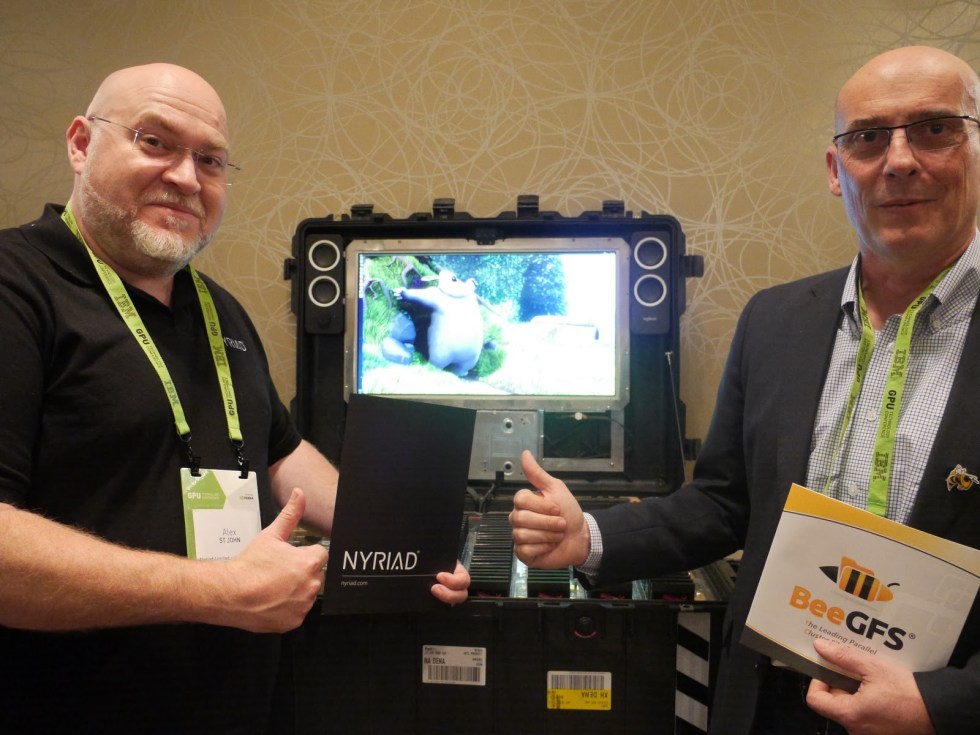 Nyriad and ThinkParQ are partnering to develop a certification programme for high performance, resilient storage systems that combine BeeGFS with NSULATE, Nyriad’s solution for GPU-accelerated storage-processing.
Safer self-driving car tests with NVIDIA Drive Constellation
 A number of self-driving cars sporting NVIDIA’s autonomous driving technologies were present at GPU Technology Conference in San Jose this week. However, none was available for a test drive — a sensible move by NVIDIA in the light of the fatal Uber self-driving car accident the week before.
VRgineers ups the notch in enterprise VR
 VRgineers is harnessing the potential of the new NVIDIA Quadro GV100 GPU for its high-resolution virtual reality (VR) headset, enabling even complex 3D scenes, high-poly models and high-resolution textures to perform smoothly at full refresh rates.
Leadtek introduces new entry-level workstation GPU
 Leadtek has released NVIDIA Quadro P620, an entry level professional GPU that gives designers an expansive visual workspace to view all creations in stunning detail.
Project Clara is truly amazing
 One of the most eye-catching demo during NVIDIA CEO Jensen Huang’s keynote address at GTC 2018 is Project Clara.
NVIDIA DGX-2: Insanely powerful

NVIDIA CEO Jensen Huang (above) dubbed it the “world’s biggest GPU”. And he certainly wasn’t kidding as the NVIDIA DGX-2 is a massive 350-pounder that delivers an amazing two petaflops of computational power.
GTC hits new highs

The GPU Technology Conference (GTC) has hit new highs with a record of more than 8,000 participants, and filling the entire San Jose McEnery Convention Center.
Sad day for autonomous vehicles
 A 49-year-old woman has become the first pedestrian to be killed by an autonomous vehicle.
Broadcom’s takeover bid of Qualcomm takes broadside hit
 Singapore-based Broadcom has been dealt a major blow in its takeover bid of Qualcomm. US president Donald Trump has issued an order against the US$117 billion deal.
Bangladesh smartphone market continues growth trajectory
Bangladesh mobile operators began offering 4G services last month, albeit in limited areas, after gaining the necessary licences.
Amazon Echo laughter freaks users
 While laughter is said to be the best medicine, it can send chills down the spines of hearers, as in the case of the mysterious laughter coming from Amazon Echo.
Something old, something new
 The telecommunications industry, specifically mobile communications, is converging in Barcelona this week. Even before Mobile World Congress (MWC) kicks off today, two companies have fired the first salvo with something old, something new.
Xjera Labs zooms in to AI to enhance security

Security is a growing concern among governments and organisations of all sizes. They must balance the need to provide access to the right people while keeping suspicious folks at bay. Any lapse can result in dire consequences that impact confidence in the country or company.
Hardwarezone hacked!
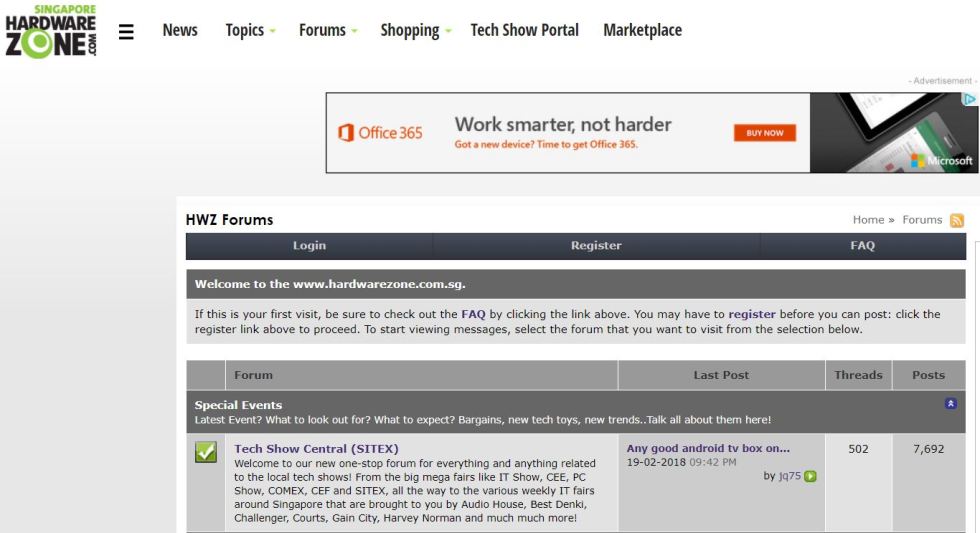 Hardwarezone (HWZ), a leading technology website and forum in Southeast Asia, was hacked with data of 685,000 registered users compromised.
ViSenze takes visual search and image recognition to the next level

Every day, around three billion images and videos are uploaded online, creating a massive need to make them discoverable and searchable.
India is fastest growing smartphone market in 2017
India has become the fastest growing smartphone market in the world with total shipment growing 14 percent to 124 million units in 2017, according to IDC.
Emtech Asia: AI, quantum computing and more

Marina Bay Sands Expo and Convention Centre was a hive of activities of a different sort as more than 700 technologists from 21 countries converged for EmTech Asia on January 30 and 31.
Singapore creates drone zone

With concerns over privacy, security and safety, drone flying has been limited to only certain areas and heights. However, recognising the need to test unmanned aircraft systems (UAS), the Singapore government has established the nation’s first drone estate.
Apple Watch outsells Swiss watches
 How the watch industry has changed! As a show of its strength and popularity, Apple Watch has taken the crown, not just among smartwatches, but outselling the entire Swiss watch industry in Q4. Now, that’s quite an accomplishment!
Dathena transforms data from liability to asset

It’s been said that more data was generated in 2017 than in the previous 5,000 years. According to Statista, this figure will increase 10 times in less than a decade.
Samsung to make cryptocurrency mining chip
 Cryptocurrency mining has been given a boost with the revelation that Samsung is working on chip just for that purpose.
Towards a longer life
Throughout the ages, men have always been searching for the mythical Fountain of Youth and ways to extend life. Needless to say, many have tried and failed.
SAP to acquire Callidus
 SAP has agreed to acquire Callidus Software for US$2.4 billion.
Alibaba and Google drive SEA transportation initiatives
 Most Southeast Asian capitals and major cities are notorious for its traffic congestion. In separate developments, Alibaba and Google have taken steps to be more involved in the transportation industries in Malaysia and Indonesia respectively.
More analysis than data scientists
 For the past few years, data scientists are highly sought after to analyse data that can help organisations better understand their business, customers and trends. But, it looks like artificial intelligence-based solutions may be taking over that role in the near future.
Mindset change needed for an AI future
 Think artificial intelligence (AI) and the advent of powerful thinking machines and images of Arnold Schwarzenegger of The Terminator come to mind.
Apple iPhone X is holiday bestseller despite axe rumours
 Amid rumours that Apple was going to axe the iPhone X came encouraging sales numbers by Canalys.
Chery to pop NVIDIA-powered ZP ProAI system into autonomous vehicles
 China carmaker Chery has adopted the new ZP ProAI system, powered by NVIDIA Drive AI self-driving technology, for its autonomous vehicles. The move will bring Level 3 autonomous driving to the world’s biggest auto market.
Global IT spending to rise to US$3.7t in 2018
Global IT spending is expected to grow to US$3.7 trillion in 2018, an increase of 4.5 percent from 2017, according to Gartner.
Spectre of a Meltdown

In a week where the world’s eyes were supposed to be focusing on the exciting new gadgets and technologies coming out at CES 2018, it was news from past technologies that had the world reeling.
Gaming monitors get bigger

BFGD — that’s the new acronym that gamers need to know. Introduced by Jensen Huang, CEO of NVIDIA this week, it stands for Big Format Gaming Display.
Smart speaker adoption to rise in 2018

Amazon and Google went head to head in the smart speaker market last year and the battle is expected to be more intense in the coming days with more players joining the fray.
Keysight and SUTD to advance electronic measurement research

Keysight Technologies and Singapore University of Technology and Design (SUTD) have inked a Memorandum of Understanding (MOU) for research collaboration and opened the new Measurement Technologies Laboratory.
Apple apologises
 Apple has apologised for slowing down the performance of older iPhone models to prevent accidental shutdowns due to aging batteries.
Apple caught slowing down
 The names Benjamin Lazarus, Jeffrey Aberman, Stephen Margolis, Sandy Brodsky, and Victoria Childs are probably unfamiliar to most. But inthe days to come, they may become more popular.
AI will create more jobs
One of the biggest fears amid the excitement about artificial intelligence (AI) is the loss of jobs. Many are afraid of being made redundant as AI becomes more pervasive.
NVIDIA Titan V: Not for gamers

It’s easy to understand why the media and gamers were getting all excited following NVIDIA’s announcement of the Titan V. After all, it’s dubbed as “the world’s most powerful GPU for the PC, driven by the world’s most advanced GPU architecture, NVIDIA Volta”.
Honda to accelerate smart car R&D with SenseTime
Honda has signed a long-term agreement to develop autonomous cars with SenseTime, a China artificial intelligence (AI) company. The partnership will leverage Honda’s vehicle control system with SenseTime’s AI algorithms to jointly create an autonomous driving […]
Forced migration

By Edward Lim
The telecommunications market, except for mobile, is facing a slowdown in growth. According to IDC, the Pay TV services market, which consists of cable, satellite, Internet protocol (IP), and digital terrestrial TV services, will remain flat over from 2017 to 2021.
Learn robotics at Udacity
 Robotics is no longer just a hobby but serious stuff. NVIDIA’s Deep Learning Institute is now working with online learning provider Udacity to develop a programme that will immerse students in the field of robotics, giving them career-ready skills.
Robotaxis are coming!

With the advent of robotaxis, car sales are expected to peak in 2022, according to Canalys.
Pre-order Razer smartphone on November 23

Razer’s first smartphone will be available for pre-order in Singapore on November 23.
Qualcomm invests in China AI startup SenseTime
 China artificial intelligence (AI) startup SenseTime has signed a strategic investment agreement with Qualcomm.
NVIDIA Tesla V100 gains widespread acceptance

NVIDIA’s Volta architecture is leaving quite an impression. According to a NVIDIA press release issued at SC17, the Volta-based NVIDIA Tesla V100 GPU is available through every major computer maker and chosen by every major cloud to deliver artificial intelligence (AI) and high performance computing.
We are 5!
 Entelechy Asia turns five today. So much has changed since we launched in November 2012.
Short cut to A-
 An Asean scholar disgruntled with his grades hacked his professor’s account to bump himself from B to A-. The Singapore Management University (SMU) student was soon found out and will be spending four months in prison reflecting on his folly.
5 things to do when your social media platform is down
 When WhatsApp was down for a few hours last Friday (November 3), Facebook timelines were filled with panic posts by people unable to communicate on WhatsApp. Snapchat is reported to be down at the point of writing and again, there is frenzy over the outage.
Beware of fake Facebook accounts
 It’s become something of a daily routine. Friend requests are coming from people we don’t know on Facebook.
 Entelechy Asia