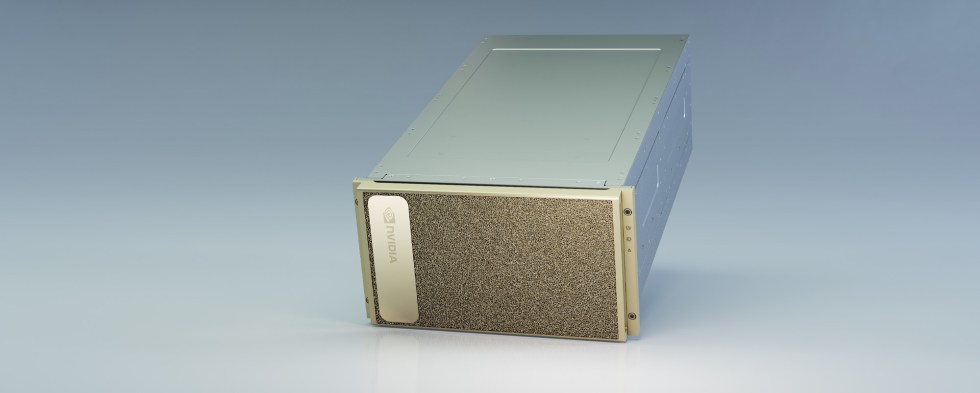
Indochina is certainly becoming a happening place for innovations. Just a week after Vietnam’s VinAI announced that it was using the new NVIDIA DGX A100 for natural language processing research, Thailand’s Chulalongkorn University is now turning to the same system to power its Thailand 4.0 innovations.
Natural language processing (NLP) requires loads of computing power so research lab VinAI has turned to the new NVIDIA DGX A100 system — making it the first in Vietnam and one of the first in Southeast Asia to deploy the newly-launched GPU-accelerated data centre in a box.
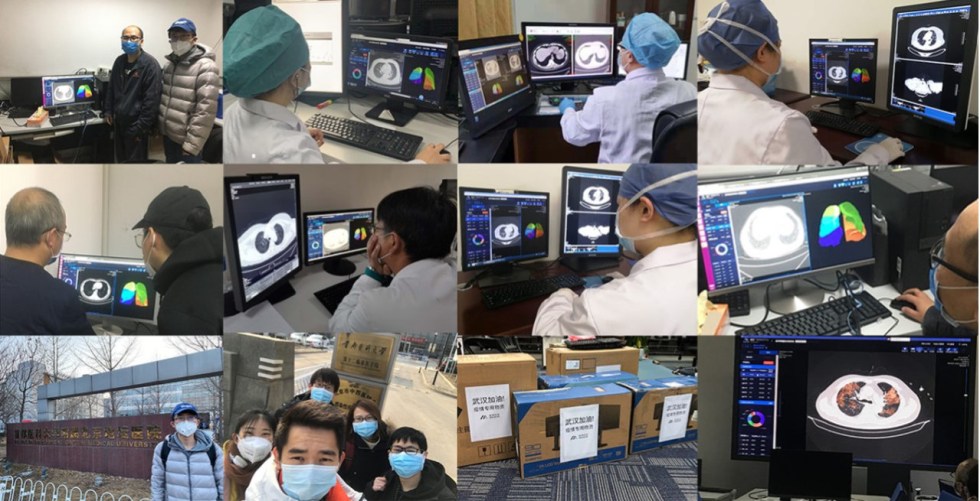
GPU-powered Lung Doc is used by 30 hospitals in China.Shukun Technology was busy improving its AI-powered platform to diagnose heart disease and strokes when COVID-19 struck. The China AI startup quickly switched gear to develop a system that analyses chest CT scans to help speed up diagnoses of COVID-19 patients.
Photo by Emiliano Arano from PexelsIs this a sign of things to come in the tech industry? Wave Computing has filed for Chapter 11. And it’s a company that’s focused on artificial intelligence (AI) and deep learning, an area that is still very much the flavour of the month.
Signed, sealed and delivered: US$7 billion acqusition
Ten days after it received approval from China’s State Administration for Market Regulation, NVIDIA has completed its US$7 billion acquisition of Mellanox Technologies.
Huang to make announcements in keynote address.If things had gone as originally planned, NVIDIA’s GPU Technology Conference (GTC) would have been done and dusted by now. But the coronavirus has forced the conference to go digital with NVIDIA Founder and Chief Executive Officer Jensen Huang set to deliver his keynote address on May 14, 9pm (Singapore time).
If ever there’s a time to for technology to come to the forefront, it’s now. Artificial intelligence (AI) has been around for decades, creating hope but delivering on few promises. The emergence of deep learning in recent years has changed that landscape. It has brought drawn more to invest in and work on AI with results to boot.
If there’s a phrase to describe artificial intelligence (AI) startup Vuno, it has to be “It thinks BIG”. While most startups aim to use technology to tackle one medical condition, the Korea company decided to cast its net wide by using NVIDIA GPU-powered AI products to address diagnoses of different diseases.
Dell EMC and Comet have unveiled a Kubernetes reference architecture for data science teams using the their artificial intelligence (AI)-enabled infrastructure and machine learning platform.
China has just made the battle for artificial intelligence (AI) supremacy a little more intense following the announcement by Megvii Technology that it would make its MegEngine deep learning framework open source.
What could have been a dampener may just turn out to be a better offering for participants who have registered for this year’s GPU Technology Conference (GTC). Yes, they won’t get to go to San Jose. Yes, they will miss the face-to-face meetings. But, NVIDIA has put great thoughts into making GTC Digital, the online version, just as engaging and informative. Plus, NVIDIA has refunded all participants so they can attend most of the conference for free.
Source: ArmArm has launched the Cortex-M55, an artificial intelligence (AI) processor based on the Armv8.1-M architecture with Arm Helium vector processing technology for significantly enhanced, energy-efficient digital signal processing and machine learning (ML).
Nearly one million riders on the Tokyo Metro Ginza Line will now be able to tap on the capabilities of Bebot, an AI chatbot.They will be able to access naviation and useful train information all along the line using the app
Singapore will have 100 more artificial intelligence (AI) architects and 1,000 more AI developers over the next three years — thanks to the newly-launched Huawei AI lab.
AI Singapore (AISG) has announced the AISG AI Certification, a structure learning pathway to enable Singaporeans to reskill, upskill and deep skill in artifical intelligence (AI).
NVIDIA has announced the NVIDIA EGX Edge Supercomputing Platform which lets organisations deliver next-generation AI, IoT and 5G-based services at scale and with low latency. Along with annoucing this at his keynote address at the opening of Mobile World Congress in Los Angeles, NVIDIA Founder and CEO Jen-Hsun Huang declared that we have entered a new era, where billions of always-on IoT sensors will be connected by 5G and processed by AI.
As a city, Singapore is the world’s most ready for the artificial intelligence (AI) revolution, according to research firm Oliver Wyman Forum. London, New York, San Francisco, and Paris made up the rest of the top five with Sydney slotting in at 10th.
NVIDIA Founder and CEO Jensen Huang made a slew of announcements during his near three-hour keynote address at the GPU Technology Conference last week. But among the date centre and server offerings, partnerships with leading brands and a new development in autonomous driving, one that doesn’t seem as loud and prominent could prove to be the spark to trigger a robotics tsunami.
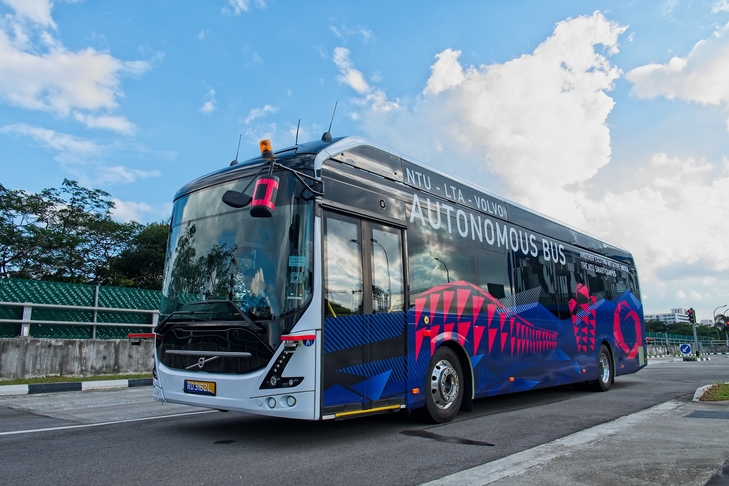
Singapore’s Nanyang Technological University (NTU) and Volvo Buses have launched the world’s first full size, autonomous electric bus. The single-deck 12-metre long Volvo electric bus has a capacity of 80 passengers.
Singapore has released Asia’s first model artificial intelligence (AI) governance framework to provide detailed and readily implementable guidance to private sector organisations deploying AI solutions.
Speaking with a passion of an artificial intelligence (AI) in healthcare evangelist, Kimberly Powell declared that the age of AI in radiology is here. And she has earned the right to say that because she has been championing this since she joined NVIDIA 11 years ago.
Leading China-based AI company SenseTime has unveiled an autonomous driving park in Joso, Japan. The testing course will be used to develop autonomous driving technology and conduct road tests of autonomous vehicles.
A new player has entered the machine learning arena. While big players such as Google, Intel and NVIDIA have been slugging it out, Amazon has thrown its hat into the ring with its newly-launched Inferentia chip.
Huawei has upped the ante with an ambitious US$140 million investment in developing one million artificial intelligence (AI) talents in three years. Under its AI Developer Enablement Programme, the China telecoms giant will work with universities and research institutions as well as partners and developers to build an ecosystem with AI resources, platforms, courses, and joint solutions to better support AI development.
A battle of sorts is taking place in the field of artificial intelligence (AI). It has been widely reported that China is ramping up its focus on the technology that is expected to transform businesses and industries. Numbers from ABI Research point to a swing in favour of China.
Copywriters, beware! A new tool dubbed “The AI copywriter” by Alimama can generate an astounding 20,000 lines of copy in a second. Alimama is the digital marketing arm of China e-commerce giant Alibaba.
Machine learning and deep learning are two expressions of artificial intelligence (AI) that have been widely written about. But, another approach to AI called reinforcement learning is coming to the fore. One of the first applications of reinforcement learning is in training AI bots to beat humans in the highly popular game Defense of the Ancients 2 (Dota 2).
With its ability to crunch massive data and make predictions, it was only a matter of time before artificial intelligence (AI) was going to be applied to gambling, if it had not already done so.
Artificial intelligence (AI) is on the rise with global business value expected to hit US$1.2 trillion in 2018, an increase of 70 percent from 2017, according to Gartner.
H2O.ai has announced that its Driverless AI automated machine learning platform and H2O4GPU open source GPU-accelerated machine learning package are now both fully optimised for the latest-generation NVIDIA Volta architecture GPUs — the NVIDIA Tesla V100 — and CUDA 9 software.
Arm is taking its recently-announced Project Trillium a step further with a collaboration with NVIDIA. The partners will bring the open-source NVIDIA Deep Learning Accelerator (NVDLA) architecture into Project Trillium platform for machine learning.
Adobe and NVIDIA have formed a strategic partnership to rapidly enhance their industry-leading artificial intelligence (AI) and deep learning technologies.
Chu: “NVIDIA GPUs compared to CPUs are much more cost effective.”
Security is a growing concern among governments and organisations of all sizes. They must balance the need to provide access to the right people while keeping suspicious folks at bay. Any lapse can result in dire consequences that impact confidence in the country or company.
Leonard wants to see more research become productised and commercialised.
Marina Bay Sands Expo and Convention Centre was a hive of activities of a different sort as more than 700 technologists from 21 countries converged for EmTech Asia on January 30 and 31.
It’s been said that more data was generated in 2017 than in the previous 5,000 years. According to Statista, this figure will increase 10 times in less than a decade.
Mariusz Kozlowski, Research Associate of Asia Genomics: “Track biological age and help prevent high-risk diseases.”
Throughout the ages, men have always been searching for the mythical Fountain of Youth and ways to extend life. Needless to say, many have tried and failed.
China carmaker Chery has adopted the new ZP ProAI system, powered by NVIDIA Drive AI self-driving technology, for its autonomous vehicles. The move will bring Level 3 autonomous driving to the world’s biggest auto market.
One of the biggest fears amid the excitement about artificial intelligence (AI) is the loss of jobs. Many are afraid of being made redundant as AI becomes more pervasive.
Honda has signed a long-term agreement to develop autonomous cars with SenseTime, a China artificial intelligence (AI) company. The partnership will leverage Honda’s vehicle control system with SenseTime’s AI algorithms to jointly create an autonomous driving […]
Robotics is no longer just a hobby but serious stuff. NVIDIA’s Deep Learning Institute is now working with online learning provider Udacity to develop a programme that will immerse students in the field of robotics, giving them career-ready skills.
NVIDIA’s Volta architecture is leaving quite an impression. According to a NVIDIA press release issued at SC17, the Volta-based NVIDIA Tesla V100 GPU is available through every major computer maker and chosen by every major cloud to deliver artificial intelligence (AI) and high performance computing.
The need for deep learning skills is increasing as more and more companies and industries hop on the bandwagon. Launch a little more than a year ago, NVIDIA’s Deep Learning Institute (DLI) has already trained tens of thousands of students, developers and data scientists.
And the company is expanding its DLI offerings with:
New partnerships: Team up with Booz Allen Hamilton and deeplearning.ai to train thousands of students, developers and government specialists in artificial intelligence (AI).
New University Ambassador Program: Instructors worldwide can teach students critical job skills and practical applications of AI at no cost.
New courses: More courses are added to teach domain-specific applications of deep learning for finance, natural language processing, robotics, video analytics, and self-driving cars.
NVIDIA Fellow Dr David Kirk delivers the keynote address at the NVIDIA AI Conference.
Singapore’s aim to be an artificial intelligence (AI) hub has been boosted with two initiatives — the setting up of a shared AI platform for researchers and the awarding of scholarships to develop AI talents.
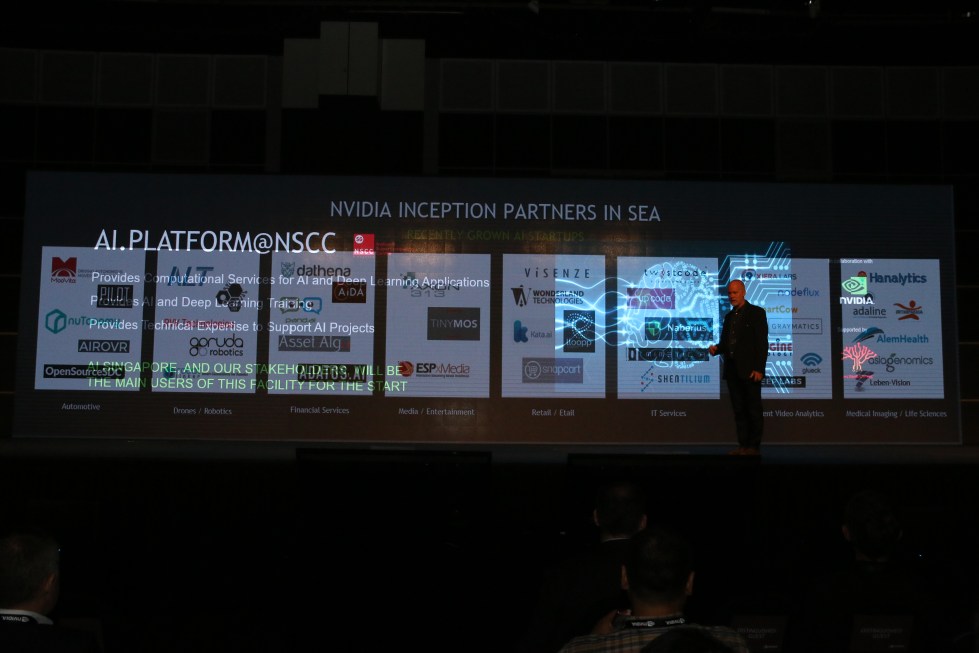
At the NVIDIA AI Conference in Singapore yesterday, NVIDIA and Singapore’s National Supercomputing Centre (NSCC) agreed to establish a platform to bolster AI capabilities among its academic, research and industry stakeholders and in support of AI Singapore (AISG), a national programme set up in May to drive AI adoption, research and innovation in Singapore.
Called AI.Platform@NSCC, it will provide AI training, technical expertise and computing services to AISG, which brings together all Singapore-based research and tertiary institutions, including the National University of Singapore (NUS), Nanyang Technological University (NTU), Singapore University of Design and Technology (SUTD), Singapore Management University (SMU), as well as research institutions in the Agency for Science, Technology and Research (A*STAR).
More than 1,000 participants attending the NVIDIA AI Conference in Singapore next week are in for a treat as the organisers are bringing in a tantalising line-up of speakers.
The two keynote speakers are Dr David B Kirk, NVIDIA Fellow and inventor of more than 60 patents and patent applications relating to graphics design; and Dr Wanli Min, AI scientist of Alibaba Cloud, who will touch on A Revolutionary Road to Data Intelligence.
Besides these two, there are special guest-of-honour Chng Kai Fong, Managing Director of Singapore’s Economic Development Board, and a panel discussion on AI for the Future of Singapore Economy.
No steering wheels, pedals or mirrors. Sounds like science fiction but the fully autonomous robotaxi is on its way with the launch of a new system that NVIDIA has codenamed Pegasus.
Pegasus extends the NVIDIA Drive PX AI computing platform to handle Level 5 driverless vehicles. NVIDIA DRIVE PX Pegasus delivers over 320 trillion operations per second — more than 10 times the performance of its predecessor, NVIDIA DRIVE PX 2, announced Jensen Huang, Founder and CEO of NVIDIA at his keynote address at GTC Europe in Munich.
Robotaxis powered by NVIDIA DRIVE PX Pegasus will have interiors that feel like a living room and arrive on demand to safely whisk passengers to their destinations, bringing mobility to everyone, including the elderly and disabled.
The role of the CIO is changing, according to a Gartner survey of 3,160 CIO respondents in 98 countries.
The findings revealed that the CIO role is transitioning from delivery executive to business executive, from controlling cost and engineering processes, to driving revenue and exploiting data.
Ninety-five percent of CIOs expect their jobs to change or be remixed due to digitalisation. While world-class IT delivery management is a given, it will take up less and less of the CIO’s time.
Appier has appointed Sean Chu as Chief Strategy Officer (CSO) to lead its operations in Japan and Korea. Chu will help drive the company’s growth as it moves to create new AI platforms to help […]
China’s top technology companies are betting big on the NVIDIA Volta platform.
Alibaba Cloud, Baidu, and Tencent are incorporating NVIDIA Tesla V100 GPU accelerators into their data centres and cloud-service infrastructures to accelerate AI for a broad range of enterprise and consumer applications.
At the heart of the new Volta-based systems is the NVIDIA V100 data centre GPU. Built with 21 billion transistors, it provides a 5x improvement over the preceding NVIDIA Pascal architecture P100 GPU accelerators, while delivering the equivalent performance of 100 CPUs for deep learning. This performance surpasses by 4x the improvements that Moore’s law would have predicted over the same period of time.
Inspur, Lenovo and Huawei are using the NVIDIA HGX reference architecture to offer Volta-based accelerated systems for hyperscale data centres. Using HGX as a starter “recipe,” original equipment manufacturer and original design manufacturer partners can work with NVIDIA to more quickly design and bring to market a wide range of qualified GPU-accelerated AI systems for hyperscale data centres to meet the industry’s growing demand for AI cloud computing.
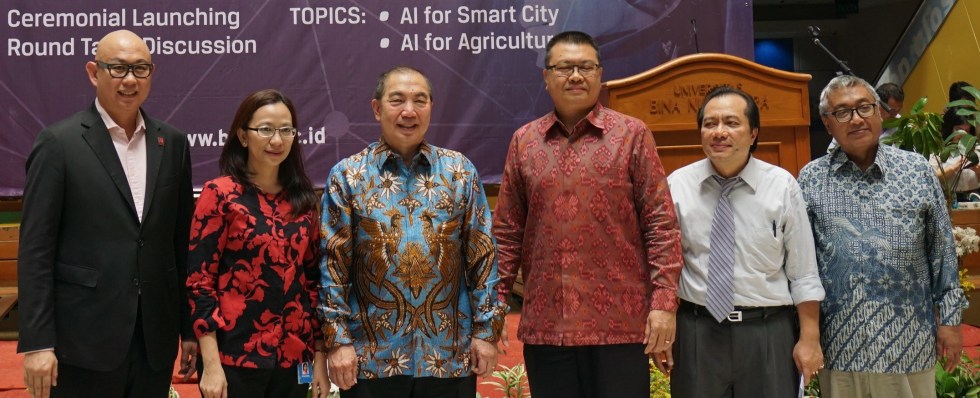
Launch completed (from left): Raymond Teh of NVIDIA, Sanny Hadinata of Tech Data, Bernard Gunawan of BINUS Nusantara, Hengkie Kastono of HPE, Bens Pardamean of BINUS, and Bahtiar Saleh Abbas of BINUS.
NVIDIA has teamed up with BINUS University and Kinetica to establish the first artificial intelligence (AI) research and development (R&D) centre in Indonesia.
Located at the university’s Anggrek Campus, the centre will support BINUS University’s aim to be the premier R&D hub for Al in Indonesia. Leveraging the power of NVIDIA’s GPUs, it will be a showcase of the commercial potential of GPU-accelerated deep learning applications.
“Today, we stand at the beginning of the AI computing era, ignited by a new computing model, GPU deep learning. This new model — where deep neural networks are trained to recognise patterns from massive amounts of data — has proven to be ‘unreasonably’ effective at solving some of the most complex problems in computer science. In this era, software writes itself and machines learn. Soon, hundreds of billions of devices will be infused with intelligence. AI will revolutionise every industry. NVIDIA provides the products and solutions to power this revolution,” said Raymond Teh, Vice President of APAC Sales and Marketing of NVIDIA.
Spurred by growing interest in artificial intelligence (AI), the Asia-Pacific (APAC) robotics market is expected to growth to US$162 billion in 2021, accounting for 70 percent of the world’s total robotics market in 2021, according to […]
The cloud infrastructure services market is continuing to grow strongly, up 47 percent year on year in Q2 to reach US$14 billion, according to Canalys. Growth was driven by demand for primary cloud infrastructure services, such as on-demand computing and storage, across all customer segments and industries.
However, future growth is expected to be fueled by customers using the artificial intelligence (AI) platforms cloud service providers are building to develop new applications, processes, services, and user experiences.
Amazon Web Services (AWS) maintained its leadership position, growing 42 percent on an annual basis and accounting for more than 30 percent of total spend. But its growth rate was lower than those of its main rivals, Microsoft (up 97 percent growth) and Google (up 92 percent), but higher than fourth-placed IBM (up 23 percent). Overall, the top four cloud services providers represented 55 percent of the cloud infrastructure services market, which includes IaaS and PaaS.













 A new player has entered the machine learning arena. While big players such as Google, Intel and NVIDIA have been slugging it out, Amazon has thrown its hat into the ring with its newly-launched Inferentia chip.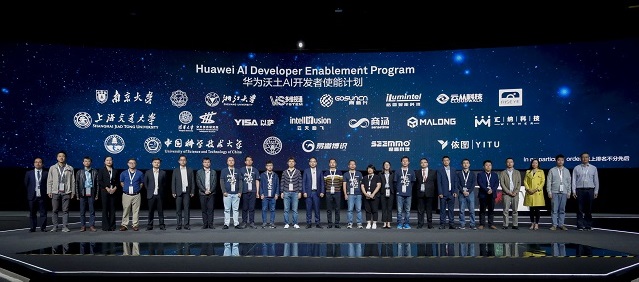
 NVIDIA and Microsoft have announced that Microsoft Azure is now supported on the NVIDIA GPU Cloud (NGC) platform.
 A battle of sorts is taking place in the field of artificial intelligence (AI). It has been widely reported that China is ramping up its focus on the technology that is expected to transform businesses and industries. Numbers from ABI Research point to a swing in favour of China.
 With its ability to crunch massive data and make predictions, it was only a matter of time before artificial intelligence (AI) was going to be applied to gambling, if it had not already done so.
 Artificial intelligence (AI) is on the rise with global business value expected to hit US$1.2 trillion in 2018, an increase of 70 percent from 2017, according to Gartner.
 Cryptics has launched what it claims is the world’s first cryptocurrency analytics solution based on artificial intelligence (AI).
 H2O.ai has announced that its Driverless AI automated machine learning platform and H2O4GPU open source GPU-accelerated machine learning package are now both fully optimised for the latest-generation NVIDIA Volta architecture GPUs — the NVIDIA Tesla V100 — and CUDA 9 software.
 Arm is taking its recently-announced Project Trillium a step further with a collaboration with NVIDIA. The partners will bring the open-source NVIDIA Deep Learning Accelerator (NVDLA) architecture into



 Think artificial intelligence (AI) and the advent of powerful thinking machines and images of Arnold Schwarzenegger of The Terminator come to mind.

 China artificial intelligence (AI) startup SenseTime has signed a strategic investment agreement with Qualcomm.
 Entelechy Asia turns five today. So much has changed since we launched in November 2012.


 The cloud infrastructure services market is continuing to grow strongly, up 47 percent year on year in Q2 to reach US$14 billion, according to Canalys. Growth was driven by demand for primary cloud infrastructure services, such as on-demand computing and storage, across all customer segments and industries.
 Entelechy Asia